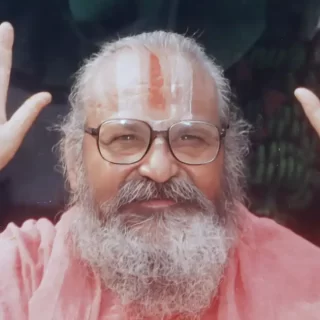
Our Supreme Saint Sri Ramanujacharya Ji
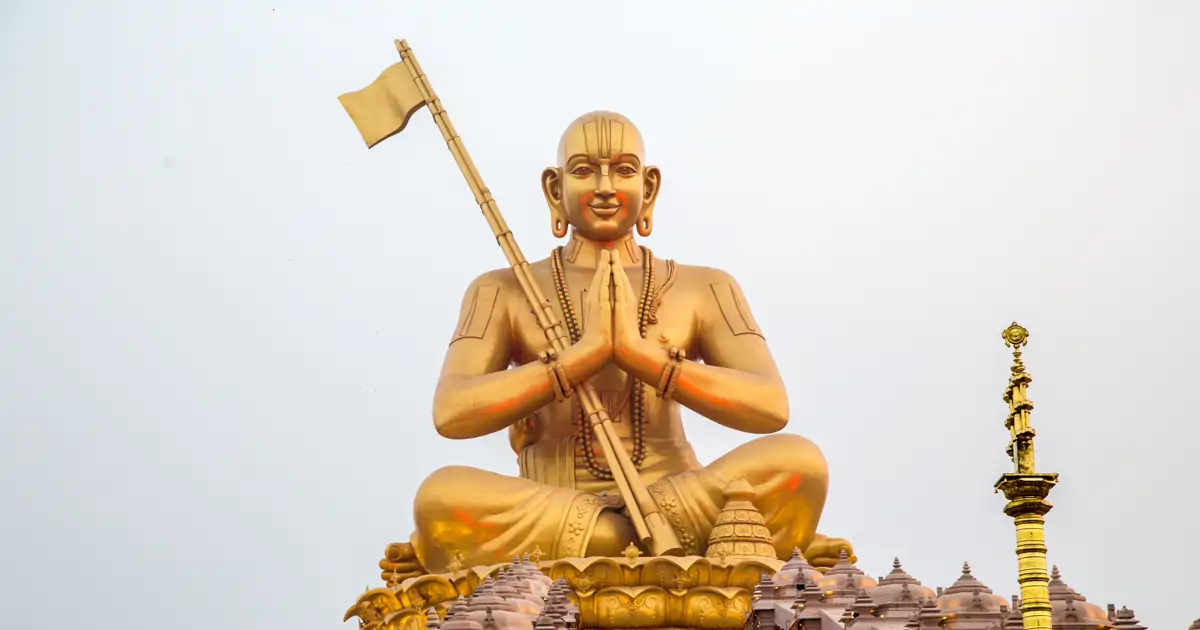
Ramanuja belonged to the Acharyas, believers who worked to systemize the monotheistic theology of Vaishnavism. He was an exponent of a qualified nondualism known as Vishishta-Advaita. He combined the northern and southern traditions of Vaishnavism and strengthened the religious belief and worship of Vishnu. He encouraged the general population toward a devotional expression of Hindu spirituality by teaching that the Divine entails rather than transcends all qualities.
Information on the life of this Indian theologian and teacher is based primarily on legend handed down through the centuries. Ramanuja was born into a privileged Brahmin family in about 1017 in Sriperumbudur, a village in southern India about 25 miles west of Madras. His father was Keseva Samayaji, his mother, Kantimathi. Around 1033, Ramanuja married a girl named Rahshambal. His father died within a few days of the wedding, and this caused him considerable grief. Ramanuja gathered his young wife and his mother and left for Kanchipuram, where he settled. Ramanuja’s cousin, Govina Bhatta, his closest friend and a man with whom he shared a mutual affection from early childhood soon joined them. Bhatta would play a pivotal role in Ramanuja’s future, delivering him from a plot to take his life. Ramanuja’s marriage lasted until he was thirty, when he gave up the worldly life for that of religion.
Ramanuja was considered a brilliant boy of extraordinary intelligence and as a youth studied the Vedanta, one of the six classical systems of Indian philosophy. Soon after moving to Kanchipuram, he met Yadavaprakasha, a teacher of Advaita philosophy and follower of the monistic system of Vedanta of Shankara, an eighth-century philosopher. Ramanuja adapted well to his studies but soon found himself in conflict with his teacher. Yadavaprakasha preached strict nondualism, while Ramanuja qualified his beliefs, stating that the Divine One is not without distinction but embodies infinite contrast. Profoundly religious, he frequently argued with his teacher, questioning his instruction and professing a different understanding of the religious teachings. He found mistakes in Yadavaprakasha’s teachings, and soon the teacher became jealous of his student. Yadavaprakasha realized that his student had a clearer understanding of the religious texts than the teacher. After several more instances of being corrected by his student, the guru considered him a threat and plotted to kill him.
‘ADHAM TE ADHAM ADHAM ATI NAARI,
“AMONG THE LOW, THE LOWEST OF THE LOW, AND EVEN LOWER, THE MOST FALLEN IS A WOMAN.
TINH MEHN MAIN MATIMAND AGHARI’
AMONG THEM, I AM THE MOST FOOLISH AND SINFUL.”
Ramanuja wandered lost in the forest and was soon found by a hunter and his wife who helped him find his way out. During this time he was said to have had a vision of the God Vishnu and his wife Laksmi. Ramanuja believed the hunter and his wife to be the incarnations of Vishnu and Laksmi and immediately began a daily worship ritual at the place where he first beheld them.
When the teacher and his students learned of Ramanuja’s escape, they sought him but were unable to find him and believed he died in the forest. Soon Ramanuja found his way out of the forest only to discover that he had returned to the same spot from which he had departed. When Yadavaprakasha discovered that Ramanuja returned he feared his plot would be discovered, and he set about convincing the young man to return to the guru and resume his lessons. Ramanuja agreed, but times had not changed, and Ramanuja continued to find fault with Yadavaprakasha’s interpretations of religious writings, resulting in a final falling out between student and teacher.
After the second split, Ramanuja became a temple priest at the Karadaraja temple at Kanchi where he was loved and respected by his students. At the temple he began teaching that the worship of a personal god and the soul’s union with him is an essential part of the doctrines of the Upanisad (part of the ancient Hindu texts) on which the system of Vedanta is built.
During this time, Ramanuja came to the attention of a guru by the name of Yamunacharya, the leader of the Vishishtadvaita school. He was an elderly man, aware that he was dying. He had been searching for the right man to follow in his tradition, and upon seeing Ramanuja he became convinced this was the right one to continue his work.
When Yamunacharya learned of the separation of Ramanuja and his guru, he invited Ramanuja to visit. Ramanuja traveled to Srirangam to meet the famous teacher, but upon his arrival he discovered the great man had died. While viewing the body, he observed that three of Yamuna’s fingers were twisted, and Ramanuja interpreted this to be a message directing him to make three vows – to make the people surrender to God; to write a commentary on the Vedantasattra (Sri bhashya) and to write an encyclopedia on the Puranas. He was told by the disciples of Yamunacharya that he had been selected by the guru to carry on his teachings.
Ramanuja was a popular teacher and remained in Srirangam; but like many Hindu thinkers he undertook an extended pilgrimage throughout India. Upon his return to Srirangam, the king of the Chola dynasty persecuted him. This monarch was a fanatical worshipper of Shiva and planned to force Ramanuja to adopt his religious views. Ramanuja fled to Mysore where he was said to have founded 700 monasteries. He organized temple worship and taught a monistic philosophy based on a doctrine of devotion to the incarnation of Vishnu.
While in Mysore, he converted King Bittiveda of the Haysala dynasty. This act led to the founding of the town of Melukote (1099). It was here that he dedicated the temple to Selva Pillai. It was twenty years before Ramanuja returned to Srirangam, where he organized a temple of worship, and it was said that here he founded 74 centers to disseminate his doctrine. According to tradition, Ramanuja died in 1137 at 120 years of age.
Ramanuja is considered the most influential thinker of devotional Hinduism. He spread devotion and discipline in society through his nine works known as Navaratnas. In his three major commentaries, the Vedartha-Sangraha, the Sri-bhasya and the Bhagavadgita-bhasya, he provided an intellectual basis for devotional worship. He gave new insight into southern Indian Vaishnavism and became known as its foremost saint.
Ramanuja formulated a Yoga that taught that the cultivation of bhakti is more important than mediation. Bhakti-Yoga is a form of supreme attachment to one divine person. Ramanuja believed and taught his disciples that devotion was not merely the means to liberation but the goal of all spiritual endeavors.
The prayer he repeated at the beginning of his Sri-Bhasya best describes the essence of his teachings- “May knowledge transformed into intense love directed to Sri Narayana (Vishnu), the highest Brahman, become mine, the Being to whom the creation, preservation and dissolution of the Universe is mere play, whose main resolve is to offer protection to all those who approach Him in all humility and sincerity, and Who shines out like the beacon light out of the pages of the Scripture (vedas).”
Summary
Ramanuja was a significant figure in the development of Vaishnavism, known for systematizing its theology through Vishishtadvaita, a qualified nondualism. Born in 1017 into a Brahmin family in Sriperumbudur, he was a brilliant scholar who studied under Yadavaprakasha, a teacher of Advaita philosophy. However, Ramanuja disagreed with his teacher’s strict nondualism, advocating instead that the Divine encompasses and manifests all qualities. After a falling out with Yadavaprakasha, Ramanuja became a temple priest and began teaching the importance of devotion to a personal god, specifically Vishnu, as essential for spiritual liberation.
Ramanuja’s teachings gained prominence, leading him to succeed Yamunacharya as the leader of the Vishishtadvaita school. He undertook pilgrimages and established numerous monasteries, spreading his doctrine across India. He was instrumental in the spread of devotional Hinduism, particularly through his writings, which provided an intellectual foundation for bhakti (devotional worship). His teachings emphasized that bhakti was not just a means to liberation but the ultimate goal of spiritual practice. Ramanuja’s influence extended far beyond his lifetime, with his works and temples continuing to shape Hindu spirituality.
Important Points
- Ramanuja was a key proponent of Vishishtadvaita, a qualified nondualism in Vaishnavism.
- He was born in 1017 in Sriperumbudur and belonged to a Brahmin family.
- Ramanuja studied under Yadavaprakasha but disagreed with his strict nondualism, advocating for a more qualified understanding of the Divine.
- He became a temple priest and emphasized the worship of a personal god, particularly Vishnu, as essential for spiritual liberation.
- Ramanuja was chosen by Yamunacharya to lead the Vishishtadvaita school but took over after Yamunacharya’s death.
- He undertook extensive pilgrimages, established monasteries, and spread his teachings throughout India.
- Ramanuja played a crucial role in the spread of devotional Hinduism, particularly through his nine major works, known as Navaratnas.
- His teachings provided an intellectual basis for bhakti and emphasized devotion as the ultimate spiritual goal.
- Ramanuja’s teachings influenced both the northern and southern traditions of Vaishnavism.
- He believed that bhakti was not just a means to liberation but the goal of all spiritual endeavors.
- He established 74 centers in Srirangam to disseminate his doctrine.
- Ramanuja was persecuted by the Chola king, a Shiva devotee, but he continued to spread his teachings.
- He converted King Bittiveda of the Hoysala dynasty and founded the town of Melukote.
- Ramanuja is considered one of the most influential thinkers in devotional Hinduism.
- His prayer in the Sri-Bhasya reflects the essence of his teachings, focusing on devotion to Vishnu as the highest Brahman.