Milestones of Vaishnavism – Alvars
The great Hindu revival that took place in Tamil Nadu between the fifth and ninth centuries A.D. saw the emergence of Tamil as a powerful instrument that carried the old faith to the masses and served as a resplendent medium of expression for bhakti, or love of God, which was the chief characteristic of its resurgence. Buddhism and Jainism had previously spread in the South, using Tamil as the language of religious propaganda and poetic expression in the two Tamil epics, Manimekalai and Silappadikaram. Hinduism followed suit, not merely because of precedent, but as a consequence of the fervor that animated a few saintly souls and found natural expression in their mother tongue.
The revival of Hinduism took two main directions, which later crystallized into what were identified as two distinct faiths, leading to theological wrangles and controversies that often follow an era of genuine spiritual uplift. This period of Hindu religious expansion saw the rise of the Nayanmars and the Alvars, with the Nayanmars representing Saivism and the Alvars serving as the poetic voice of Vaishnavism.
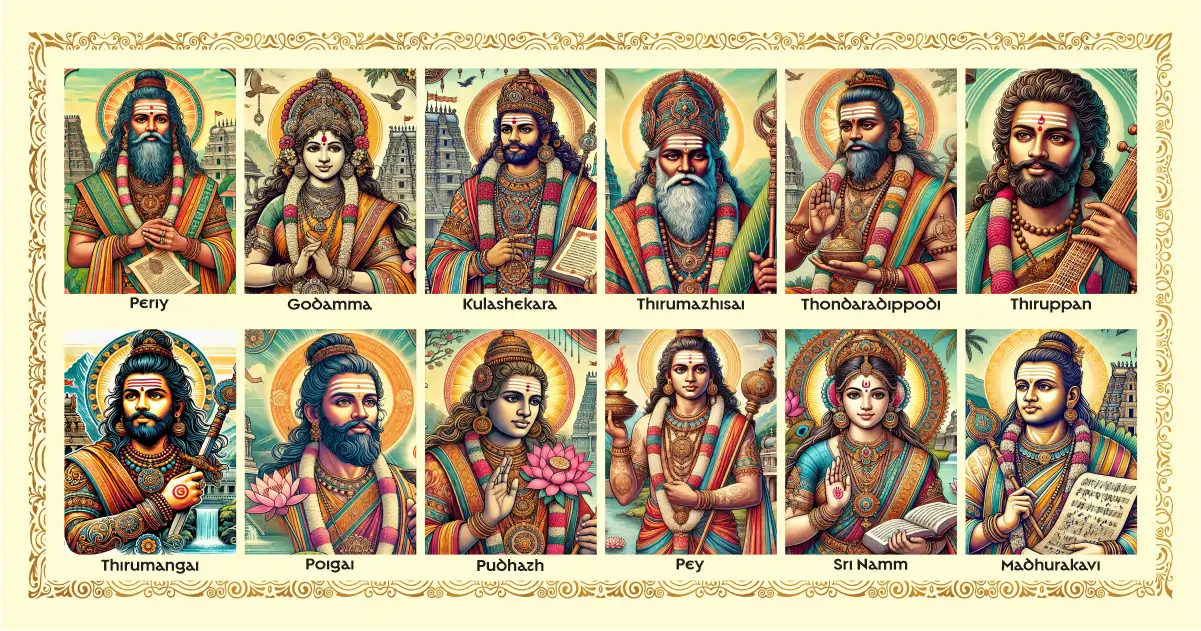
The Alvars are twelve in number. Eleven of them have sung of God, and one, Madhurakavi, sang of his spiritual preceptor, Nammalvar. The chronological order of their appearance, as accepted by the Ramanuja school of Vaishnavism, is still a matter of controversy and historical research. Tradition places them roughly between 4200 and 2700 B.C., while historical, linguistic, and literary research assigns them a period from the fifth or sixth to the ninth century A.D.
Details of their lives and the dates of their birth and death are lost in the mists of time. However, Vaishnava tradition places Nammalvar as the fifth among the Alvars in order of birth but gives him the foremost place in sanctity, hailing him as “Kulapati.” It considers all the other Alvars as limbs and Nammalvar as the body, raising him to a place of worship as one who intercedes with God for saving the souls of men. Nammalvar (literally “Our Alvar”) is the name by which he is generally known now, indicating the reverence in which the Vaishnava world holds him.
Voluminous commentaries in manipravala, a mixture of Sanskrit and Tamil, have been written on Nammalvar’s works, linking his writings with the theology of Sri Ramanuja. These commentaries are a marvel of scholarship and theological acumen, sensitive to the human element in Nammalvar and to the poetry in which it finds expression. Although the commentators primarily focus on theology, they often bring out the poetic suggestions and overtones in a manner that an aesthete might envy.
The commentators start with the premise that Nammalvar is a saint, not a man who struggled towards Reality but a realized soul from birth, an avatara or descent of one of the aspects of God. They believe he is the incarnation of Senai Mudaliar, the Chief of Hosts of the Lord, and some even consider him an avatara of God Himself. If this is accepted, the yearning and the travail that Nammalvar’s works record seem strange. If he was born a realized soul and aware of the purpose of his descent from God, why the agony of seeking? One explanation is that, though in touch with God, he voluntarily assumed the human condition and worked out the stages of liberation for the world to follow. Thus, Nammalvar’s works are seen as a portrayal of a soul’s progress to the Ultimate.
This may be true, but it cannot fully explain the intensity of Nammalvar’s poetry as mere drama or imagined experience. We may consider Nammalvar’s life as both being and becoming. His being a man did not prevent his final vision of God, though it posed challenges. If we accept this perspective, we see Nammalvar’s works as personal expressions of trials, failures, achievements, despair, hope, and final merging with what transcends the individual. This approach does not diminish his saintliness but highlights the evolution of a saint from a man, revealing the human quest for Reality.
Nammalvar’s poetry, starting from earthly experiences and expressing itself through the language of the earth, reflects this duality. It is a testament not only to his saintliness but also to human destiny. His passion transcended the earth to reach the sky, yet it began here, rooted in the language and experience of the earth. Denying this would overlook the lyric cry that characterizes Nammalvar’s work. This book attempts to interpret his poetry in this light, appreciating its symbolic, dramatic, puranic, and philosophical elements while recognizing its profound lyrical essence.
Summary
The Hindu revival in Tamil Nadu between the fifth and ninth centuries A.D. was marked by the emergence of Tamil as a powerful medium for expressing bhakti (devotion to God). This period saw the rise of two major religious movements, represented by the Nayanmars (devotees of Shiva) and the Alvars (devotees of Vishnu). The Alvars, twelve in number, are revered for their devotional poetry, which played a significant role in the resurgence of Vaishnavism. Among them, Nammalvar is regarded as the most sanctified, often considered an incarnation of a divine being. His works are deeply theological, yet they also express the human struggle and yearning for divine connection, reflecting the dual nature of being both a saint and a seeker.
Nammalvar’s poetry, revered in the Vaishnava tradition, is seen as a portrayal of a soul’s journey towards the Ultimate Reality. While some commentators view him as a realized soul from birth, his intense lyrical expressions suggest a personal struggle towards spiritual fulfillment. This duality in his works highlights the evolution of a saint and the universal human quest for divine truth. Nammalvar’s poetry, rooted in earthly experiences yet transcending to the divine, serves as a testament to both his saintliness and the broader human experience of seeking the divine.
Important Points
- The Hindu revival in Tamil Nadu between the fifth and ninth centuries A.D. emphasized bhakti, or devotion to God, expressed through Tamil.
- The Nayanmars and Alvars were central to this religious resurgence, representing Shaivism and Vaishnavism, respectively.
- Nammalvar, one of the twelve Alvars, is highly revered and considered the most sanctified among them.
- Nammalvar’s works are deeply theological and are linked to the teachings of Sri Ramanuja.
- His poetry reflects both his saintliness and the human struggle towards spiritual fulfillment.
- Nammalvar is considered by some as an incarnation of a divine being, yet his works express a personal quest for divine connection.
- The intensity of Nammalvar’s poetry suggests a duality of being both a realized soul and a seeker.
- His works are seen as a portrayal of a soul’s progress towards the Ultimate Reality.
- The commentaries on Nammalvar’s works are rich in theological insight and often highlight the poetic elements of his writings.
- Nammalvar’s poetry is rooted in earthly experiences but transcends to express a divine connection, reflecting the human quest for God.