Life of Bhashyakar Bhagwan Shri Ramanujacharya
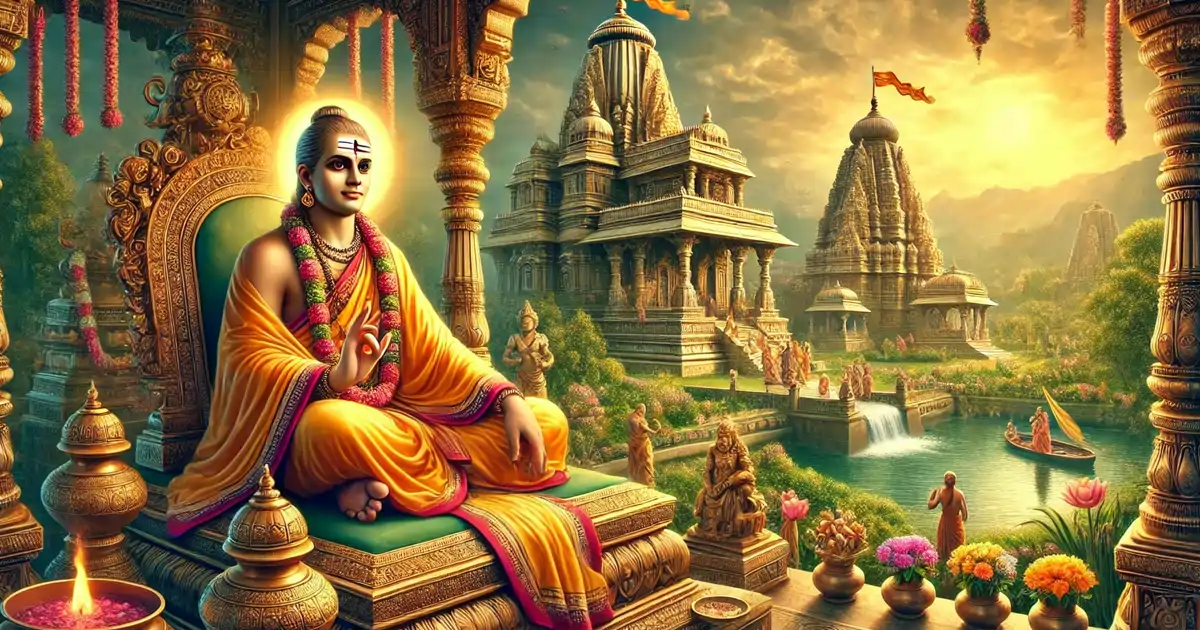
Bhagwan Sri Ramanujacharya is well known in South India, where his influence was paramount. There are very few people who follow the doctrine of Bhashyakar Ramanujacharya outside South India. Those that do follow his doctrine belong to what is known as the Sri Sampradaya. It is time that people of the world know what religious doctrine he preached and the basis of his philosophical conclusions (Siddhanta). It is important to know whether this doctrine was in vogue prior to his time, why his followers are known as Sri Sampradayis, and whether there is any agreement between him and Bhagwan Sri Sankaracharya’s doctrine of non-duality.
First of all, I would like to give the views of Swami Vivekananda on Bhashyakar Bhagwan Shri Ramanujacharya. While describing the ‘Reaction Movements’ of resurgent Hinduism that followed the decadence of Buddhism in India, Swami Vivekananda wrote in a paper entitled ‘The Historical Evolution of India’:
“… The Movement of Sankara forced its way through its high intellectuality, but it could be of little service to the masses, because of its adherence to strict caste laws, very small scope for ordinary emotions, and making Sanskrit the only vehicle of communication. Ramanuja, on the other hand, with a most practical philosophy, a great appeal to the emotions, an entire denial of birthrights before spiritual attainments, and appeals through the popular tongue, completely succeeded in bringing the masses back to the Vedic religion.”
It is sheer shortsightedness to remain ignorant of the life and teachings of that great soul, who is worshipped by his followers as the manifestation of Sri Lakshmana, the prince among devotees, whose loving heart is the refuge of one and all—right from Brahma to a blade of grass, and whose incisive and well-reasoned arguments stand arrayed to meet the impregnable Advaitic doctrines of the highly intellectually endowed Bhagwan Sri Sankaracharya. He still is a great influence among the followers of his school whose teachings have enabled them to withstand the materialism and atheism of modern times and to reflect, even in spite of all the changes that have come over their mode of life, a little of that overflowing love of his Rishi-heart in their pure vegetarian habits, which is a token of their acceptance of the principle that it is a heinous sin to slaughter fellow living beings for the upkeep of this corrupt body of ours.
The lives of the great ones are always consecrated to the good of the many. They descend on earth for no selfish ends of their own. They are ever preoccupied with the thought of how to remove the afflictions of the lowly, the indigent, and the helpless. This is why searching and thoroughly studying their lives is immensely beneficial. By knowing and following the path discovered by the deep and constant meditation of these great beings for the good of all living beings, one can live one’s life here on earth in supreme happiness and can find one’s way to heavenly bliss or liberation hereafter. Is it not the paramount duty of all intelligent people to drink, from the life stories of the great ones, the elixir that brings good in this world and the next?
Supremely glorious and large-hearted, Sri Ramanujacharya is among the foremost of such Mahatmas. The path shown by him is established on Sattva. Not being unsteady and fleeting like those resting on Rajas and Tamas, this path of Sattva yields everlasting results. All who aspire to share in ever-abiding supreme bliss should follow in the footsteps of the magnanimous ones like Bhagwan Sri Ramanujacharya. “There is no other way but this.” The rich and the poor, the erudite and the unlettered, the high and the low—all can tread the path shown by Bhashyakar Bhagwan Ramanujacharya with great ease and much benefit.
Furthermore, it is strongly recommended and highly profitable to study the lives of the great ones rather than to repeat parrot-wise hard and abstruse sermons. When the maxims, that are abstract and difficult to grasp, find concrete expression in the lives of the great ones, they can be easily comprehended and followed by average people. By even unthinkingly following in their footsteps, men advance in the path of virtue, gradually overcome animal impulses, and become fit to find refuge in the Divine. From one’s very boyhood, one continually hears it said that to tell the truth is one’s duty. But after witnessing the systematic violation of truth wherever one may turn one’s eyes, one gets almost convinced that the maxims about truthfulness can at best adorn the pages of books of ethics and that in practice, speaking of unalloyed truth is an utter impossibility. Such an idea would have established itself in the human mind, like the immovable and unshakable Mount Sumeru, had there not been born in this world those noble ones who are perfect images of truth itself.
God, the all-powerful Father of all, out of infinite compassion for His children, comes into this world, assuming the forms of holy men, to resuscitate religion and help men progress in the path which leads to good here and hereafter. Is it not then the duty of everyone to study the lives of such holy persons?
(Abstract from the ‘Life of Sri Ramanuja’ by Swami Ramakrishnananda, a disciple of Shri Ramakrishna Paramhans).
To be continued…
Summary
Bhagwan Sri Ramanujacharya, a highly revered figure in South India, profoundly influenced Hinduism, particularly through the Sri Sampradaya tradition. His teachings offered a practical philosophy accessible to the masses, emphasizing devotion, spiritual attainments over birthrights, and communication in the popular language, which made Vedic religion more approachable. Swami Vivekananda acknowledged Ramanujacharya’s success in reinvigorating Hinduism for the general populace, in contrast to the more intellectual and exclusive approach of Bhagwan Sri Sankaracharya’s Advaita Vedanta.
The life and teachings of Sri Ramanujacharya hold immense significance for spiritual seekers. His philosophy, grounded in the principle of Sattva, offers a path to everlasting bliss and liberation, accessible to all, regardless of social standing or intellectual capacity. The article underscores the importance of studying the lives of such great souls as a means to comprehend and embody virtuous principles, emphasizing that by following the examples set by these Mahatmas, individuals can overcome base impulses and progress toward spiritual fulfillment.
Important Points
- Sri Ramanujacharya’s influence is primarily in South India, particularly within the Sri Sampradaya tradition.
- His teachings emphasized practical spirituality, devotion, and communication in the popular language.
- Swami Vivekananda recognized Ramanujacharya’s success in making Vedic religion accessible to the masses.
- Ramanujacharya’s philosophy is rooted in Sattva, offering a path to lasting spiritual fulfillment.
- Studying the lives of great souls like Ramanujacharya is essential for understanding and practicing virtuous principles.
- His teachings provided a contrast to the intellectual and exclusive Advaita Vedanta of Bhagwan Sri Sankaracharya.
- Ramanujacharya’s life is seen as a manifestation of compassion, aimed at helping all beings achieve liberation.
- His path is accessible to everyone, regardless of social or intellectual status.
- Ramanujacharya is revered as a divine figure, considered an incarnation of Sri Lakshmana.
- His teachings continue to inspire and guide followers in resisting materialism and maintaining spiritual purity.