Good Consequences of Service
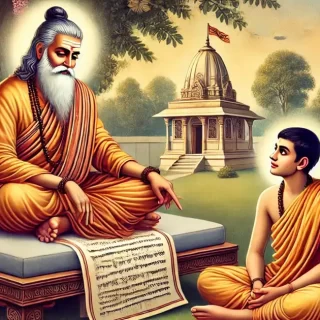
The consequence of service to mother, father, and Acharya or teacher is very significant and noteworthy. Service to these three bestows the fruit or consequence of going on pilgrimage or performing yagnas. One can never do anything in return for receiving the Grace of these three people; you are indebted to them all your life.
The grace or blessings one receives from these three is known to be the actual nectar. Just as we go to the temple and perform puja to the Lord, we must have reverence for our mother, father, and Acharya or teacher. None can predict what a parent or a teacher would give their child or student.
One always receives good consequences from any service they do. Service is never wasted. The Lord is also very happy when one serves someone. The desired consequence received from service to others is considered superior to even yagnas.
Man meets several people during the course of his work. He has to receive cooperation from several people to conduct his work and has to cooperate with several others in their work. The give and take of cooperation is also a kind of service.
A person is free from all pain and grief the moment he serves unhappy people, taking them to be Lord Narayana. The moment one takes man (nara) to be Narayana, he automatically develops faith in Lord Narayana. He begins to lose interest in all worldly and materialistic aspects of life. When a person tells the Lord, “I am yours, and you are everything to me,” the Lord assures him, “I am also yours.” What evil can befall a person who has the Lord on his side?
A man immersed in the materialistic aspects of the world cannot do anything. Similarly, if you tie the hands and legs of a person and ask him to plough the field, he obviously can’t. You will say, “Maharaj! He can plough the field, provided we untie his hands and legs.” Certainly, he can plough the field and grow grain on earth, but someone has to relieve him from bondage to do all the work. The question arises as to who actually has to free him from bondage.
There are many ways a person can free himself from bondage. Spiritually inspiring bhajan, satsang, kirtan, service, and similar alternatives are ways with which one can easily cross the ocean of the materialistic world and find a secure place for himself at the feet of the Lord.
If we include seva or service with singing in praise of the Lord or singing bhajans, despite adverse climatic conditions, I am certain that nothing can pull you out of seva or service. What kind of seva dharma or service-minded person would be detained by climatic conditions? Climate is not permanent, and its consequences are not permanent either. On the contrary, service is permanent and is an action of significance to human life. The consequences of service are preordained.
Seva is the result of self-restraint (sayyam), good conduct (sadaachaar), and hard work (parishrama). There is no specific definition assigned to seva or service. Remember, you must respect your elders and ensure that you don’t disrespect them inadvertently. Elders just melt away with our respectful behavior and are extremely happy with us. In families where there is respect for elders and love for children, one would love to blend himself in such a family, akin to the sacred meeting of Ganga, Jamuna, and Saraswati.
You may go on several pilgrimages, bathe in the holy Ganges, and visit other religious places—it doesn’t make a difference. The more dharma or quality of righteousness you adopt, the act delivers appropriate consequences. On the other hand, one is relieved of all constraints in life. People in the neighborhood will see and discuss how well-mannered people in that family are, how much love there is between them, and so on.
These people are the foundation of a healthy society. When members of society work together with happiness and brotherhood, the Lord is also very happy. He always likes His children to be happy and content.
Those who worship God fulfill their desires in life. The Lord is happy when people respect the Brahman. The Brahman is a person appointed by the Lord to guide people on the right path in society, so one must give him due respect. The Guru is the incarnation of God who totally changes your life. He teaches us the modalities of this world and imparts knowledge about the extramundane activities in this world. Man derives benefits from this ‘with his body, and after his body,’ meaning he derives benefits in his present life and also after his life upon this earth. Respecting the learned or scholars gives us the ability to conduct ourselves in society. Their association takes us to the highest peak in society, provided we acquire Gyana and put it to right use. There should be sanctity in life. A simple heart and a focused mind are essential qualities of life. It enhances your acceptability in society. Your words will be music to others. People will enjoy your association and be eager to receive you, just like bees thronging over a flower. Have you ever seen bees on a cactus plant?
This discussion about life and conduct will bring peace and permanence to your life. You will receive all that you want to receive. God is always eager to help those who conduct themselves righteously. If you remain silent, there is no place for ego in you. Ego is the greatest enemy of righteous conduct. A polite person can never hide from others and is always dear to all. With politeness, you can get anything done.
Can you tell me what you can achieve by fighting with your neighbor? You don’t achieve anything. On the contrary, he will try to implant obstacles in your life. You can’t find any solution when there are fights; situations get worse, and you will have to repent later. So, for any problem, we must be able to talk it over and find a solution rather than fight and worsen the situation.
A man is far away from sin if he is humble and pure within himself. He cannot think of committing sin if he has a clear conscience. Actually, there is no reason for a person to sin at all. The Lord has provided animals, insects, and other beings with means to live; we are human beings. When the jeeva does not think about itself, why do we need to think about them? When the Lord is there to take care, why do we need to bother ourselves? An animal is born to enjoy the pleasure of lust, and it doesn’t care about eating. The Lord has determined everyone’s role in this world. Anything earned from sin has direct implications on our body and soul. Food and grain earned by committing sin have never favored anyone. It is sensible to avoid sin.
You must concentrate and focus on your karma or duty. Karma is what you do for the Lord. Chitragupt maintains an account of all karma you have done for the Lord. The account decides the destiny of the jeeva. So, we can always decide upon our destiny from today and this moment. We won’t have to repent for it later.
Acharya Shri
“The food and grain earned from committing sin can never do good to anyone.”
Summary
The text emphasizes the profound importance of service (seva) to one’s parents, teacher (Acharya), and others as a means of spiritual and personal growth. Serving these three—mother, father, and Acharya—is likened to the spiritual benefits of pilgrimage and performing yagnas, and it is a debt one carries throughout life. The text advocates for humility, respect for elders, and self-restraint as essential qualities for a righteous life. It stresses that service, rooted in good conduct and hard work, has lasting positive consequences, both in this life and beyond. Additionally, the text underscores the significance of karma (righteous action), the role of the Guru in guiding one’s spiritual path, and the importance of living a life free from sin, focusing on humility, righteousness, and the avoidance of conflict.
Important Points
- Service to parents, teacher (Acharya), and others is highly significant and comparable to spiritual practices like pilgrimage and yagnas.
- The grace received from serving these three is invaluable and lifelong.
- Service is a permanent, meaningful action that yields positive consequences, surpassing even the benefits of yagnas.
- Serving others, especially the unhappy, as Lord Narayana helps develop faith and detachment from materialism.
- Humility, respect for elders, and polite conduct are essential for living a righteous life and gaining social acceptance.
- The role of the Guru is crucial in guiding one’s spiritual journey and teaching about the world and beyond.
- Avoiding sin is vital for maintaining a clear conscience and ensuring that one’s actions do not negatively impact one’s body and soul.
- Focusing on righteous karma determines one’s destiny and future spiritual progress.