Destroy All Your Impurities on the Great Festival Holi
Holi also means “sacrifice.” Burn all the impurities of the mind, such as egoism, vanity, and lust, through the fire of devotion and knowledge. Ignite cosmic love, mercy, generosity, selflessness, truthfulness, and purity.
In days of yore, there were communities of cannibals in India. They caused much havoc, threatening the lives of many innocent people. One of them was Holika or Putana. She took immense delight in devouring children. Sri Krishna destroyed her and thus saved the little children. Even today, the effigy or figure of Holika is burnt in the fire. In South India, the clay figure of Cupid is burnt. This is the origin of the great festival of Holi.
Holi begins about ten days before the full moon of the month of Phalgun (February-March), but is usually observed for the last three or four days, terminating with the full moon. This is the spring festival of the Hindus. In the spring season, all the trees are filled with sweet-smelling flowers. They all proclaim the glory and everlasting beauty of God. They inspire you with hope, joy, and a new life, and stir you on to find out the creator and the indweller, who is hiding Himself in these forms.
Holi is known by the name of Kamadahana in South India, the day on which Cupid was burnt by Lord Siva.
Another legend has it that once upon a time an old woman’s grandchild was to be sacrificed to a female demon named Holika. A Sadhu advised that abuse and foul language would subdue Holika. The old woman collected many children and made them abuse Holika in foul language. The demon fell dead on the ground. The children then made a bonfire of her remains.
Connected to this legend of the demon Holika is Bhakta Prahlad’s devotion to Lord Narayana, and his subsequent escape from death at the hands of Holika. Prahlad’s father, Hiranyakashipu, punished him in a variety of ways to change his devotional mind and make him worldly-minded. He failed in his attempts. At last, he ordered his sister, Holika, who had a boon to remain unburnt by fire, to take Prahlad on her lap and enter into the blazing flames. Holika did so. She vanished, but Prahlad remained untouched and laughing. He was not affected by the fire on account of the Grace of Lord Narayana.
This same scene is enacted every year to remind people that those who love God shall be saved, and that those who torture the devotee of God shall be reduced to ashes. When Holika was burnt, people abused her and sang the glories of the Lord and of His great devotee, Prahlad.
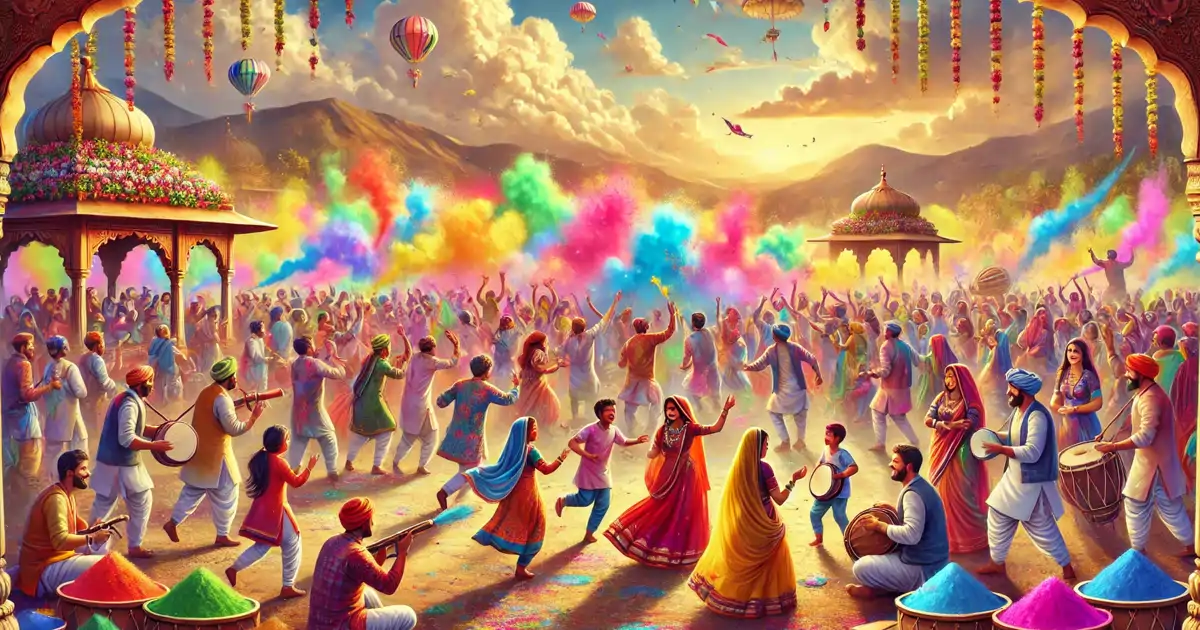
In North India, people play joyfully with colored water. The uncle sprinkles colored water on his nephew. The niece applies colored powder on her aunt’s face. Brothers and sisters and cousins play with one another.
Huge bundles of wood are gathered and burnt at night, and everywhere one hears shouts of “Holi-hai! Holi-hai!” People stand in the streets and sprinkle colored water on any man who passes by, be he a rich man or a poor one. There is no restriction on this day. People compose and sing special Holi songs.
On the festival day, people clean their homes, remove all dirty articles from around the house, and burn them. Disease-breeding bacteria are thereby destroyed. The sanitary condition of the locality is improved. During the festival, boys dance about in the streets. People play practical jokes with passers-by. A bonfire is lit towards the conclusion of the festival. Games representing the frolics of the young Krishna take place joyously around a fire.
On the last day of Holi, people take a little fire from this bonfire to their homes. They believe that their homes will be rendered pure and their bodies free from disease.
Nowadays, people are found indulging in all sorts of vices in the name of the Holi festival. Some drink intoxicating liquor like toddy and fall unconscious on the roads. They indulge in obscene speech as a result of drinking. They lose respect for their elders and masters. They waste their money on drink and dice-play. These evils should be totally eradicated.
Festivals like Holi have their own spiritual value. Apart from the various amusements, they create faith in God if properly observed. Hindu festivals always have a spiritual significance. They wean man away from sensual pleasures and take him gradually to the spiritual path and divine communion. People perform havan and offer to the gods the new grains that are harvested.
On such holy occasions, there should be worship of God, Satsangs, and Kirtan of the Lord’s Names, not merely the sprinkling of colored water and lighting of bonfires. These functions are to be considered most sacred and spent in devotional prayers, visiting holy places, bathing in sacred waters, and Satsang with great souls. Abundant charity should be done to the poor. Then only can Holi be said to have been properly celebrated. Devotees of the Lord should remember His delightful pastimes on such happy occasions.
All great Hindu festivals have religious, social, and hygienic elements in them. Holi is no exception. Every season has a festival of its own. Holi is the great spring festival of India. Being an agricultural country, India’s two big festivals come during the harvest time when the barns and granaries of our farmers are full and they have reason to enjoy the fruits of their hard labor. The harvest season is a festive season all over the world.
Man wants relaxation and change after hard work. He needs to be cheered when he is depressed on account of work and anxieties. Festivals like Holi supply him with the real food and tonic to restore his cheer and peace of mind.
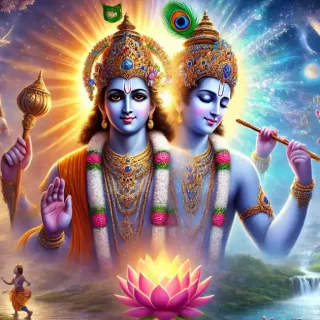
The religious element in the Holi festival consists of worship of Sri Krishna. In some places, it is also called the Dol Yatra. The word dol literally means “a swing.” An image of Sri Krishna as a babe is placed in a little swing-cradle and decorated with flowers and painted with colored powders. The innocent frolics of little Krishna with the merry milkmaids—the Gopis of Brindavan—are commemorated. Devotees chant the Name of Sri Krishna and sing Holi songs relating to the frolics of little Krishna with the Gopis.
The social element during Holi is the uniting or “embracing” of the great and the small, of the rich and the poor. It is also the uniting of equals. The festival teaches us to “let the dead bury the dead.” We should forget the outgoing year’s ill feelings and begin the new year with feelings of love, sympathy, cooperation, and equality with all. We should try to feel this oneness or unity with the Self also.
Holi also means “sacrifice.” Burn all the impurities of the mind, such as egoism, vanity, and lust, through the fire of devotion and knowledge. Ignite cosmic love, mercy, generosity, selflessness, truthfulness, and purity.
Summary
The article explores the spiritual, cultural, and social significance of the Holi festival in India. Holi, celebrated in the spring season, is a time of joy, unity, and renewal, where people play with colors, burn bonfires, and engage in various rituals. The festival symbolizes the victory of good over evil, as seen in the legend of Prahlad and Holika, where devotion to Lord Narayana triumphs over malice. Holi also serves as a reminder to purify oneself, burning away impurities of the mind like egoism and lust, and instead fostering virtues such as love, mercy, and generosity. The festival’s rituals and celebrations are intended to bring people together, promote hygiene, and renew their spiritual connection with God, particularly through the worship of Lord Krishna.
The article also emphasizes that while Holi is a time for merriment, it should be observed with spiritual consciousness. The festival’s deeper purpose is to strengthen faith in God, promote unity and equality among people, and encourage the burning away of negative traits in favor of divine qualities. It highlights that true celebration of Holi involves not just the external festivities but also inner spiritual reflection, devotion, and acts of charity.
Important Points
- Holi symbolizes the victory of good over evil, exemplified by the legend of Prahlad and Holika.
- The festival is celebrated with bonfires, color play, and the worship of Lord Krishna.
- Holi is a time for purification, burning away impurities of the mind like egoism and lust.
- The festival promotes unity, embracing both social and economic equality.
- Holi is associated with the renewal of life, joy, and the beauty of spring.
- It has religious, social, and hygienic significance, connecting people with spiritual values.
- The festival encourages letting go of past grievances and starting anew with love and cooperation.
- True celebration of Holi involves spiritual devotion, charity, and reflection, not just external festivities.
- In South India, Holi is also known as Kamadahana, commemorating the burning of Cupid by Lord Shiva.
- Holi’s social aspect includes uniting the rich and poor, and fostering feelings of oneness.