

Advaita & Vishishtadvaita
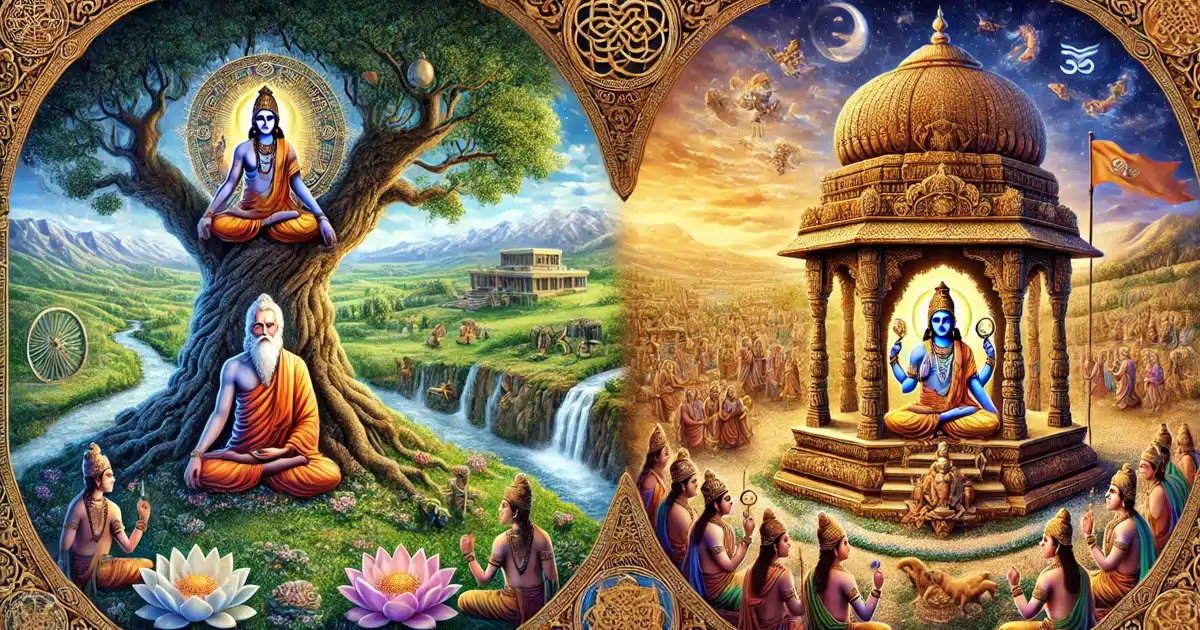
Advaita and Vishishtadvaita have no connection at all. Advaita is implicit atheism. Advaita is called “Prachanna Bauddham” (hidden Buddhism). Advaita is based only on a personal interpretation of Abheda-sruti. In Advaita, Brahman is the only knowledge-self reality and is without any attributes. The three types of differences, namely difference in individuality, difference in types, and differences in its integral parts, are not in Brahman. Nothing other than this Brahman is reality.
Though Brahman is eternally free and only knowledge-self, it gets obstructed/covered by ignorance and, without realizing itself as Brahman (as told above), comes to realize itself wrongly as Jeevaatman and gets bound in the material universe, which is not a reality. This is what the Veda, through verses like “Tat Tvam Asi,” conveys. Except for Brahman, everything is an illusion/falsehood. The God and the sentient-living and insentient-matter that are controlled by God are only illusions and have no reality.
There is nothing called bound Jeevaatman and liberated Jeevaatman, as Brahman and Jeevaatman are the same entity. Only one body is with Jeevaatman, which is Brahman covered/obstructed by ignorance. Other bodies are without Jeevaatman as they are just like Brahman covered by ignorance. It is not possible to point out which body has that Jeevaatman. The experience of Brahman during its illusion is also false. The preceptor who imparts this knowledge about Brahman is unreal. The disciple who listens to the preceptor is unreal. The Veda, which gives this knowledge about Brahman, is also unreal.
Brahman, by the knowledge of knowing that nothing other than itself (which is only knowledge-self reality without any attributes) is real, gets its ignorance cleared and realizes itself as Brahman, and this is liberation. Advaita thus declares everything is unreal except the only knowledge-self Brahman, which is without any attributes using the unreal Shastra, which is Veda!
Dvaita is the philosophy that is based on the Bheda-srutis, which states that the sentient soul (Jeevaatman), the insentient matter, and the Brahman are different from one another. It stresses the difference between the entities categorically as follows:
Dvaita holds that the Brahman who is Vishnu (Narayanan) is just the efficient cause (instrumental cause) in the creation of the universe. It stresses that only Bhakti, as told in Upanishads through 32 Vidyas, is the means to attain liberation. It states that the goal is experiencing the bliss in Lord Vishnu’s transcendental divine world, Parampada Shree Vaikuntam. It also recognizes inequality in the status of liberated Jivatmans.
Summary
The article contrasts the fundamental differences between Advaita, Vishishtadvaita, and Dvaita, three significant schools of Vedantic philosophy. Advaita, founded by Adi Shankaracharya, posits that Brahman is the only true reality, attributeless and non-dual, with the world and individual souls being illusory due to ignorance. In contrast, Vishishtadvaita, propounded by Ramanujacharya, acknowledges the reality of the world and individual souls as distinct yet inseparable parts of a qualified Brahman, characterized by attributes like omniscience and omnipotence. Vishishtadvaita emphasizes Bhakti (devotion) as the path to liberation, where the soul ultimately unites with the personal God, Vishnu.
The article also presents a critique of Advaita from a Dvaita (dualism) perspective, which views Advaita as implicitly atheistic and dismissive of the reality of the world, souls, and God. Dvaita, established by Madhvacharya, asserts the eternal distinction between the individual soul, the material world, and God (Vishnu), emphasizing the real and separate existence of these entities. It advocates Bhakti as the means to attain liberation and recognizes the hierarchical status of souls even in liberation.
Important Points
- Advaita philosophy states that only Brahman is real, and the world and individual souls are illusions (Maya).
- Advaita emphasizes that liberation is achieved through knowledge (Jnana), realizing one’s identity with Brahman.
- Vishishtadvaita holds that Brahman is a personal, attribute-endowed being, and the world and souls are real and dependent on Brahman.
- Vishishtadvaita stresses devotion (Bhakti) as the path to liberation, leading to eternal service to God (Vishnu).
- Dvaita critiques Advaita, labeling it as implicit atheism and denying its claim that the world and souls are illusory.
- Dvaita philosophy asserts the eternal distinction between Brahman, individual souls, and the material world.
- Dvaita emphasizes that liberation is achieved through devotion to Vishnu, with recognition of inequality in the status of liberated souls.
- Brahman in Advaita is attributeless, while in Vishishtadvaita, Brahman is endowed with attributes.
- Vishishtadvaita and Dvaita both recognize the reality and permanence of individual souls and the material world.
- Advaita is sometimes referred to as “Prachanna Bauddham” or hidden Buddhism due to its denial of the world’s reality.


