Essence of Thoughts
Om Namo Narayana!
Discretion, or the power to decide, is another name for the essence of thought. The essence of the canons is also discretion. We are the sons of Parmatma. We have to unite with Parmatma. Whenever such knowledge awakens in us, it is said we have gained discretion. In fact, when such discretion covers our mind and intellect, it is not that physical matter disappears, but our attachment to the physical world dwindles. It diminishes spontaneously.
In our Rajasthani tongue, we have a fable: Two siblings, a brother and a sister, had a quarrel. Their mother came and began to scold the boy, “Bhayaji, why did you beat this girl?” Look at what she is saying to her son. “Bhayaji, this girl belongs to someone else. She will leave this home tomorrow if not today and go to her in-laws’ home.” That is, she will have to leave her parental home. Why then is he having a quarrel with her?
I often cite the example of a manager. A bank manager does not have any attachment to the money he manages. If someone deposits fifty million rupees in the bank, he will not dance in the evening or cook a variety of foods. Also, if someone withdraws fifty million rupees the same day, the bank manager will not be gloomy. He knows that it is not his money. It belongs to the owner. A bank is a government enterprise, and the bank manager is getting his salary. If there is a robbery in the bank, the incident shall be reported to the police. The arising of such feelings marks the awakening of discretion in a person. After this awakening, a person is not far from Parmatma. But as long as we are surrounded by petty temptations, discretion does not arise.
How then can such discretion arise? The answer is satsang. Satsang (pious company) is necessary for the awakening of our discretion. When we hear good, pious discourses repeatedly, discretion dawns on us. This is true to some extent, but not entirely the whole truth. A person must accept this. Then he will say that it is indeed true. But as long as we do not make this our goal and are determined to achieve this goal, discretion too cannot awaken.
Satsang is not delivered for mere listening pleasure. It is also not delivered to be forgotten the moment it is finished. The essence of the Satsang should be imbibed as well. If we are promised USD 5000 for performing a job, we have heard it, but will only be happy once the salary is deposited into our bank account at the end of the month. Merely hearing from the boss that a salary will be paid and receiving nothing does no good. Our happiness lies not just in listening to the boss utter that he shall pay us USD 5000, but in bringing the salary home, buying food, and enjoying the benefits of the salary. Similarly, we feel happy in doing business and reaping its profit. Likewise, when we go for Satsang, the happiness lies in imbibing the essence of the Satsang delivered. When we imbibe the Satsang, the intended result is delivered to the devotee.
Satsangs have extraordinary virtues. It is for this very reason that Lord Shiva asked for it. He not only attended the Satsang at Sage Kumbha’s hermitage but also visited the hermitage of Sage Bhardwaj and did not attend these alone but took his consort Parvati as well.
Virtue is comparable to the sacred cow. A cow eats grass in different places and, many times, is subjected to merciless beating by angry individuals. She, however, continues to eat grass and drink water wherever available, but ends up producing milk. She eats grass without caring if it is green or dry. If her master does not feed her, she will eat in the market or bazaar and drink water wherever available. But despite all odds, she gives her master her nectar-like milk, which has all qualities. Sages say that nature makes the cow’s milk golden. When the sun’s rays fall on the cow’s spine, a golden chemical is produced there. That golden chemical is responsible for increasing intellect and brilliance in human beings. So while the cow eats in different places, she gives her master her nectar-like milk.
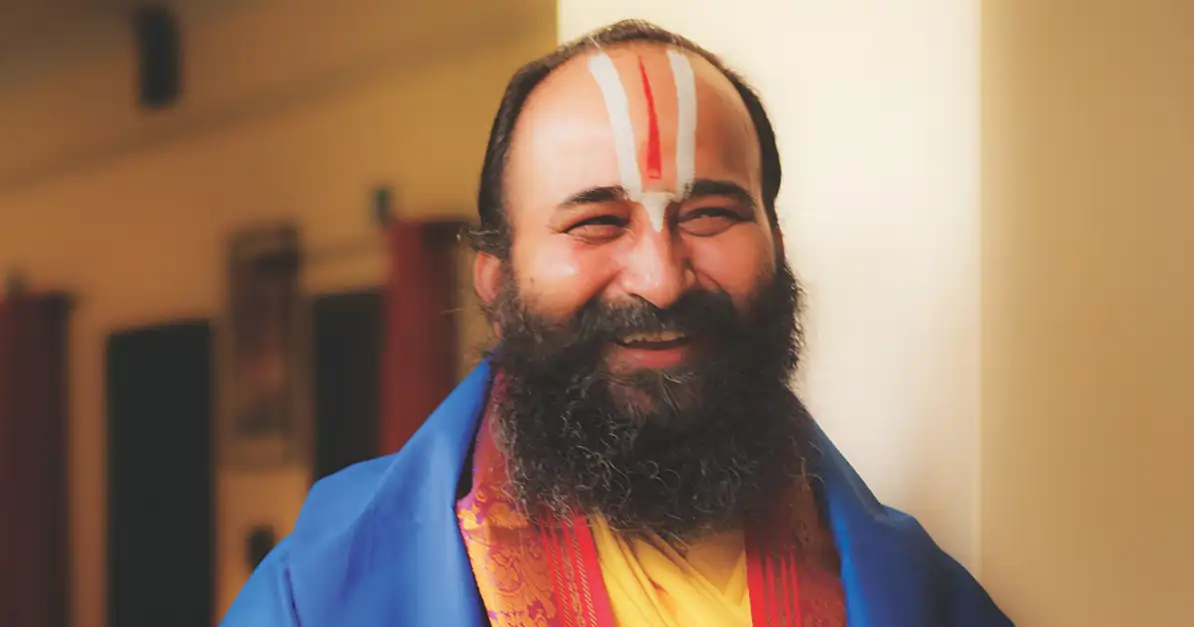
In a similar manner, Guruji travels to different places, has knowledge of the entire Brahmand, contemplates for long on the essence of all of them, and converts it into simple language. The simplified essential nectar of all the scriptures and the written and unwritten laws of the universe are delivered to us through Guruji’s Pravachans.
The message contained in this small narrative is that we should be like the owner of the cow (Satsang), and at every opportunity that we get, milk this cow called Satsang to derive maximum benefit from her. It will not only save us in the Kali Yuga but will also facilitate our decision-making in this materialistic world, will enable us to know at all times right from wrong, and will eventually assist us in performing the very task for which God has kindly granted us the human form – good karma to be eventually freed from the cycle of life and death. In imbibing Satsang, we also make the work of our Guru easier and in the end, the individual and the Satsang will definitely be united, through Guruji, to the Parmatma.
Summary
The passage emphasizes the importance of discretion (or the power to make decisions) as an essential quality that arises when one aligns their thoughts and actions with the divine purpose. This discretion helps individuals detach from the material world and move closer to the Supreme Being, Parmatma. The fable of a bank manager and the analogy of a cow highlight how this detachment and discretion manifest in everyday life, where the focus is not on personal gain but on fulfilling one’s duties with awareness and wisdom.
Satsang (pious company or spiritual discourse) is identified as a crucial means for awakening discretion and spiritual wisdom. The passage underscores that merely listening to spiritual discourses is not enough; one must internalize the teachings and apply them in daily life. By consistently engaging in Satsang and imbibing its essence, individuals can better discern right from wrong, perform good karma, and ultimately fulfill the purpose of human life—liberation from the cycle of life and death. The narrative draws parallels between the virtues of a cow’s milk and the wisdom gained from Satsang, encouraging individuals to seek and apply spiritual teachings to unite with Parmatma.
Important Points
- Discretion is the essence of thought and is crucial for spiritual growth.
- Discretion helps in detaching from materialistic attachments and moving closer to Parmatma.
- Satsang (spiritual discourse) is essential for awakening discretion and spiritual wisdom.
- Merely listening to Satsang is not enough; one must internalize and apply its teachings.
- The fable of the bank manager illustrates the importance of detachment and fulfilling duties with awareness.
- The analogy of the cow highlights the value of extracting wisdom (milk) from Satsang.
- Guruji’s teachings simplify complex spiritual truths, making them accessible and practical.
- Satsang aids in decision-making and helps distinguish right from wrong in the material world.
- Spiritual growth through Satsang ultimately leads to liberation from the cycle of life and death.
- Engaging in Satsang makes the Guru’s work easier and facilitates union with Parmatma.