The Sanatan Dharma – “Guru and the Disciple”
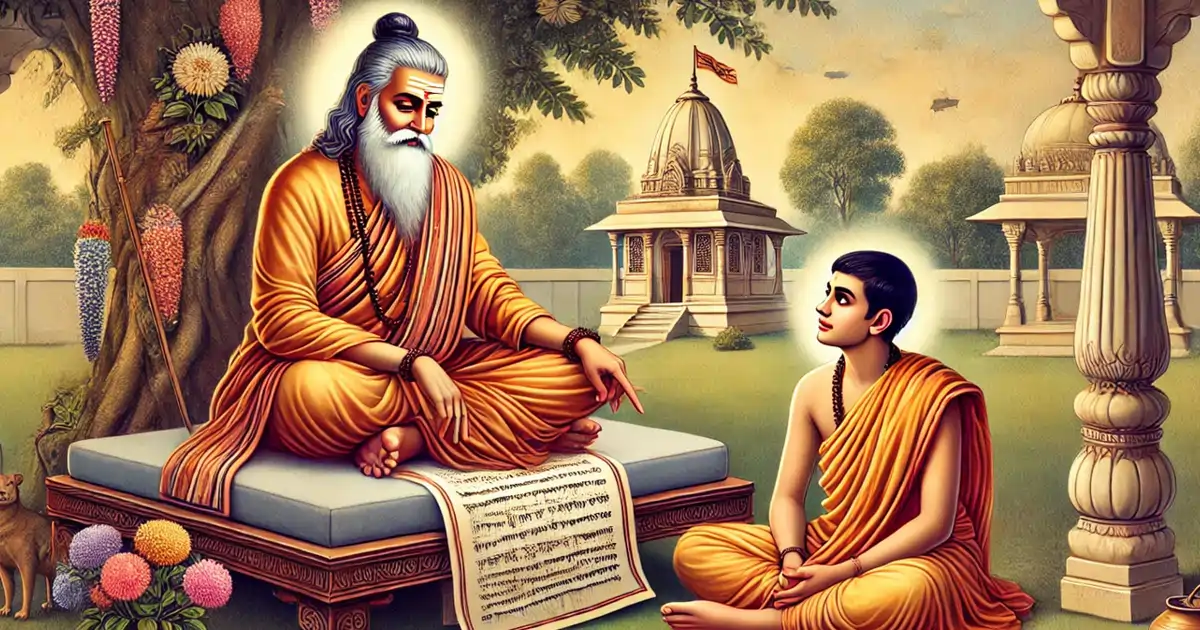
By the mercy of the Lord, one finds a Guru, and by the mercy of the Guru, one finds the Lord.
“The Guru receives benediction from the ocean of mercy. Just as a cloud pours water on a forest fire to extinguish it, so the Guru delivers the materially afflicted world by extinguishing the blazing fire of material existence. I offer my respectful obeisances unto the lotus feet of such a Guru, who is an ocean of auspicious qualities.”
“It has been established that Brahmaji, the firstborn living entity, received knowledge directly from the Supreme Lord, and the same knowledge was imparted to Narada, the next disciple. Narada asked to receive the knowledge, and Brahmaji imparted it on being asked. Therefore, asking for transcendental knowledge from the right person and receiving it properly is the regulation of the disciplic succession. This process is recommended in the Bhagavad-gita (4.2). The inquisitive student must approach a Guru to receive transcendental knowledge by surrender, submissive inquiries, and service. Knowledge received by submissive inquiries and service is more effective than knowledge received in exchange for money. A Guru in the line of disciplic succession from Brahma and Narada has no demand for money. A bona fide student has to satisfy him by sincere service to obtain knowledge of the relation and nature of the individual soul and the Supersoul.”
“One should approach a Guru who can extinguish the blazing fire of this material world, the struggle for existence. People want to be cheated and therefore go to yogis and swamis who play tricks, but tricks do not mitigate the miseries of material life. If being able to manufacture gold is a criterion for becoming God, then why not accept the Lord, the proprietor of the entire universe, wherein there are countless tons of gold? One cannot become happy by accepting a false Guru. A Guru should be accepted as advised in Srimad-Bhagavatam (11.3.21).
Tasmat gurum prapadyeta jijnasuh sreyah uttamam
Therefore, one who is inquisitive about the highest good should surrender to a guru who is well-versed in the scriptures (śāstra) and firmly established in the Absolute Truth (Brahman), and who has taken shelter of peace (upashama).
Shabde pare ca nisnatam brahmany upasamasrayam
One should approach a bonafide Guru to inquire about the highest benefit of life. Such a Guru is described as follows: sabde pare ca nisnatam. Such a Guru does not manufacture gold or juggle words. He is well-versed in the conclusions of Vedic knowledge (vedais ca sarvair aham eva vedyah). He is free from all material contamination and is fully engaged in the Lord’s service. If one is able to obtain the dust of the lotus feet of such a Guru, his life becomes successful. Otherwise, he is baffled both in this life and in the next.”
“One’s first duty is to accept a bonafide Guru. The disciple should be very inquisitive; he should be eager to know the path of salvation. The words Guru-susrusaya (by serving the Guru) mean that one should personally serve the Guru by giving him bodily comforts, helping him in bathing, dressing, sleeping, eating, and so on. This is called Guru-susrusanam. A disciple should serve the Guru as a menial servant, and whatever he has in his possession should be dedicated to the Guru:
Pranair arthair dhiya vaca sreya-acaranam sada
One should always engage in the welfare of others by dedicating one’s life (prāṇa), wealth (artha), intelligence (dhiyā), and speech (vācā) in the service of the Supreme Lord, Hṛṣīkeśa.
Smaritam saptavidham tattvam hrisikese hi sarvada
Srimad-Bhagavatam
Everyone has his life, his wealth, his intelligence, and his words, and all of them should be offered to the Supreme Personality of Godhead through the via media of the Guru. Everything should be offered to the Guru as a matter of duty, but the offering should be made to the Guru with heart and soul, not artificially to gain material prestige. This offering is called arpana. Moreover, one should live among devotees and saintly persons to learn the etiquette and proper behavior of devotional service.”
“According to sastras, the duty of the Guru is to take the disciple back home, back to Godhead. If he is unable to do so and instead hinders the disciple from going back to Godhead, he should not be a Guru.
Gurur na sa syat sva-jano na sa syat
A teacher who does not lead his disciple to liberation is not a teacher; a relative who does not help his kin attain liberation is not a true relative; a father who does not guide his son towards liberation is not a father; a mother who does not lead her child to liberation is not a mother; and a god who does not grant liberation is not a god; a husband who does not help his wife attain liberation is not a husband.
Pita na sa syaj janani na sa syat
Daivam na tat syan na patis ca sa syan
Na mocayed yah samupeta-mrityum
Mahabharata, Udyoga Parva, 179.25.
One should not become a Guru if he cannot enable his disciple to advance in Lord consciousness. The goal of life is to become a devotee of the Lord so that one may be freed from the bondage of material existence
Janma karma ca me divyam evam yo vetti tattvatah
One who knows the divine nature of My birth and activities does not, upon leaving the body, take birth again in this material world, but attains My eternal abode, O Arjuna.
Tyaktva deham punar janma naiti mam eti so’rjuna
Bhagavad Gita, Chapter 4, Verse 9
The spiritual master helps the disciple attain this stage by developing Lord consciousness. Anyone who is supposed to be a Guru but who goes against the principle of Vishnu-bhakti cannot be accepted as Guru. If one has falsely accepted such a Guru, one should reject him.”
“A materialistic so-called Guru instructs his materialistic disciples about economic development and sense gratification, and because of such instructions, the foolish disciples continue in the materialistic existence of ignorance. But Your Lordship gives knowledge that is eternal, and the intelligent person receiving such knowledge is quickly situated in his original constitutional position.
In other words, because of the instructions of a fake Guru, one remains perpetually in material bondage and suffers its tribulations. But if one is intelligent enough to take instructions from the Supreme Personality of Godhead, as enunciated in the Bhagavad-gita, one can very soon attain liberation and be situated in his original position of spiritual life.”
Summary
The importance of a genuine Guru in spiritual life is emphasized, highlighting the idea that by the Lord’s mercy, one finds a Guru, and by the Guru’s mercy, one finds the Lord. The Guru is described as a spiritual guide who can extinguish the fire of material existence through the impartation of divine knowledge. The relationship between Guru and disciple is one of profound respect and service, where the disciple dedicates all aspects of life to the Guru. The ultimate duty of the Guru is to guide the disciple towards liberation and God-realization, and a Guru who fails in this duty should not be accepted. The true Guru leads the disciple towards liberation and eternal union with the Divine.
Important Points
- The Guru receives divine blessings and helps extinguish the sufferings of material existence.
- Knowledge is passed down through the disciplic succession, emphasizing the importance of a true Guru.
- A Guru should be well-versed in the scriptures and established in the Absolute Truth.
- The disciple’s duty is to serve the Guru with devotion, offering life, wealth, intelligence, and words.
- The Guru’s role is to guide the disciple back to Godhead, ensuring liberation.
- A false Guru, focused on material gains, keeps the disciple bound in ignorance.
- The true Guru teaches the disciple to transcend material existence and realize the Supreme Personality of Godhead.