The Poetry of the Alvars
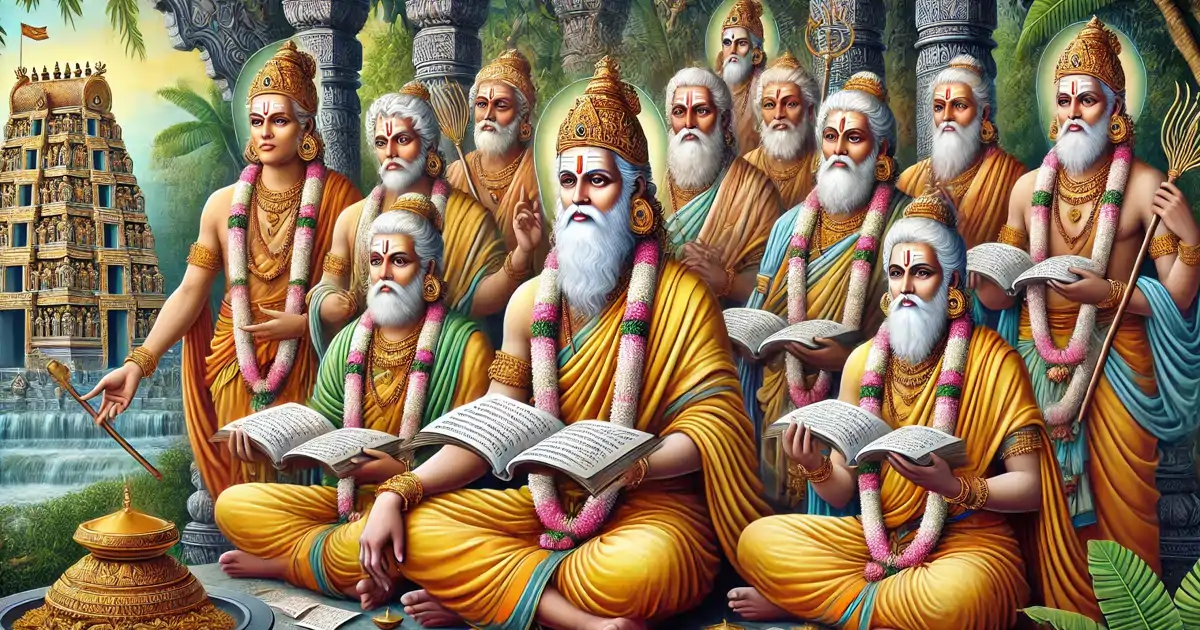
The figure of Rama and several episodes from the Ramayana are prominent in the poems of the Tamil mystics (Alvars), as well as in the devotional meditations and theological arguments of the Srivaishnava preceptors (Acharyas). This article will explore the importance of the Ramayana in Srivaishnava theology and experience by focusing on the Tamil poetry of the Alvars and on the interpretation of these verses by their commentator, Periyavaccan Pillai (born 1228 A.D.), a Srivaishnava theologian of some prominence and distinction. Besides writing commentaries on all the works of the Alvars, Periyavaccan Pillai also commented on selected verses from the Ramayana and wrote some independent treatises; he was also a devotee of Rama.
Between the sixth and ninth centuries A.D., several devotees of Vishnu (Alvars) who lived primarily in the area now called Tamil Nadu, traveled all over the southern part of India, singing His praise. These poems were compiled into an anthology by the eleventh century A.D. and are known today as the Nalayira Divya Prabandham, or the “Sacred Collect of Four Thousand Verses.” Since the eleventh century A.D., these songs have been considered to be “revealed” and have been venerated as the Tamil Veda by the Srivaishnavas. The Srivaishnava community saw (and continues to see) itself as inheriting the “dual Vedanta”; i.e., the “Tamil Veda” of the Alvars and the Sanskrit Vedanta that was interpreted by its most important Acharya, Ramanuja.
The Tamil poems of the twelve Alvars reveal their love for Vishnu in all His manifestations. The Alvars are cognizant of the mythology of the Sanskrit epics and several Puranas and also seem to have access to other traditions from which they drew stories. While Krishna figures prominently in their poems, it would be quite misleading to call it “Krishna Bhakti.” On the other hand, it has been noted by historians that while Rama is mentioned in early Tamil poems (1st to 5th century A.D.), He does not seem to be very important. It is quite remarkable then that knowledge of the Ramayana as well as devotion to Rama became as widespread as it did by the time of the Alvars.
What then is the significance of the Ramayana for the Alvars? Given the paucity of references in earlier classical Tamil poetry, the awareness of the Ramayana story that the Alvars seem to have, as well as the in-depth knowledge of the various incidents, is striking in itself. Even more important is the fact that they seem to have had access to another tradition, possibly oral, from which they drew stories. Secondly, we see (for the first time in Tamil literature) poets actually participating in the story of Rama by identifying themselves as and then talking in the guise of various characters in the epic. Rama is also the only character in Alvar poetry to whom the poets sing from the viewpoint of another male; Kulacekara Alvar puts himself in the place of Dasaratha grieving over the departure of Rama, and Tirumankai Alvar actually identifies himself with the defeated Rakshasas of Lanka seeking Rama’s protection and then sings through their voices. The Alvars also do not show exclusive devotion to Rama or to Krishna and we must note its absence; both Rama and Krishna are portrayed as two of the several manifestations of Vishnu. We also see that Rama is not excluded from the “parental” or erotic sentiments expressed by the Alvars (usually Krishna is the focus of all this attention in later North Indian poetry). We see a lullaby addressed to Rama and several of the Alvars pine for Rama and for Krishna. More importantly, the figure of Rama is identified with the Lord enshrined in a temple. The image itself is not in any way lesser than the incarnation; to the Alvar, the enshrined image, be it Krishna or any of Vishnu’s manifestations, seems to be equal. The whole lullaby of Kausalya for Rama, composed by Kulacekara Alvar, is addressed to a generic form of Vishnu in a temple at Tirukan(n)apuram.
We can see the Alvars’ devotion to Rama manifested in two ways: through hundreds of allusions to Rama, and through their participation in the story of Rama by singing through the voices of various characters in the Ramayana. In Tirumankai Alvar’s Periya Tirumoli alone (1180 verses, and constituting over a quarter of the entire corpus of Alvar poetry), there are about 106 allusions to Rama or to incidents from the Ramayana. Apart from these allusions, we also have about six different “sets” of poems (about sixty-three verses) where the words are spoken by the Alvar in the guise of a character from the Ramayana.
Of the hundreds of references to the story of Rama, the incident most frequently alluded to is the actual killing of Ravana and the destruction of Lanka. Thus, in the Periya Tirumoli of Tirumankai Alvar, out of approximately 106 references to Rama or to an incident from the Ramayana, over 51 deal with the killing of Ravana and the destruction of Lanka. The Alvars seem cognizant of all the main incidents of the Ramayana. The composite story closely resembles the Sanskrit Ramayana of Valmiki. We have references to the birth of Rama in Ayodhya, going forth with Visvamitra, the killing of Tataka, protecting Visvamitra’s sacrifice, breaking the bow and winning Sita, a (hunchback) poisoning Kaikeyi’s mind, the exile, Rama departing with Laksmana and Sita, friendship with Sugriva, Dasaratha’s grief, giving the sandals to Bharata, acquaintance with Agastya and getting a bow from him, dwelling in Citrakuta, anger against Kabandha and the crow seeking refuge, Surpanakha’s nose being cut, the sighting of the magic deer, Sita’s abduction, friendship with Sugriva and the killing of Vali, the chopping of seven trees, Hanuman being sent in search of Sita, anger at the sea king, the building of a bridge across the sea, Kumbhakarna’s tendency to sleep, the killing of Ravana and the chopping of his shoulders, the sack of Lanka, the grief of Mandodari, the handing over of Lanka to Vibhisana, etc. Kulacekara Alvar also mentions several incidents from the Uttara Ramayana.
To be continued…
Summary
The Ramayana holds a significant place in Srivaishnava theology and experience, particularly as reflected in the Tamil poetry of the Alvars and its interpretations by Periyavaccan Pillai, a prominent Srivaishnava theologian. The Alvars, devotees of Vishnu from the sixth to ninth centuries A.D., composed numerous hymns that expressed deep devotion to Vishnu in all his manifestations, including Rama. These hymns were later compiled into the Nalayira Divya Prabandham, revered as the “Tamil Veda.” The Alvars displayed an intimate knowledge of the Ramayana and participated in the epic’s narrative by assuming the perspectives of various characters, a unique feature in Tamil literature at that time.
The Alvars’ devotion to Rama is evident through hundreds of references to incidents from the Ramayana, particularly the killing of Ravana and the destruction of Lanka. They viewed Rama not just as a mythological figure but as a manifestation of Vishnu, equal to any deity enshrined in a temple. The Alvars’ poetry reflects a deep integration of the Ramayana’s themes into their spiritual experience, where Rama and Krishna are seen as different forms of Vishnu, with no exclusive devotion to one over the other. Their poems demonstrate a profound engagement with the Ramayana, both in their allusions to its narrative and in their imaginative participation in its story.
Important Points
- The Ramayana plays a crucial role in Srivaishnava theology, as seen in the Tamil poetry of the Alvars.
- The Alvars’ hymns, compiled in the Nalayira Divya Prabandham, are considered the “Tamil Veda” by Srivaishnavas.
- The Alvars demonstrated an extensive knowledge of the Ramayana, incorporating its stories into their devotion to Vishnu.
- The Alvars participated in the Ramayana narrative by adopting the voices of its characters, a unique feature in Tamil literature.
- Rama is seen as one of the many manifestations of Vishnu, with no exclusive devotion over Krishna.
- The killing of Ravana and the destruction of Lanka are the most frequently referenced incidents in the Alvars’ poetry.
- Periyavaccan Pillai, a Srivaishnava theologian, provided extensive commentaries on the works of the Alvars and their Ramayana references.
- The Alvars’ devotion to Rama includes viewing him as a deity enshrined in temples, equal to any other form of Vishnu.
- The Alvars’ poetry integrates the Ramayana deeply into their spiritual experiences and theological reflections.
- The Alvars’ engagement with the Ramayana shows a profound connection between Tamil devotional literature and the broader Hindu epic tradition.