

Param Tattva Vishnu
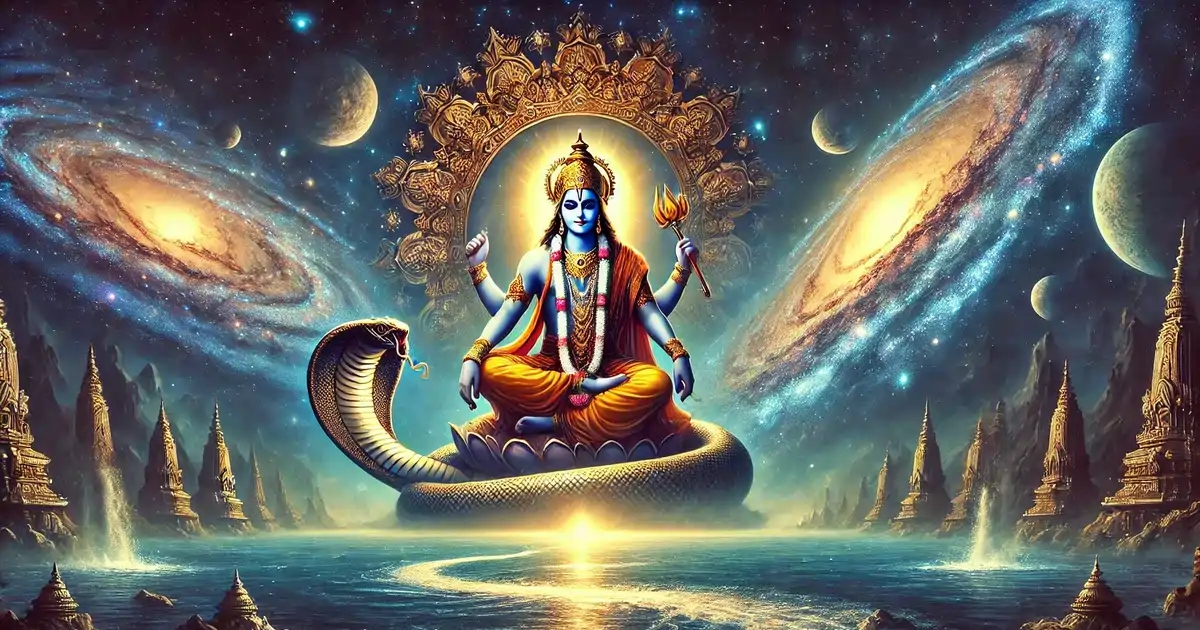
Akhanda Mandakini
The Vedas, Itihasa (history), Puranas, Ramayana, Mahabharata, and other scriptures have conclusively established that Vishnu is the ultimate reality. This is because He embodies the qualities of Sattva (purity) and is the support of the entire universe. He is the essence of all creation, the source of all existence, and the supreme protector of all beings.
Yato va imani bhutani jayante jivanti
From where all these beings originate and where they live
Chandogya Upanishad 3.1.1
The revered Narayana is the supreme deity. Calling upon His name ‘Om’ brings forth the essence of ‘Tattva’ or truth. Therefore, the wise chant the sacred syllable ‘Om’ with reverence.
Tatvamasi Shvetaketo
You are That, O Shvetaketu
Chandogya Upanishad 6.8.4
Satyam jnanam anantam Brahma
Brahman is Truth, Knowledge, and Infinity
Taittiriya Upanishad 2.1.1
Bhagavan Narayana, who is beyond comprehension, is referred to as Vishnu. The divine Vishnu is also recognized as Sri Vishwaksena, Aniruddha, Pradyumna, and Sankarshana. Those who worship Him with devotion are granted the divine vision of His supreme form.
Tam eva viditva ati mrityum eti
By knowing that (Brahman), one transcends death
Shvetashvatara Upanishad 3.8
It is through the realization of Vishnu that one transcends death and achieves eternal peace. Vishnu, who pervades all, is worshiped as the ultimate protector, creator, and destroyer of the universe.
Tad Vishnoh paramam padam sada pashyanti surayaḥ
The divine realm of Vishnu, the supreme abode, is always seen by the gods.
Diviva chakṣur atatam
It is like seeing with the eyes of the gods themselves
Rigveda 1.22.20
Vishno: Paramam padam sadapi bhavatu Vishnuh:
May Vishnu’s supreme abode always be
Shrutismriti iti Vishnu smriti japat
The remembrance of Vishnu is done by reciting the texts of Shruti (Vedas) and Smriti (scriptures)
Vishnu, as described in the scriptures, encompasses the attributes of omnipresence, omnipotence, and omniscience. He is the eternal, unchanging reality.
Satyam vada dharmam chara
Speak the truth and follow righteousness
Taittiriya Upanishad 1.11.1
In essence, Vishnu is the embodiment of truth and righteousness. Those who meditate upon Him, who adhere to His teachings, achieve the highest state of liberation and eternal peace.
The scriptures proclaim:
Those who see the divine form of Vishnu, who meditate upon Him with unwavering faith, transcend the cycles of birth and death and attain eternal bliss
Therefore, let the name of Vishnu resonate in your heart and mind, for it is the supreme reality that leads to liberation.
Summary
The article explores the concept of Vishnu as the supreme reality, as established in Vedic scriptures, Itihasa, Puranas, and epics like the Ramayana and Mahabharata. Vishnu is depicted as the embodiment of Sattva (purity) and the ultimate protector, creator, and destroyer of the universe. The article emphasizes the importance of chanting the sacred syllable ‘Om,’ representing Vishnu, as it leads to the realization of truth (‘Tattva’) and ultimately to liberation from the cycle of birth and death. Through unwavering faith and devotion to Vishnu, one can attain eternal peace and transcendence.
The article further discusses the omnipresence, omnipotence, and omniscience of Vishnu, as highlighted in the Upanishads and Rigveda. Vishnu is portrayed as the eternal, unchanging reality, and adherence to His teachings leads to the highest state of liberation. The scriptures proclaim that meditating upon Vishnu with unwavering faith enables devotees to transcend the cycles of birth and death, achieving eternal bliss and divine vision. The name of Vishnu is thus considered the supreme reality that guides one to liberation.
Important Points
- Vishnu is established as the ultimate reality in Vedic scriptures.
- He embodies the qualities of Sattva (purity) and supports the entire universe.
- Chanting ‘Om,’ which represents Vishnu, leads to the realization of truth.
- Vishnu is the supreme protector, creator, and destroyer of the universe.
- Devotion and unwavering faith in Vishnu lead to eternal peace and liberation.
- The Upanishads and Rigveda highlight Vishnu’s omnipresence, omnipotence, and omniscience.
- Vishnu is the eternal, unchanging reality that transcends time and space.
- Meditating upon Vishnu helps one transcend the cycle of birth and death.
- Adherence to Vishnu’s teachings leads to the highest state of liberation.
- The name of Vishnu is the supreme path to achieving eternal bliss and divine vision.


