Guru
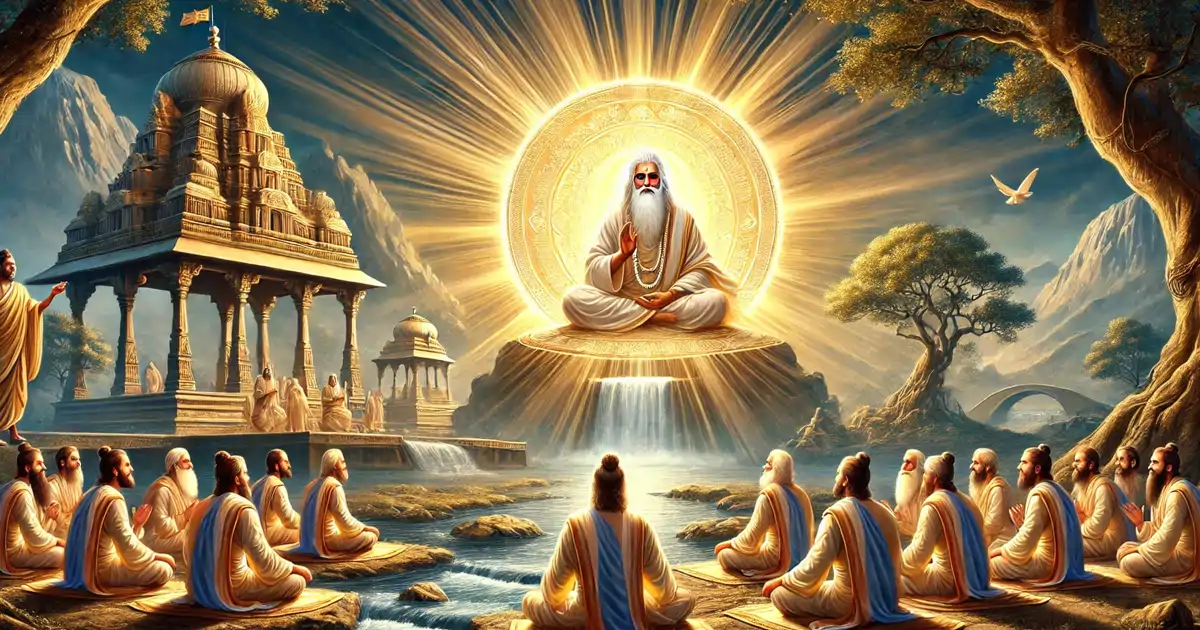
When Lord Narayan was in the midst of creating the universe, Goddess Laxmi, His consort, was very upset. Lord Narayan saw this and asked Her the reason. She replied that Lord Narayan was creating the universe, in which He would create human beings and the Karma Department, which would be totally independent of anything. Due to the Karma theory, mankind would only suffer due to their own doings, as Karma is a totally independent theory. No God or demigod influences what a human being wants to do, and all this would only lead to misery and unlimited sorrow and sadness.
Since humans are no one else but the children of Lord Narayan and Goddess Laxmi, it was obvious that a mother would cry if she saw her children in misery. So She wanted the Lord to create some method which could end the misery of mankind. To this, Lord Narayan created the following method:
He said that any human being, no matter whatever bad Karmas he has done earlier in this birth as well as previous births, once he accepts a spiritual leader or Guru (in the disciplic succession or the guru parampara), takes Naamdaan from the Guru, and surrenders himself totally to His Guru (Sharanagati), this person’s sins would be forgiven and forgotten, and he would be on the path to Moksha (oneness with the Supreme Lord).
Laxminath Samarambah,
Beginning with the Lord of Lakshmi,
Nathya Muni Madyamah,
Asmadacharya Paryanta,
Vande Guru Parampara
Continuing through the sages like Nath Muni,
And extending up to my own Guru,
I bow down to the lineage of Gurus
Dhyan Moolam Guromurti,
The root of meditation is the Guru’s form,
Pujamoolam Goropadam,
Mantramoolam Gurovakyam,
Mokshamoolam Gurokripa
The root of worship is the Guru’s feet,
The root of mantra is the Guru’s word and,
The root of liberation is the Guru’s grace.
Dear friends, Guruji says that having a Guru is the most important thing in life. He further says that we feel Guru Nanakji was himself a Guru, so he may not have needed another Guru. But dear friends, even Lord Rama, Lord Krishna, and everyone else needed a Guru to sail across this life cycle. It is written in the Puranas:
May There Be A Thousand Suns In The Sky,
May There Be A Thousand Moons In The Sky,
But Without A Guru,
Our Life Is Full Of Darkness.
Kabir Dasji wrote:
Ram Krishna Se Ko Bade,
Who is greater than Ram or Krishna?
Jinhone Guru Kinha,
Teen Lok Taran-Tarn Guru Aage Aadheen
It is the one who has accepted a Guru.
The Guru is superior, as he guides even the three worlds and is worthy of reverence.
In the Puranas, we can find the knowledge of our Gurus. Guru Nanakji in his Granth starts by saluting his past four Gurus, including Pandit Har Dayal Shastri, who was his teacher. He salutes him, for it was he who taught him all that he knew. This teaches us that all our teachers, whether in school or elsewhere, are our Gurus. Even if you learn something from a child, you should touch his feet and thank him for he taught you something. After saluting all his Gurus, Guru Nanakji says: “SAB TERA HAI,” meaning everything I have today is yours, my dear Guruji. In the end, he salutes Shriman Narayan, for when the earth comes to an end and when the earth and water merge, then it is only Shriman Narayan who shall start the world again.
He also salutes Shri Laxmi Mata, the wife of Shriman Narayan, for when all the loks end, everyone’s name shall fade; only Shriman Narayan and Shri Laxmi’s names shall exist. Guruji says that even in the Guru Granth, the importance of Gurus is there. When the Lords like Ram, Krishna, and Brahma needed a Guru, don’t you think we, as ordinary people, need a Guru? He further says that one who does not make a Guru shall get lost in the 84 lakh life cycle. He shall never be able to get out of it. This law was made at the beginning of life that one shall only be able to get out of the life cycle with the help of a Guru. And laws once made are to be followed. Guru Nanakji says:
Hari Ko Bhaj So Hari Ka Hoyee
One who worships Hari (God) becomes His own
He states that one who takes the name of the Lord shall be one with the Lord, may he be a man, woman, child, rich, or poor. There is no difference in the status of the person, nor is there any caste difference in the house of the Lord. All of us shall get what we deserve as per our karmas.
Guruji further says that if we just hang the photograph of a president or a prime minister, can we run the country with their photographs alone? If we show our nerves to the photo of a doctor, can we get cured? NO! Only when we see the doctor personally, shall we get the medicine and get cured. Similarly, only with the presence of a Guru can our life function properly. He alone can guide us to perform good karmas.
In the Guru Granth Sahib, it is clearly stated that there have been ten dynasties of Gurus. That is why Guru Nanakji says: “Guru Charan Saroj,” (I bow to the lotus feet of the Guru) there has to be some Guru whose feet he is saluting. He further says:
Bhav Bhandan Mere Katiyo, Jab Mantra Diyo Guru Kaan
My bonds of worldly existence were cut when the Guru whispered the mantra into my ear
He says that when he got the Guru Mantra in his ear, his life changed, and he detached himself from worldly bhandans. This mantra must have been given by his Guru only. He sang the praise of the Lord, his Guru, Shriman Narayan, and then only could he cross the bhav sagar. Guruji says that Brahma, Shiv, Vishnu, all the Rishis, and Maharishis, all of them needed the Guru Mantra from their respective Gurus to attain moksha. Till today, the same routine exists. We shall attain moksha only when we get the Guru Mantra. Mind you, if we don’t follow the principles, we shall never get moksha. The principles are Seva, Simiran, and Satsang.
Some Aspects as to Why a Coach/Teacher (Guru) is So Important in Spiritual Life It is very funny that if someone wants to learn music, they look for a good music teacher. If someone wants to learn tennis, they look for a good tennis coach. But when it comes to spiritual life, it is basic human nature to think they are good enough on their own and do not need a teacher in this field. This is a very common thing we hear regarding spiritualism:
“It Should Come From Within.”
Once someone was asked what other thing comes from within or is inbuilt. He said breathing was inbuilt as everyone knows it from birth and no one is required to teach how to breathe. To clarify this point, there is something called ‘Pranayama,’ which is the science of breath. A good teacher can actually teach one how to control one’s breath. For example, in the Kumbh Mela, you can find many such saints who are over one hundred years old, and that’s because they have mastered the art of minimum use of breath.
Basically, it is not one’s age that is written in destiny; it is the number of breaths which are numbered. So by doing something which leaves you breathless, like getting angry or upset, you can be sure that you are actually reducing your lifespan. So even something as common as breathing needs a teacher to master the technique.
Similarly, one may say that eating comes naturally to a person – but even each grain or morsel which one consumes is measured as they very commonly say:
Daane Daane Par Likha Hain Khaane Waale Ka Naam
On every grain is written the name of the one who will eat it
And if someone teaches us how to eat, what food to eat, we can be assured of a longer and healthier life. By overeating, we must realize that we have actually reduced the number of days of our life as we ate more than what was due to us.
In fact, in the scriptures, there was a question as to what is the secret of a long life. The answer came from a saint called Bhaskaracharya. He said that the secret to a long and healthy life is to eat little, eat what is beneficial, and not eat what is forbidden. So here we can see that everything needs a teacher. How on earth can we enter the spiritual world without a teacher?
Actually, there is a reason as to why people hesitate to go for a spiritual teacher or Guru. The reason is that in this Kalyug, our thinking is that there are two types of people – one who cheats and one who gets cheated. So if we choose a spiritual Guru and he actually cheats us, that means we get cheated, and no ego will accept this in today’s world. So better do not have a spiritual teacher. This is the mentality.
But the scriptures clearly say that spiritual life is like a razor’s edge, not the regular twin-blade razor but the cut-throat one in which if you are not properly guided, then you may have to pay a very heavy price. Since this spiritual world is like a razor’s edge, the chances are far more that you would slip and hurt yourself badly.
So that is why a spiritual teacher or Guru is so important. The scriptures also say that a Guru is not only important but essential, which means that there is no choice. If one wants to head towards self-realization, then one has to have a Guru, and there is no allowance to this rule.
Lord Krishna Himself tells Arjuna that if you want to approach me, then approach me through a teacher who himself is self-realized and who knows what I am so that he can guide you successfully through this spiritual world and make you one with Me. He also says that I only consider those souls as devotees who are actually devotees of My devotees. So let us open our eyes and see what a great devotee of the Supreme Power is our own Guruji and let us become His devotees, and then automatically, the Supreme Lord will consider us as His devotees.
Last but not least, we must not forget that even the Lord Himself in the form of Lord Rama had Vashishta Muni as his spiritual teacher, and Lord Krishna’s spiritual teacher was Sandipan Muni. So who are we to go through the spiritual world without a teacher or a Guru? Guru Pooja Is The First Pooja
Gurur Brahma, Gurur Vishnu,
The Guru is Brahma, the Guru is Vishnu,
Gurur Devo Maheshwara
Gurur Sakshat Param Brahma
Tasmai Shri Guru Veh Namah
The Guru is Shiva (Maheshwara),
The Guru is verily the Supreme Brahman,
Salutations to that Guru.”
Guruji says that after doing pooja for many devi-devtas, there still remains one pooja left. A Brahmin normally does Shri Narayan’s pooja to complete the pooja, but Guruji says that if you just do your Guru’s pooja, then it includes the pooja of not only the devi-devtas but also Shri Narayan’s pooja.
A true Guru is one who helps his disciples to cross the bhav sagar with the least possible difficulties. He helps his devotees to come out of the life-death cycle. He arouses the humanity within us, makes us good people, and hence lights the lamp of our souls. When we surrender ourselves completely at the feet of such a Guru, follow every step of his, and listen to every command of his, then we surely will cross the bhav sagar without any difficulty.
Guruji says that if in the world there exists at least one true Guru and one true disciple, then there would surely be a continuation of the dharmas, as a Guru would surely pass on the words full of nectar to his disciple. The Guru Mantra itself would be the beginning of the holy books. Till humans are free from this life-death cycle, till their humanity is aroused, and till the greed of knowledge exists, Guruji says there surely will be holy men, saints, and sages who would take birth for the service of mankind. They surely will be given all the love and honour by their devotees. It is an old saying:
Guru Gobind Dono Kharde Hain, Kake Lagun Pav, Balhari Guru Aapne Govind Diyo Milaye
“Guru and God (Gobind) both stand before me, to whom should I bow first?
I bow to the Guru, for it is he who has shown me the path to God.”
Kabir Das
The saying goes like this: The Lord himself and my dear Guru are both in front of me, whose feet do I first touch, and whom should I first honour? Dear Guruji, I first bow to your feet, for it is because of you that today I got the honour of seeing my dear Lord. The Lord has given us this life, but it is our dear Guruji who has made us worthy of meeting The Lord. He is the one who takes us across the bhav sagar. Our parents just help us get this body, this life. But it is our dear Guruji who lightens the light within us, He opens the eyes of our soul, with which we see Lord Narayan Himself. Guruji tells us one beautiful story: Once Shri Narad Muni went to Vaikuth Dham, He told Shri Narayan that he had visited the earth (mirtulok). Shri Narayan was very happy and welcomed Narad Muni. He showed great hospitality towards Narad Muni and told him that it is only on earth that you can do any karmas. In heaven, in Vaikuth Dham, you can only enjoy the fruits of your good karmas, and earth was the best place among all the loks as it is only there that you can get your Guru. Did you make any Guru on earth, Narad Muni? asked The Lord. Narad Muni asked the Lord as to what was a Guru and what was the importance of a Guru? The Lord told him that he shall find the answers to his questions only on earth. Narad Muni left for earth and made up his mind that the first person he shall see on earth with the first rays of the sun shall be his Guru.
The next morning, Lord Narayan, in the form of a fisherman, came in front of Narad Muni. Narad Muni had made a promise to himself regarding the first person to be his Guru. He found the fisherman to be smelling but had to make him his Guru. The fisherman knew nothing about being a Guru. Narad Muni told him GU means darkness and RU means light. Hence, Guru means one who would remove the darkness of our life with the light of knowledge. The fisherman wanted to ignore him and just said, “I accept being your Guru,” and went away to his work. Narad Muni now came back to Lord Narayan and was asked if he had now made a Guru. Narad Muni was unaware as to who was actually the fisherman. He said, “Yes, I found a smelling fisherman and had to make that fool only my Guru.” The Lord was not upset at hearing the foul language for himself but was very upset to hear wrong words for a Guru. He cursed Narad Muni that for the next 84 lakh lives, he shall have to go through the life cycle. Narad Muni pleaded for forgiveness, but The Lord refused to hear anything and said that the only way out shall be found on earth. Now Narad Muni came back to his fisherman Guru and told him the whole story. His Guru told him something in his ears, and Narad Muni happily went back to The Lord. Shri Narayan asked him as to what his Guru had said. Narad Muni said that as per your wish, I shall go through the 84 lakh lives, but could you, my dear Lord, draw out the map of the 84 lakh lives? The Lord, not understanding this request, drew out the map of the 84 lakh lives. Narad Muni immediately started rolling over the map. Shri Narayan saw this and understood what the Guru must have told Narad Muni. Narad Muni said, “Dear Lord, the 84 lakh lives are made by you, and this map also is drawn by you. For me, it is as good as going through the life cycle.” Shri Narayan was pleased and said, “One who follows the words of his Guru shall surely cross through all problems of his life, may they be small or big.”
One who has a Guru, one who follows his Guru’s steps, shall rise very high in the spiritual life, that is our main aim of life. We are too small to talk about the great men. People have been singing the glory of the Lord, are still singing, and shall sing in the future also. We can never explain the greatness of our Guru. Even the holy books shall fall short if we want to write anything about our Guru. During Guru Poornima, we bow down to our dear Guru, who himself is Lord Narayan for us. We place our good and bad everything at his feet. As Guruji says, complete surrender is very necessary in any relationship. Dear friends, let us lay our entire lives—past, present, and future—at the feet of our dear Guruji, and then you see the difference in our lives.
Importance of Guru Poornima A Guru gives a part of His punya, praan, and tap to His disciples. He is the connection of man with God. Without a Guru, we cannot have any direct communication with God. In other words, He is a living God for us. Guru Poornima is a festival of our faith and love for our Guru. Today’s day we show our gratitude towards our Guru. He in return showers all the blessings He has. With the help of His own tap, a Guru fills within his disciples the goodness of thinking in the right direction and hence attaining vivek. Once the disciple is full of vivek, the Guru also feels satisfied. It is then up to us, the disciples, as to how we do our own homework and get good marks in His exams. It doesn’t mean that our Guru takes any test, but the more we practice what he preaches, the happier He shall be. Once we have taken full sharanagati of our Guru, we have taken an oath that come what may, we shall not doubt our Guru for a second also. Our fast or prayers on that day are a promise to Him that we are all His. Our Guru is that seed in our hearts which grows the tree, on which we climb up to Lord Narayan Himself. To get a loving glimpse of our Guru is also a big thing. We should be very happy and feel extremely lucky for our dear Guruji always smiles at us, even through His pictures, which I believe all of us may have noticed. Like our Guru gives us a part of His punyas, we as disciples should also give Him something. But what should that be? We should give Him our shradha, our sadhna, our faith, and our love. With all this, we shall be able to build a relation with our Guru. This should be our main aim. All this is done on Guru Poornima itself.
A Guru is the Radio Through Which God Contacts His Devotees Once Swami Vivekananda was meditating under a tree at Hathras Station (sorry, don’t know where exactly it is situated). He was sitting there very peacefully when the station master came and saw him. This man, Sharatchandra, had been in search of a Guru for a very long time. As he saw Swamiji sitting there, he felt that his Guru had himself come to him and that his search was now over. He walked up to Swamiji and took him to his house. After taking his bath and food, Swamiji still didn’t ask Sharatchandra anything but kept quiet. Sharatchandra, who was so full of joy, told Swamiji, “I am grateful to you, my Lord, for you have given me darshan. I am your servant (das). Please guide me as to what can I do in your service. I would like to get Atma Gyan from you.”
Listening to this, Swamiji said nothing but started humming one bhajan which meant, “If you do need any knowledge, then come with me, leaving behind everything.” Sharatchandra replied, “Guruji, I am all yours, I shall do whatever you tell me.” To which Swamiji replied that he had a big job to do in this world and asked if Sharatchandra was ready to be a sanyasi for his sake. Sharatchandra replied that he could even give up his life for Swamiji’s goal to be accomplished. To this, Swamiji gave him his bag and said, “Get something in this bag from your juniors at your station. Beg from all who are there, both coolies and passengers.” He did as he was told. Swamiji was really impressed by this act, for he felt no shame in begging from his juniors or anyone else at the station where he was at the top position. Swamiji accepted him in his sharan and gave him the name Swami Sadanand, who in his later life helped continue Swami Vivekananda’s mission.
This story was narrated by Guruji to teach us that once we have accepted a Guru, we should feel no shame in doing whatever is told to us by Him. Accept the situations our Guru puts us in, never say a “but” or an “if.” Only when you are fully His, both physically and mentally, then you also are accepted by Him. As quoted earlier: “A GURU IS THE RADIO THROUGH WHICH GOD CONTACTS HIS DEVOTEES.” If only we are near to the radio and listen to it carefully, then only we shall get the message of God. But if we listen to Him only for our own needs, then we shall miss out on the most important messages sent by The Almighty Himself. Guruji says, “Don’t rest till you have achieved your goal, for every time you rest, you shall lose an opportunity.” He says, “Get up, go ahead, find your Guru and follow His path, which is the only way to Moksha, our prime aim in life.”
Guru Kripa is What Shall Give Us Mookti Dear friends, as we always say:
Dhyan Moolam Guromurti,
The root of meditation is the Guru’s form,
Pujamoolam Goropadam,
Mantramoolam Gurovakyam,
Mokshamoolam Gurokripa
The root of worship is the Guru’s feet,
The root of mantra is the Guru’s word and,
The root of liberation is the Guru’s grace.
We all know that without His grace, we would not have got this life. It is also known that we must have surely taken birth in our past life in some form or the other, and there are also so many forms of life today. We should feel very fortunate to have got this life of a human. Surely, Guruji says that there must have been some karma of yours that has led you to come back on earth again. Try and rectify that fault and do things by which you shall not come back. Guru dhyan comes first. We should first of all always remember our Guru. This shall lead to constant remembrance and hence simiran. Then comes a yearning to learn more. This feeling of more learning shall then lead you to vairagya (a feeling of detachment, without attachments). Dear friends, Guruji says once you have detachments from the world, you shall have attachments with the Lord. We should always have faith in our minds and always one aim in life: to meet the Lord. All other aims in life are actually worthless.
Guruji then says that there are many types of devotees. Many are followers, but their level of acceptance varies. He further says that there are four types of sharanagatis:
- The first type of devotee who is under the shelter of the Lord feels no difference as to the situations around him. He has left everything to his Lord/Guru and hence no happiness or sorrow affects him much as he feels that everything my Lord does is for the best. He is happy in sorrow also, and equally loves his Lord at all times.
- The second type of devotee who is also under the shelter of his Guru feels the pain of the sorrow and the happiness of anything good around him and then says to the Lord/Guru that all is done by you. But in this case, he first acknowledges the sufferings and then thanks his Guru.
- The third type of devotee loves his Lord but also loves to fight and argue with his Guru like a child. Here the ifs and buts are always there. There are always questions to the Guru as to why this happened and why that didn’t happen. Here the devotee out of love always fights his Guru/Lord.
- The fourth type of devotee, Guruji says, is like Draupadi, who at the time of utmost need called out to the Lord. He says this devotee also followed the Lord, but only acknowledged Him. She accepted His love only when she was in difficulty.
Dear friends, Guruji says we are all smart enough to understand where we stand. We should try and reach the first stage, where the existence of “I” is vanished. The other three stages have that existence. We all love our dear Guruji. We also say that we follow Him. We believe that we shall do anything for Him. But dear friends, have we made ourselves that capable that Guruji shall ask us for a favor? We have yet to make ourselves capable of His daya and kripa. His hand is always there on our heads, but how many of us actually value that daya? Let us learn to value His daya, then automatically we shall get His kripa as well.
Some Instances to Prove the Greatness of a Guru A true Guru generally is in such a position that He has attained ‘Moksha’ or liberation from the cycle of birth and death, but still takes birth so that He can share with His loved ones the path to attain liberation or become one with the Supreme God.
Even if you ask a common lady for the recipe of a dish which she makes exceedingly well, she generally will on purpose omit one part or one ingredient so that our dish, when cooked, does not turn out as good as hers. But just see the greatness of a true Guru. He who has spent hundreds or even thousands of births learning and researching the path to liberation just in one Satsang reveals the basic truth to His listeners, no matter who they are. But for a Guru, the most important thing is that those listeners have taken an effort to come to a Satsang. This proves how great a Guru is and how tremendous His sacrifice is!
Another instance to prove the greatness of a Guru is the tradition of Guru Mantra. Guru Nanak, one of the greatest saints of all times, and even our Guruji, has decided that He would do research on the teachings of Guru Nanak and include them in His Satsangs. So this itself shows what a great saint Guru Nanak Himself was. Guru Nanak said that He spent all his years in search of eternal happiness, but all throughout His life, he never attained satisfaction in His soul. There were too many bindings, too many responsibilities, and too many problems of the human birth. In spite of several years of research, He did not achieve what He was looking for until one day He came out of all problems and attained eternal bliss. That was the day when His Guru whispered the Guru Mantra in His ear. It was from this day onwards that Guru Nanak realized the God within Himself.
The Guru Mantra, when given by a Guru to His disciple in the correct way as prescribed by the scriptures, gives a disciple a reason to live. It increases his confidence by a thousand times. He loses fear of all problems this world has to offer and suddenly realizes his priorities in life, which is Ek Bhakti Bhagwan. It is then that the disciple realizes that this world is full of Maya which is destructible and cannot be retained by oneself for a long time. So it is better that he spends time on something which he can keep for himself even after he leaves this world. This not only gives him happiness and satisfaction in the spiritual world but also gives him material happiness as well.
And who gives the Guru Mantra? A Guru, of course. So this again proves how great and all-important the presence of a Guru is in a human birth.
Summary
The concept of the Guru is central to spiritual life and holds immense importance in the journey towards self-realization and liberation (Moksha). In the narrative, Lord Narayan addresses the concern of Goddess Laxmi regarding the misery that karma would bring to humanity. To alleviate this suffering, Lord Narayan establishes the practice of accepting a Guru, taking Naamdaan (initiation), and surrendering oneself completely to the Guru (Sharanagati) as a path to forgiveness of sins and attaining Moksha. The text emphasizes the necessity of a Guru for guidance, even for divine beings like Lord Rama and Lord Krishna, underscoring that spiritual progress is nearly impossible without a Guru’s presence. Through various teachings and examples, it is shown that the Guru is the bridge between the disciple and the divine, leading them out of the cycle of birth and death.
The text also discusses the significance of Guru Poornima, a day dedicated to expressing gratitude to the Guru, and the vital role of the Guru Mantra, which empowers and guides the disciple on the path to spiritual and material well-being. It is highlighted that without the Guru’s guidance, the spiritual journey is as perilous as walking on a razor’s edge. The Guru is portrayed as the ultimate source of knowledge, the one who dispels darkness with the light of wisdom and whose grace is essential for attaining liberation. The narrative encourages complete surrender to the Guru, as only through this relationship can one attain the ultimate goal of life—Moksha.
Important Points
- Significance of a Guru: A Guru is essential for spiritual progress and attaining Moksha.
- Guru’s Role in Karma: The Guru helps alleviate the suffering caused by one’s karma through Naamdaan and Sharanagati.
- Divine Endorsement: Even divine beings like Lord Rama and Lord Krishna needed a Guru for guidance.
- Guru Poornima: A day to express gratitude and receive the Guru’s blessings, vital for spiritual growth.
- Guru Mantra: The initiation given by a Guru is a powerful tool for overcoming life’s challenges and advancing spiritually.
- Complete Surrender: The narrative emphasizes the importance of total surrender to the Guru for spiritual success.
- The Guru as a Guide: The Guru is the connection between the disciple and the divine, leading them out of the cycle of birth and death.
- Sacred Teachings: The teachings of the Guru are essential for navigating the spiritual path, which is likened to walking on a razor’s edge.
- Guru’s Compassion: The Guru shares his accumulated spiritual merit (punya) with disciples, guiding them towards liberation.
- Guru as the Light of Knowledge: The Guru dispels ignorance and leads the disciple towards enlightenment.
- Sharanagati: Total surrender to the Guru is necessary for crossing the ocean of worldly existence (bhav sagar).
- Role in Spiritual Practice: The Guru’s teachings and guidance are crucial in spiritual practices such as meditation and worship.
- Spiritual Tradition: The text places great importance on the Guru-disciple relationship as foundational in spiritual traditions like those of Guru Nanak and Swami Vivekananda.
- Universal Principle: The importance of a Guru is a universal principle, applicable across different religions and spiritual paths.
- Guru as the Path to God: The Guru is the radio through which God communicates with devotees, making the Guru indispensable for spiritual growth.