Book 9 – Discourse
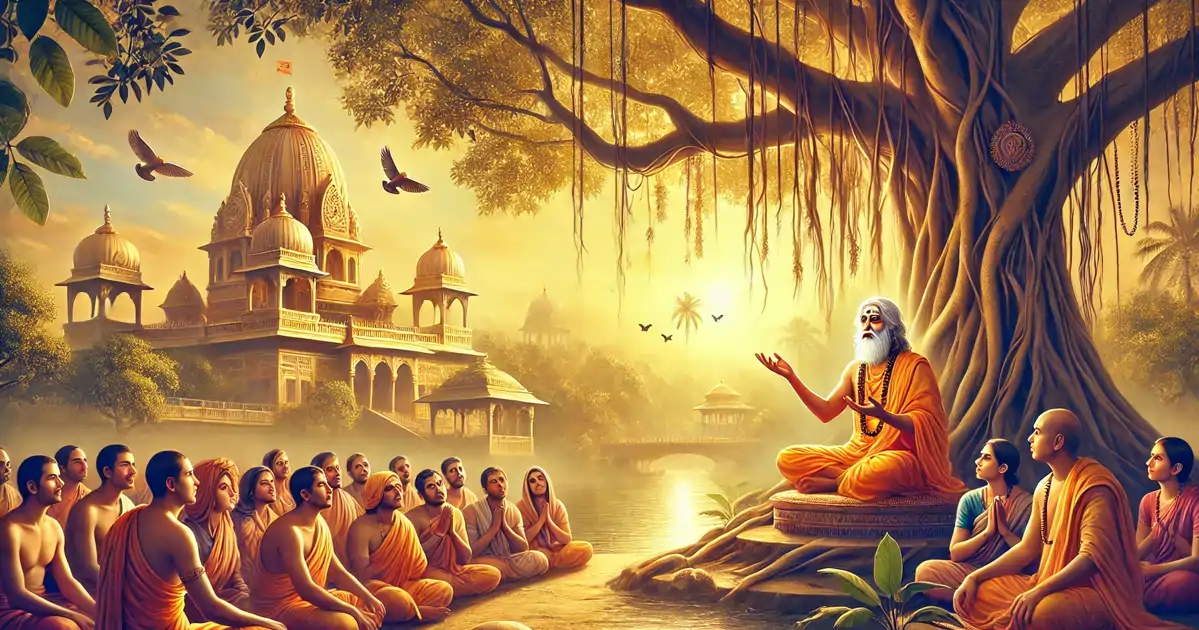
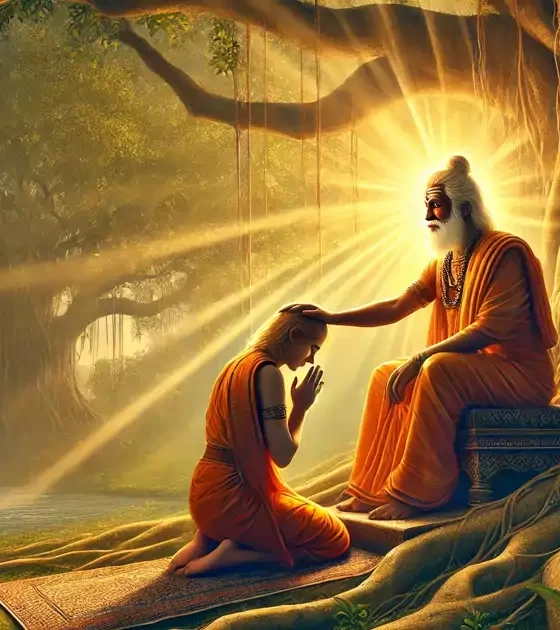
From the earliest times, it was established that crossing the ocean of existence without a guru is not possible — “Gur bin bhav nidhi taraihe na koi” (Without a guru, no one can cross the ocean of existence). The human body is meant for devotion to the Lord. Let us all gather together and sing the glories of the Lord’s name.
Narayan is a supreme word. The supreme element is called that beyond which there is nothing. In the Gita, Lord Shri Krishna explains to Arjuna, “He Arjuna! Akashe patitam toyam sagaramadhigacchati” (water that falls from the sky reaches the ocean) — water falls from the sky and becomes rivers and streams, eventually reaching the ocean — “Yatha nadinam bahavo’mbupravahah samudramevabhimukhah dravanti” (Just as many rivers flow towards the ocean). Many rivers create chaos within themselves, but they find peace when they merge into the ocean. Similarly, Arjuna, among gods, kings, warriors, etc., I am the supreme element. This supreme word has been accepted by every saint, in every scripture. Regardless of the sect — be it Ramanuji, Ramanandi, or Sannyasi, this Narayan element cannot be denied. Even Sannyasis greet each other with “Namo Narayan.” This is the supreme element. This supreme element was accepted by Tulsidas Ji. You might believe that Tulsidas Ji’s revered deity was Lord Ramchandra. However, he first bowed to his deity and said:
Neel saroruharashyam taran arun barij nayan,
With a complexion like a blue lotus, with eyes like the rising red sun,
Karau so mam ur dham, sada kshir sagar sayan
May He, who ever rests in the ocean of milk, dwell in my heart forever
May the Lord who always reclines in the ocean of milk reside in my heart. Meera worshipped Krishna her entire life and sang bhajans, but in the end, she too said:
Pag ghunghru bandh Meera nache re,
With anklets on her feet, Meera dances,
Main to mere Narayan ki aap hi ho gayi dasi re
I have completely surrendered myself as a devotee of my Narayan
Kabir Sahab also accepted the supreme Narayan:
Kahat Kabir suno bhai santo,
Kabir says, listen, O dear Saints,
Bhaj Sarangpani
Chant the name of Lord Vishnu (Sarangpani)
The name Sarangpani refers to Narayan. Thus, every saint has accepted this supreme element. In the Punjab region, Baba Nanak Dev Ji, the first Guru, was also Param Sri Vishnu. He too accepted this supreme element. He said,
Bharmat bharmat main hariyo tab sharanai aayo
Wandering and wandering, I became weary, then I sought refuge in the Lord
He surrendered to a saint, saying, “O Lord! I am tired, and the fear of death does not leave me —”
Sant dayal kripal bhaye mo par,
When the kind and merciful saints showered their grace upon me,
Tab yeh baat batayi,
Sarva dharma tab poorn hoi hai,
Gaho Prabhu sharanai
Then they revealed this truth,
All dharmas (duties) are fulfilled only when One takes refuge in the Lord
Guru Nanak said, “I do not know the Lord; I have only learned meditation and remained Nirankari.” In this context, the original scripture writes:
Naam Niranjan Neer Narayan
The Name of the Pure, the Divine Narayan, is like sacred water
My dear ones, devotees of God, scholars, and writers! To all the distinguished individuals present at this divine congregation of the Lord, I extend my heartfelt greetings and auspicious blessings.
The precious day of our lives is the one when we are inspired to devote ourselves to the Lord’s name and worship. Only that day counts in the human life span, while the rest are part of daily routines. Baba Nanak Dev, in the original scripture, writes:
Ek bhakti Bhagwan,
True devotion is to the Lord alone,
Jihi prani ke nahi man,
Jaise sukar swan,
Nanak manhu tahi tan
One who lacks devotion in their heart Is like a pig or a dog,
O Nanak, consider such a body worthless
Consider that body like that of a pig or dog if it does not have devotion to the Lord because the human body is meant only for the Supreme Being.
Ram sumir Ram sumir ehai tero kaj hai,
Chant the name of Ram, remember Ram – this alone is your true duty.
Maya ka sang tyag,
Hari ji ki sharan lag,
Jag sukh maan mithya jhootha sab saaj hai
Renounce attachment to Maya,
Take refuge in Lord Hari,
For worldly pleasures and honor are false, and all material adornments are mere illusions
We often delay our devotion, thinking we’ll worship tomorrow if not today, but we do not think similarly about our basic needs like water or food. For devotion to the Lord, we say it can wait until tomorrow if not done today. Such perceptions have become ingrained in our human life.
My dear ones! There is no certainty about this human life. Its duration is unknown. Even astrologers have made predictions, but the exact time cannot be determined. Our human life passes moment by moment.
Ratrirgamishyati bhavishyati suprabhatam,
The night will pass, and the morning will surely come.
Bhavyani drishtani hashishyati pakshapatri
What is destined to happen will be seen, and the winged one (bird) will laugh
The bumblebee, delighted by the cool, fragrant nectar of the lotus, does not realize that evening is approaching and the sun is about to set. The lotus begins to close, and the bumblebee is trapped inside, struggling for air, hoping the night will pass and morning will bring freedom. But fate is unpredictable, and an elephant comes to play in the water, breaking the lotus stem and chewing it. The bumblebee’s life ends tragically. Similarly, my dear ones, we keep postponing our joy, thinking we’ll enjoy it tomorrow or the day after, while the wild elephant of time can strike anytime and destroy the beautiful petals of our lotus-like body, ending the life of our bumblebee-like soul. This example illustrates the transience of our physical existence. Just as the bumblebee is attached to the lotus petals and cannot escape, we too are attached to the pleasures of this world, neglecting our true devotion.
Our condition is becoming like that of the bumblebee. We are attached to what we should not be and neglect our devotion to the Lord, which should be our true attachment. Everyone knows that death is certain for those who are born. In the pursuit of materialism, we forget the Supreme Being.
When we engage in chanting the Lord’s name, that is considered an auspicious day. Today is especially auspicious, a particularly blessed and significant time. We are gathered in a place named Haripur. Today is Navami (the ninth day), a significant number. Tulsidas Ji has given great importance to the number nine. It is also the Shradh period. So many auspicious alignments have come together here, making this a rare and beautiful time for our gathering.
People book tickets and endure the crowds and hardships to bathe in the holy Prayag. This is like a moving Prayag where the assembly of saints makes it a holy pilgrimage. What a beautiful conjunction! This is a highly auspicious, beneficial, and joyous occasion. My dear ones, I say this to emphasize that we should make the most of this blessed opportunity.
This human body, my dear ones, is supreme. It is the highest among all life forms. All other life forms are bound to sensory pleasures. God has endowed them with the ability to enjoy, but not the freedom to act. He has given us humans two things: the dependence on enjoyment and the freedom to act. Only humans can perform actions; no other life form can. If you ask a bird or a horse to give you a spiritual discourse, it will just shake its head. Only the human form is capable of action. Consider how great this body is.
God has created wealth and numerous sensory pleasures for this human body. But our mindset has become reversed. We have become slaves to wealth, thinking we exist for wealth. Can you eat those currency notes? Will they fill your stomach? Think about it. You need food like flour and lentils, which are more important than money as they sustain the body. God created animals and birds for the benefit of humans. They are not harmful to us. We use horses, ride elephants, milk cows, and make animals work for us. They are for our enjoyment. Think about it; who is greater? This amazing human body was created by God. It has ten windows, vents, walls, and a roof, keeping everything intact inside. God made this body in a systematic way. It’s a wonderful gift.
My dear ones, you cannot obtain this body by spending money. You can earn money with your body, but you cannot create a body with money.
Ekah prashnashto navakoti tulyah
One good question is equal to nine crore (ninety million) answers
A fraction of this body cannot be purchased for nine crores. Consider which is greater: wealth or the body. When you go to a doctor, pleading for your life, he may say he cannot save you. This body cannot be created with diamonds or pearls, nor can it be bought with charity. Some believe it takes 8.4 million lifetimes to attain a human body. My dear ones, saints also believe this. But this body does not accept it. There is no solid evidence that a human body is attained after 8.4 million lifetimes. There is no definitive proof. So how do we get it? Sant Shiromani Tulsidas Ji says:
Kabhunkinkaruna kar nar dehi,
Sometimes, the Lord bestows grace upon a human,
Det Ish binu hetu snehi
Giving selfless love without any reason
When the soul suffers greatly, God takes pity on it. God, the ocean of mercy, grants a human life out of compassion without any conditions. He does not demand worship, offerings, or rituals in return. He grants this life freely, urging us to perform good deeds and escape the cycle of suffering.
If we call this human body a body of grace, it is not an exaggeration. God has given it out of grace. Yet we boast of our actions, achievements, and deeds. You are all learned and wise. Think about it. Is this body really yours? It is given by God.
Chiti jal paavak gagan sameera,
Earth, water, fire, sky, and air—
Panch rachit yeh adham shareera
From these five elements, this lowly body is formed
This body is made of five elements. If you own any one of these elements, let me know. Are you the owner of the sky, earth, water, fire, or air? You have no part in it. We pride ourselves unnecessarily. This is where the degradation of human life begins, when we start claiming ownership of this body. This body belongs to God. He provided everything for this body. In the womb, the fetus is nourished through the umbilical cord. When it is born, the mother’s breasts produce milk 72 hours before birth. Despite the mother’s body being waste-excreting, God produces pure milk. As infants, we had nothing, yet God provided us with milk factories. As we grow, milk stops. This is God’s grace. Doctors may attribute it to hormones, but we see it as divine grace. The factory closes as we grow.
He provided milk for us to drink. When we were born, He gave us light without a bill. The sunlight and moonlight come without charge. Cool, fragrant, gentle breezes blow without a tax. Beautiful natural sights are free to enjoy. Governments may tax, but God does not. He created beautiful ponds and rivers without any tax. We grow grains in the soil but never paid rent to God. He gives us the land for free, no matter how much we sell or fight over it. He provides so much for free. My dear ones, consider this. Can’t we thank Him? Can’t we remember His name? Are we not making a huge mistake? Are we not ungrateful? He has created so much for us and continues to protect us in various forms — as Narasimha, Varaha, and more. He appears in any form to protect humanity. Yet, we do not remember His name even once a day.
People often postpone devotion, thinking they’ll do it in old age, but young people still eat, sleep, dress, and enjoy life. Why do they avoid remembering the Lord’s name? It is a tragedy that our youth consider devotion only for the elderly. Consider Meera, Sahjobai, Karmabai, Dhruva, and Prahlad. Were they old when they devoted themselves? Many avoid satsang, preferring television or serials. Some say they read scriptures and do not need satsang. Such thoughts are misguided.
My dear ones, consider that Lord Shiva himself sought constant satsang:
Bar bar mangau harsh dehu Shri Rang,
Again and again, I pray—grant me joy, O Shri Rang,
Pad saroj anpayini bhakti sada satsang
Unwavering devotion at Your lotus feet and eternal association with saints
If even Lord Shiva sought constant satsang, who are we to avoid it? Our youth should not harbor such thoughts. If we wait until old age, physical ailments may prevent us from even sitting in satsang. In youth, one can attain God quickly. Why do our youth despise the Lord’s name? This is a misfortune for humanity.
God provides free blessings to children, youth, and elders alike. We should remember and honor Him to maintain our humanity. Ungratefulness is a terrible trait, and seeing an ungrateful face in the morning can ruin one’s day. An ungrateful person denies the benefits they receive.
A saint was meditating in the forest. His meditation became so intense that when birds made noise, he glanced at them, causing them to fall unconscious. Thousands of birds died. Realizing this, the saint revived them with his glance. This made him arrogant, believing he could kill or revive with a glance. He left his hermitage and went to a house, asking for alms. The woman inside said she was bathing her child and asked him to wait. He asked again, and she replied she was dressing her child. The third time, she said she was feeding her child. The saint, impatient and arrogant, cursed her, but she calmly replied that her house was not like the birds he had mesmerized. The saint was humbled and moved on, encountering a butcher who also refused to be intimidated. The butcher told the saint he would cut his throat if threatened. The saint continued to a cremation ground, where he met a scavenger cooking meat. The scavenger, recognizing the saint, covered his food and explained that the saint’s ungrateful gaze could contaminate it.
The scavenger was actually Narayan in disguise, teaching the saint humility. God sometimes appears in various forms to correct his devotees. The saint was reminded that his powers were due to God’s grace, not his own. He realized the folly of arrogance and the importance of gratitude.
My dear ones, ungratefulness is a vile trait. We should recognize the divine gifts we receive and express gratitude. When God has made us human, we should embody human qualities. True humanity comes from accepting our humanity and cultivating virtues. Humanity involves seeking divine qualities, performing selfless actions, and remembering the Supreme Being.
Humanity requires us to purify our diet, behavior, and thoughts. Consuming pure foods like milk and fruits nourishes the body and spirit. However, society’s indulgence in meat and alcohol corrupts our humanity. Pure living leads to spiritual growth. Saints teach us to avoid materialism and focus on spiritual progress.
Humanity means respecting the divine nature of our existence. Even the smallest part of our body is invaluable. This body is given by God’s grace, not by wealth. Recognizing this, we should avoid arrogance and embrace humility.
In conclusion, humanity is about embodying divine qualities, purifying our lives, and expressing gratitude to God. By doing so, we align ourselves with the divine purpose of our existence and attain true peace and fulfillment.
On Humanity and Diet
Humanity’s diet should be pure and sacred. Nowadays, people in society have started consuming meat, which is contrary to the essence of humanity. Abandoning the sacred food offered to Lord Krishna and resorting to meat consumption goes against our culture and religion.
The Concept of Impurity
If a bird, pigeon, dog, or cat dies in your house, you would immediately call the servants or handle it yourself to dispose of the body outside. You would sprinkle Ganga water and chant ‘Hari Om’ or ‘Satnam Waheguru’ to purify the place according to your beliefs. My dear ones! I ask those who consume meat, what is in that living being that you had to clean and purify the place with Ganga water? The body remains the same. What happened to the human being that we performed all these rituals?
Their hands remain the same, their feet remain the same, their weight remains the same. What has changed? Only the life force, the prana, has left the body. That’s the only difference, nothing else. What else has changed? My dear ones! When the life force leaves the body, we consider it impure. People who eat meat are consuming something that is already dead, storing the leftovers in the refrigerator. I ask you, does that meat have life in it? It is nothing but a dead body. You cleanse yourselves after touching a dead body, perform various religious rituals, but relish eating another dead body. Is it not still a dead body? Or is it something else? Eating meat is not our duty as humans. It is not written in our scriptures that meat is our food.
Only carnivorous animals have the right to eat meat. Their jaws and digestive systems are different, designed to digest meat. Their intestines are usually 9 to 12 feet long, while ours are 32 to 36 feet long. Carnivorous animals produce a certain saliva in their mouths that helps in digesting meat. We don’t have that kind of saliva, yet we consume meat with great pleasure. My dear ones! Think about it, is this our humanity? How can someone who doesn’t eat the food of humanity be called a human?
A human is one who embodies the qualities of humanity. A human must be pure inside for the outside to be pure, regardless of how much perfume or cologne they use. Purity will come from pure diet and behavior.
God has created milk, fruit juices, and many kinds of fruits for humans. By consuming these, you can become strong and healthy.
Our modern society considers drinking alcohol a sign of prestige. Consuming that bitter liquid and then vomiting in a dirty gutter is considered a mark of a high-status family. You may get angry with me, but if speaking the truth makes you angry, so be it. I will speak the truth: this is how it is.
A human is one who has the qualities of humanity and pure dietary habits. In our society, saints are often labeled as beggars because they come to ask for alms. But my dear ones! I am not here to take monetary donations or to create disciples. I am here to share my harsh words with you. Listening to stories (kathas) alone will not grant you anything. By simply listening and then brushing it off, you cannot please the saints or Lord Krishna. We must follow their teachings. Satsang (spiritual discourse) may sound harsh because it lacks rhythm, but it is here to tell you the tough truths for your life. After embracing these truths, Yama (the god of death) will not look at you.
So, my message is that we will accept donations. If we do not receive the donation we seek, we will leave like a child who sulks. Meat and alcohol are destroying our humanity. The demonic influence is increasing, leading to daily violence, and alcohol is a major source of these vices. Therefore, we ask for three satsangs. This baba (referring to himself) is here to serve you, to show you the right path, not for money.
I speak to recognize Sanatan Dharma. I have mentioned donations, as saints ask for donations, but we seek donations of two things: giving up meat and alcohol. Without humanity, your sacrifices, merits, donations, satsangs, yogic practices, and meditations will not be in vain, but they will lead to demonic nature. Ravana’s penance and sacrifices were not wasted, but they were of demonic nature. Similarly, we should not become demons. God has said:
Paritranaya sadhunam,
For the protection of the righteous,
Vinashaya cha dushkritam,
Dharma-samsthapanarthaya sambhavami yuge yuge
For the destruction of the wicked,
For the establishment of dharma,
I manifest in every age
My dear ones! He has made it clear that He comes to protect humans and destroy demons. When we lose our humanity, we become demons. As we are turning from humans into demons, we should not expect God to protect us. He destroys demons. Ravana had a golden city, but what happened to him in the end? Today, his effigy is burnt, and children clap. What was his fate? He was a scholar, strong and wealthy, but look at his end. Whoever becomes arrogant, challenges God, and adopts demonic tendencies, their final fate is dire. Think about the fate of Duryodhana, who found no one to mourn his death, with his thigh broken, writhing in pain.
God incarnates to destroy the wicked and protect humanity because He loves humans. That’s why He keeps coming in human form. Reflect on how much He loves humanity. God has given us this human body out of His grace. Let us not stray from it, let us be His devotees. If we embrace humanity, God will love us, protect us, and give us everything we need. He will give us happiness and peace. It is beneficial for us to remain human as created by God.
If you seek liberation, if you want to be free from the cycle of birth and death, if you want to escape the punishments of Yama, if you want to avoid hell, if you want peace, then you must cultivate humanity within yourself. If our foundation is flawed, what will our future be? Therefore, we must bring humanity within ourselves.
What are the qualities of humanity? In the Gita, Lord Krishna tells Arjuna: “Satyam akrodham” – Speak the truth, do not be angry, control your senses, worship God, study and contemplate, respect elders and gurus, engage in the welfare of others, do not criticize anyone – these are the qualities of humanity. We must become humble and simple. Simplicity embodies humanity. When we become simple and flexible, humanity will not be broken. When floods come, the tall, rigid trees break, but the flexible bamboo bends but does not break. Similarly, we must have flexibility, humility, and gentleness within us. If we do not have these qualities, understand that there is still a deficiency in our humanity. Saint Tulsidas says in simple language:
Simit simit jal bharhi talava,
Limited water fills the pond gradually,
Jimi sant subhaav sajjan pehi aava
Just as the nature of saints reaches the virtuous
A virtuous person is one who embodies humanity. When humanity comes into a person, they become virtuous. If someone strays from humanity, they become wicked. Wickedness drives away virtues, while humanity attracts all virtues. The Lord is present in idols. He manifests in divine forms and incarnates to protect the world. Doubting His presence is not humanity. Embrace humanity, follow Satsang, and remember God.
Summary
The discourse emphasizes the supreme importance of devotion to the Lord, particularly through the remembrance of Narayan, the ultimate reality. Saints and scriptures across various traditions—whether Ramanuji, Ramanandi, or Sikh—have unanimously accepted Narayan as the highest truth. From Tulsidas to Kabir, Meera, and Guru Nanak, all have advocated surrendering to the Lord. Life is fleeting, and delaying devotion is a grave mistake, as no one knows when the journey will end. The analogy of a bumblebee trapped in a closing lotus illustrates the impermanence of life and the necessity of dedicating oneself to divine service without delay.
The discourse also stresses the importance of purity in human conduct, including dietary habits, humility, and selfless actions. It warns against arrogance, material attachment, and indulgence in destructive behaviors like meat consumption and alcohol, which degrade humanity. The human body is a rare gift, granted by divine grace, and must be utilized for spiritual upliftment. True humanity lies in humility, truthfulness, self-discipline, and devotion to God. The ultimate goal is to recognize the Supreme Being’s grace, surrender to His will, and embody divine virtues to attain eternal peace.
Important Points
- Narayan is the supreme reality accepted by all saints and scriptures.
- Devotion should not be postponed, as life is uncertain.
- The human body is rare and must be used for spiritual liberation.
- The analogy of the trapped bumblebee highlights the fleeting nature of life.
- Saints like Meera, Kabir, and Guru Nanak emphasized surrender to the Lord.
- Humility, truthfulness, and self-discipline define true humanity.
- Satsang (spiritual discourse) is essential for spiritual growth.
- Materialism and ego lead to downfall and suffering.
- Meat consumption and alcohol degrade human consciousness.
- Gratitude to the Supreme Being is crucial for spiritual progress.
- The Lord provides freely, yet people forget Him.
- Divine incarnations occur to protect humanity and destroy evil.
- Ravana and Duryodhana’s fate exemplify the consequences of arrogance.
- Simplicity, humility, and flexibility preserve human virtues.
- Embracing the Lord’s name ensures liberation and divine protection.