Book 9 – Questions & Answers
Question: On one hand, the Gita says:
Yada yada hi dharmasya glanir bhavati bharata,
Whenever there is a decline in righteousness, O Bharata,
Abhyutthanam adharmasya tadatmanam srijamyaham
And a rise in unrighteousness, at that time, I manifest Myself
On the other hand, when you give initiation, you mention in the ultimate mantra:
Sarva-dharman parityajya mam ekam sharanam vraja,
Abandon all duties and take refuge in Me alone.
Aham tva sarva-papebhyo mokshayishyami ma shuchah
I will liberate you from all sins; do not grieve
What are the dharmas that we should renounce to take refuge?
Answer: If we believe that Lord Krishna asked us to renounce our duties, then why did Arjuna say at the end of the Gita: “Karishye vachanam tava” – I will do as You say. He fought the war. The Lord did not ask him to renounce his household duties. Arjuna ruled the kingdom, returned to household life, and crowned his children. Thus, renunciation of household duties is not indicated.
“Sarva-dharman parityajya” means renouncing the duties of the senses and the attachment to personal pleasures and gains. The Lord says, “Do not worry about victory and defeat, joys, and sorrows. Surrender everything to Me. Then you will not grieve or worry. I will take care of you.” He did not ask to renounce sacrifices, worship, or religious duties. He asked us to give up attachments and desires, and dedicate our actions to Him.
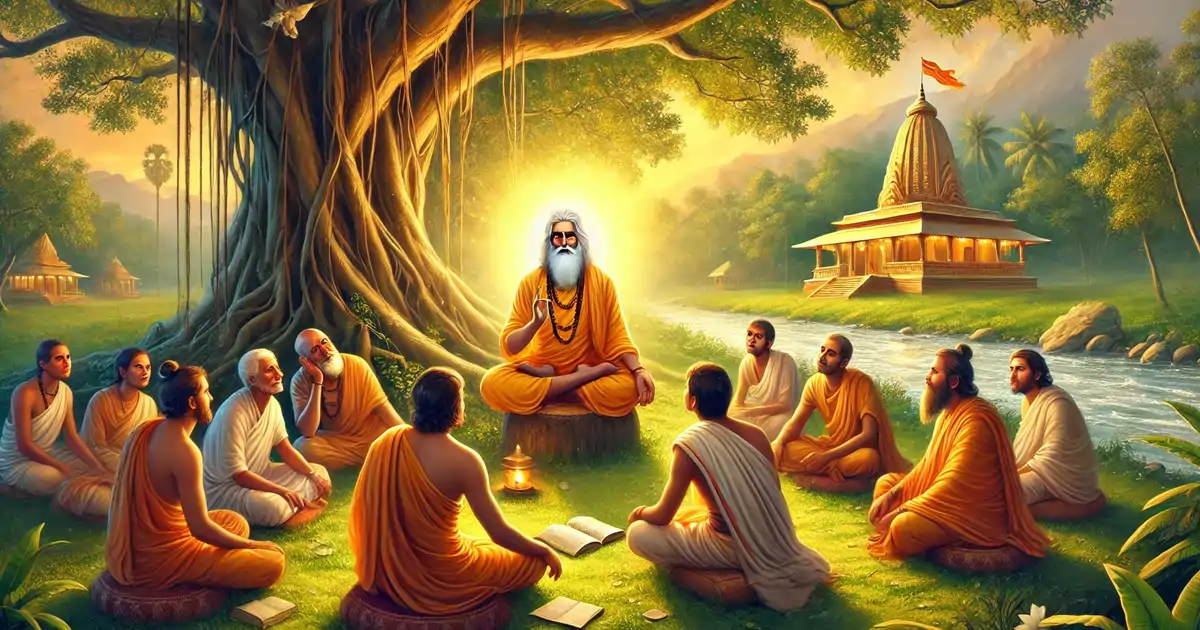
Question: To attain the refuge of the Lord, do we need to first take refuge in a Guru or a Saint?
Answer: When you were born, your mother or father taught you to walk and talk. As you grew up, their support continued. In school, you received education. Similarly, you cannot attain refuge without support. As it is said:
Rama Krishna se ko bade jinhne guru keenh,
Who is greater than Rama or Krishna? The one who accepted a Guru,
Teen lok taran taran, guru aage adheen
Even the saviors of the three worlds remain submissive before the Guru
Guru bin bhav nidhi taraihe na koyi,
Without a Guru, no one can cross the ocean of existence,
Jau viranchi Shankar sam hoyi
Even if one is as great as Brahma or Shankar
Without a guru, no one can cross the ocean of existence, not even Brahma or Shiva. Even Lord Rama and Krishna accepted gurus. Guru Nanak Dev Ji also had a guru.
The concept of guru is not new. In the beginning of creation, the word ‘guru’ was first uttered: “Adi guru kave namah.” The first guru was Lord Narayan, who taught the four Vedas to Brahma. After that,
Lakshmi-nath samaram bhavam,
I meditate upon Lakshmi-Nath (Vishnu) at the beginning,
Nathayamn madhyamam,
Asmadacharya paryantam,
Vande guru paramparam
Then upon my immediate Guru in the middle,
And up to my Acharya in succession,
I bow to the lineage of Gurus
The tradition of guru has existed since the beginning of creation. Therefore, the presence of a guru is essential. You may have knowledge and degrees, but without a witness, your case cannot proceed. Similarly, a petition without a witness’s signature is invalid. Hence, the guru’s presence is indispensable.
Question: We want to observe the Ekadashi fast. Which Ekadashis can be observed by householders?
Answer: The first thing to understand is that the term ‘fast’ itself means to stay hungry. If you are not hungry, how can it be called a fast? So, the first doubt to clear is that fasting means staying hungry. If I am eating three meals a day, what kind of fast is it? Writing that I want to fast on Ekadashi is pointless if I am not hungry. So, dear one! On Ekadashi, one must stay hungry, whether a householder or a sanyasi. On Ekadashi, you can have fruits but do not overeat. Do not eat three kilos of fruits when you usually eat only half a kilo. Drinking a kilo of milk on the pretext of fasting is not fasting.
One should fast on Ekadashi, but do not remain completely without food. After Ekadashi ends and Dwadashi begins, you can have fruits and a proper meal. But Ekadashi means you should stay hungry.
A story from Rajasthan comes to mind. A Gujjar Baba’s wife asked him if she should warm some milk for him. He replied, “If you warm the milk, I will consider you my mother.” Similarly, fasting on Ekadashi is highly esteemed. I would consider myself fortunate if you decide to fast on Ekadashi.
How often should one fast? There are two Ekadashis each month, one in the bright fortnight and one in the dark fortnight. Observe a specific Ekadashi, have a proper meal, and perform the rituals devotedly. If you do this, I would consider myself blessed that my words had some effect.
Question: In previous satsangs, we learned that the soul is eternal. What would be the form of a person who follows the voice of the soul? Is it possible to follow the voice of the soul?
Answer: There is no doubt that the soul is eternal. It is 100% eternal.
Vasamsi jirnani yatha vihaya navani grihnati naro’parani,
Just as a person discards old garments and takes new ones,
Tatha sharirani vihaya jirna nyani sanyati navani dehi
Similarly, the soul abandons worn-out bodies and enters new ones
Naenam chhindanti shastrani,
Weapons do not cut this (the soul),
Naenam dahati pavakah,
Na chainam kledayanti apo,
Na shoshayati marutah
Fire does not burn it,
Water does not wet it,
Nor does the wind dry it
The soul is eternal. It cannot be destroyed, cut, burnt, or dried. There is no doubt that the soul is eternal.
You asked about the form of a person who follows the voice of the soul. Such a person is excellent, beautiful, and praiseworthy. But dear one! Only a person who knows the soul can follow its voice. The soul’s voice can only be recognized by those who have realized it. Otherwise, the mind can deceive you, pretending to be the voice of the soul, saying, “Steal, no one is watching.” The soul does not say this, the mind does. How will you know it is the soul speaking? If you follow the soul, dear one, you will attain liberation. There are four types of liberation: samucchiay, jeevan mukti, sannyidhya mukti, and sarupya mukti. You can attain liberation while living if you follow the soul. But only when you recognize the soul.
Many false voices mimic the soul’s voice. Within us, the soul is surrounded by 18 layers. These layers are like walls, but they are as strong as diamond. The soul sits within these 18 layers, surrounded by the five organs of action, the five senses of perception, the five vices (lust, anger, greed, attachment, and ego), and the three elements (mind, intellect, and ego). To recognize the soul’s voice, complete surrender is necessary. Without surrender, you may mistake the mind’s voice for the soul’s. The mind may say, “Drink dirty water,” but it is not the soul. The mind says, “Drink it, or you will die.” The soul never says this. The mind, intellect, needs, and desires speak, not the soul.
Following the soul’s voice is challenging. After conquering the 18 layers, you can hear the soul’s voice. Then you become brahm, a realized soul. But, dear one! Don’t mistake the mind’s voice for the soul’s. Practice and surrender will help you recognize the soul’s voice, leading you to liberation.
Question: Shed light on the importance of Guru Seva (service to the guru).
Answer: A guru had many disciples. One disciple used to beg for alms and give everything to the guru. The guru did not give him even a cup of alms for a month, nor did he ask what the disciple ate. One day, the guru asked him, “My son, I haven’t given you a cup of alms, yet you look healthy and strong. What do you eat?” The disciple replied, “I beg again and eat whatever I get.” The guru said, “We have a rule that we don’t beg twice in a day.” The disciple promised not to do it again.
After a month, the guru asked again, “What do you save from the alms? You look healthier than before.” The disciple replied, “I drink milk from the cow shed.” The guru said, “Drinking milk is prohibited. Why is it prohibited? Because nature has given it for the calves. So, let the calves drink the milk, and you should not.”
One month later, the guru asked the disciple the same question again: “You are becoming even healthier. What are you eating?” The disciple replied, “Master, the calves drink milk and ruminate. I place colocasia leaves underneath them and consume their foam. That satiates my hunger.” The guru said, “Son, that is a grave offense.” The disciple responded, “Alright, Master, I will not eat it.” He continued herding cows and begging for alms. When hunger became unbearable, he could not beg for alms again, drink milk, or consume the calves’ foam. So, he started eating ak leaves. He continued herding cows.
One day, while eating ak leaves, he lost consciousness and fell into a well while herding cows. The guru wondered why the disciple hadn’t returned and went to find him. Calling out for him, they heard a voice from the well saying, “I am in the well.” The guru asked how he had fallen. The disciple explained that extreme hunger led him to eat ak leaves, which had a reaction, causing him to lose consciousness and fall into the well.
The guru said, “I taught you the hymn of the Ashwini Kumaras. Do you remember it?” The disciple replied, “Yes.” “Chant it in the well,” said the guru, and left. The disciple chanted the hymn. The Ashwini Kumaras appeared, saying, “Son, this is nectar, drink it. You will become immortal. And here are two malpuas; you will never feel hungry again.” The disciple replied, “I will not eat or drink anything without the guru’s permission.”
Summary
The discourse clarifies the meaning of “Sarva-dharman parityajya,” emphasizing that renouncing duties does not mean abandoning responsibilities like family or work but rather surrendering personal desires and attachments to God. True surrender involves dedicating all actions to Him without concern for personal gains or losses. To achieve this surrender, one must take refuge in a Guru, as even Lord Rama and Krishna accepted Gurus. The Guru guides disciples on the path of self-realization, helping them differentiate between the mind’s deceptive voice and the true voice of the soul. Recognizing the soul requires breaking through 18 layers of material conditioning, including the five senses, five organs of action, five vices, and the three aspects of the mind (manas, buddhi, and ahankara).
The importance of Guru Seva (service to the Guru) is illustrated through a disciple’s extreme devotion, demonstrating that complete surrender to the Guru leads to divine intervention and liberation. The disciple’s faith and unwavering obedience to his Guru enabled him to receive divine blessings, reinforcing the principle that serving the Guru is a crucial step toward spiritual enlightenment. Similarly, the Ekadashi fast is discussed, emphasizing that true fasting means abstaining from food, not indulging in excessive fruits or milk. Observing Ekadashi with sincerity purifies the soul. The discourse concludes by affirming that humanity, devotion, and discipline are essential for spiritual progress and that the true path to liberation lies in surrendering to the Supreme with the guidance of a Guru.
Important Points
- “Sarva-dharman parityajya” means renouncing attachments, not responsibilities.
- Surrendering to God means offering all actions to Him, without personal desires.
- Even Lord Rama and Krishna had Gurus, highlighting the necessity of a Guru.
- A Guru is essential to attain true refuge in the Lord.
- Without a Guru, even great beings like Brahma and Shiva cannot attain liberation.
- The soul is eternal and cannot be destroyed, cut, burnt, or dried.
- The mind often deceives people into mistaking its voice for the soul’s voice.
- Breaking through 18 layers of conditioning is necessary to hear the soul’s voice.
- True liberation comes from surrender and realization of the self.
- Guru Seva (service to the Guru) leads to divine blessings and transformation.
- Ekadashi fasting requires sincere abstinence, not indulgence in excessive fruits or milk.
- Materialism and attachment prevent true spiritual progress.
- Devotion in youth is essential; waiting until old age is a mistake.
- Practicing humility and discipline strengthens one’s spiritual foundation.
- Divine grace is attained through faith, devotion, and surrender to the Guru.