Book 9 – Personal Experience
I came into contact with Sri Guru Maharaj Ji in 1986 when he was living in Kotla, New Delhi. Since then, I have witnessed many miraculous events. Sri Guru Maharaj predicted many future events, all of which came true. Whenever I or my family members fell ill, praying to Sri Guru Maharaj would miraculously cure the illness. Years after my younger son got married, he and his wife were childless. One day, I prayed to Guru Ji. Exactly ten months later, they had a son. It is not only through prayer that Sri Guru Maharaj resolved issues; often, he did so without even being asked.
Four months ago, in September 2002, I injured my knee and could not walk or climb stairs. One night, Sri Guru Maharaj appeared in my dream and asked what was wrong. I told him I could not walk. Guru Maharaj said, “Do not worry, it will be fine in two days.” My knee healed in a single day. He then asked if there was anything else. I mentioned my pending pension case. I had written numerous letters to the government without any response. Guru Maharaj advised me to keep trying, assuring me the matter would be resolved in two or three months. Exactly two months later, I received a letter from the government stating that I was entitled to a pension and they sent the necessary documents. Since coming under Sri Guru Maharaj’s shelter, such blessings have continually showered upon me and my family.
From childhood, I had a keen interest in reading religious and philosophical books. I have read works by atheistic philosophers like Karl Marx and Bertrand Russell, as well as religious philosophers like Swami Vivekananda and Aurobindo Ghosh. Atheistic rulers governed Russia and China, while religious rulers governed America and Britain. All these nations are materially advanced to the utmost degree.
In my birthplace, Gharaunda, there is a Gurukul and an Arya Samaj temple where many speakers frequently visited. They often ridiculed Sanatan Dharma’s beliefs, especially idol worship, deity worship, and ancestor worship. In 1947, Swami Charandas Ji, a great figure in Sanatan Dharma, came to our village from Pakistan. Because of him, I had the opportunity to listen to great speakers of Sanatan Dharma. I also read the original books of Radha Soami faith, which deem temples, gurdwaras, mosques, and churches meaningless. They advocate focusing on the sound (word) behind our eyes. Sant Tulsidas said that meditation was a means to meet God in Satya Yuga, but in Kali Yuga, it holds no significance. Only chanting the name is effective.
Due to these various influences, I could not form a solid belief in God, deities, ancestors, gurus, the soul, or reincarnation. Whether they existed or had any importance was unclear to me. I could neither confirm nor deny their existence.
Through the grace of Sri Guru Maharaj, all my doubts vanished. Today, even if a thousand atheists claim there is no God or soul, and that deities and ancestors are fictitious, their words have no impact on me. Sri Guru Maharaj did not merely preach but provided direct experiences and evidence, proving the tenets of Sanatan Dharma to be 100% true. No one and no ideology can now sway my beliefs.
Thanks to Sri Guru Maharaj, I have no worries, fears, or uncertainties about the future. I have complete faith that the Supreme Being and the Guru, present everywhere and at all times, are perfectly just and infinitely compassionate towards their devotees. They break their rules to alleviate the sufferings of their devotees, as I have personally experienced and firmly believe.
Sufferings and joyful circumstances come as the fruits of our actions. Being distressed in such circumstances or pretending to be superior is foolish. We should utilize every situation positively. While we are bound in experiencing the fruits of our actions, we have the freedom to act and use every situation positively. No problem arises without the surrender to the Guru or Lord.
Sri Guru Maharaj and Sri Siddhadata Ashram, though seemingly two, are one. Those who have faith in them are surely protected.
The Two Powers of Man
Man possesses two powers: the power to contemplate and the power to perceive. The power to contemplate should be directed towards the divine attributes of God. The essence is that whenever we observe a special quality, greatness, uniqueness, or supernatural trait in any object or person, we should attribute it to God and contemplate Him there. This is why God spoke of His divine attributes in the tenth chapter.
The power to perceive should also be directed towards God. Just as the divine, eternal, and infinite universal form of God contains countless forms, shapes, and visions, so too does this world, which is a part of that universal form. In it, the divine essence is completely present in various names, forms, and shapes.
Arjuna prayed for both these insights twice. In the seventeenth verse of the tenth chapter, Arjuna asked, “O Lord, in what forms should I meditate on You?” To direct the power of contemplation, God described His divine attributes. At the beginning of the eleventh chapter, Arjuna expressed his desire to see God’s form. God then revealed His universal form and granted Arjuna divine vision to perceive it.
Thus, a practitioner should not spend their powers of contemplation and perception on anything other than God. They should meditate on God and see God in everything.
Ishwarah Sarvabhutanam Hriddeshe ‘rjuna Tishthati,
The Lord resides in the hearts of all beings, O Arjuna,
Bhramayansarvabhutani Yantrarudhani Mayaya
And by His divine illusion, He makes them revolve as if mounted on a machine
If we accept this statement of God that the Supreme Father resides in the heart of every being, then whom will we consider as “other” and whom as “ours”? The feelings of “mine” and “yours” will vanish. Once this acceptance is internalized, how can we harbor enmity or attachment, jealousy, and ego?
God said:
Sarvasya Chaham Hridi Sannivishto
I am seated in the hearts of all beings
Although the Supreme is present in every particle, the heart holds a special place. The Supreme can be manifested in the heart. This human body is given to us to manifest the Supreme Father in our hearts. How is this Supreme essence manifested? In the words of God:
Ye Bhajanti Tu Mam Bhaktya Mayi Te Teshu Chapyaham
Those who worship Me with devotion,
They reside in Me, and I too dwell in them
The water element is present everywhere in the earth, but it is obtained from a well. Similarly, saints have said:
Ghat Ghat Mera Sai Ramta, Kadak Vachan Mat Bol Re
In every heart, my Lord resides, So speak not harsh words
As long as a person maintains a relationship of “I” and “mine” with the body, God directs them according to their nature, and they continue to revolve in the cycle of birth and death. Nature resides in the causal body and manifests in the subtle and gross bodies.
The relationship of “I” and “mine” with the body creates attachment and aversion, which corrupts nature.
Here arises a doubt: If God makes us wander and act, where is the freedom to choose what to do or not to do? Because being mounted on the mechanical body, we become subservient to God, and thus dependent. Then the controller of the body will act as He wishes. The common belief is that humans are powerless and whatever happens is according to God’s will.
Many times, seekers in satsang have questioned Sri Guru Maharaj whether effort is superior or fate. Sri Guru Maharaj explained that both have their significance. Man is completely dependent on experiencing the fruits of actions but completely independent in performing actions. If humans were as dependent as other living beings, what would be the value of human life?
Humans, animals, birds, gods, yakshas, demons, and all beings are mounted on mechanical bodies and are directed by God. The nature of the body determines the inspiration from God and the actions performed. The actions of one who considers the body as “I” and “mine” are influenced by their nature. Those with good nature perform superior actions, while those with evil nature perform harmful actions. Therefore, the responsibility for good or bad actions lies not with God but with each person’s own nature.
Electricity operates devices according to their nature. It turns water into ice in a fridge and vaporizes it on a heater. Similarly, God directs beings according to their nature. As the nature, so the action. Improving or worsening nature is in the hands of humans; no one is dependent. But other beings like animals, birds, gods, etc., do not have the right or freedom to improve their nature. The human body is given for self-improvement, hence, complete freedom to improve oneself. Using this freedom properly, man can improve his nature, and by misusing it, he can deteriorate it.
God resides in the hearts of all beings – this means that like water is present everywhere in the earth but can be obtained from a well, similarly, the Supreme is equally present everywhere but is specially obtained in the heart.
Tameva Sharanam Gachha Sarvabhavena Bharata,
Surrender unto Him alone with all your being, O Bharata,
Tatprasadat Param Shantim Sthanam Prapsyasi Shashvatam
By His grace, you will attain supreme peace and the eternal abode
In this verse, God means that we should not keep the relationship of “I” and “mine” with the body but surrender only to God. Our minds should meditate on that Supreme, our bodies should worship Him, lovingly chant His name, and be extremely happy with His every decision, recognizing it as God’s will and for our ultimate welfare.
In this verse, God urges surrender to the omnipresent God. Here, one might question whether Lord Krishna is not God Himself. If He were God, why would He say, “Surrender to Him”?
We must note that God referred to surrender to the omnipresent God as “Guhyadguhyataram” (18/63), meaning more confidential than confidential, but surrender to Himself as “Sarvaguhyatamam” (18/64), meaning most confidential of all. This establishes the supremacy of the personal form of Lord Krishna over the impersonal omnipresent God.
In reality, the indwelling God and Lord Krishna are entirely identical. The God residing in everyone’s heart as the indweller is Lord Krishna, and Lord Krishna is the indwelling God in everyone’s heart. He said:
Sarvasya Chaham Hridi Sannivishto
I reside in the heart of every being
Arjuna asked Lord Krishna for guidance on his salvation and welfare. God described all the means of welfare – Jnana Yoga, Karma Yoga, Bhakti Yoga, Samata Yoga, Dhyana Yoga, Laya Yoga, Ashtanga Yoga, Yajna, Dana, Tapas, etc. Lord Krishna personally stated that the highest means is surrender to the personal form of God. Surrender to the formless, impersonal Brahman was called “Guhyadguhyataram,” while surrender to Himself was called “Sarvaguhyatamam.” The essence of the Gita is encapsulated in the 66th verse of the 18th chapter. We must remember that the teachings of the Gita were given by a guru to his disciple:
Shishyasteham Shadhamam Tvam Prapannam
I am your disciple; instruct me, for I have taken refuge in you
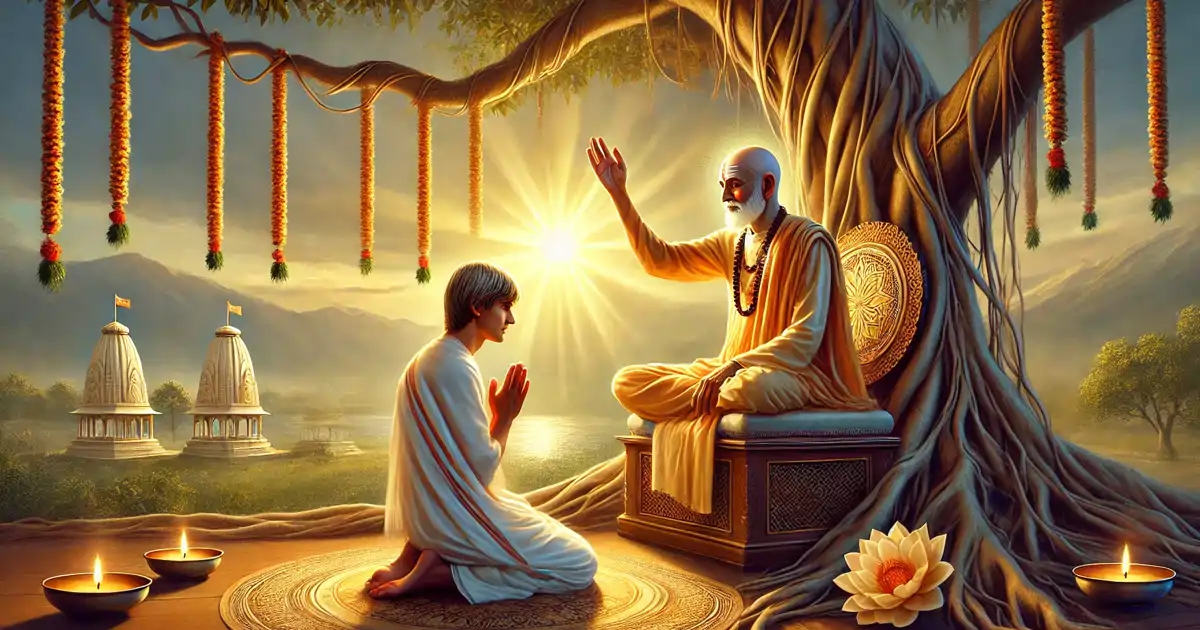
Therefore, the implication is that we should surrender to the guru with all our hearts. The guru will destroy the disciple’s sins, but only when the disciple truly surrenders, has complete faith in the guru’s words, and acts according to his teachings. It should not be like saying, “Your decision is absolutely right, but the drain will remain where it is.”
Rameshwar Singh
Summary
The author first came into contact with Sri Guru Maharaj Ji in 1986 and has since witnessed numerous miracles and divine interventions. Sri Guru Maharaj accurately predicted future events, healed ailments, and resolved issues even without being asked. A significant turning point was a knee injury that was miraculously healed overnight after a vision of Sri Guru Maharaj, followed by the resolution of a long-pending pension case. These experiences cemented the author’s faith in Guru Maharaj’s divine presence and guidance. Initially influenced by various philosophical ideologies, including atheism and spiritual skepticism, the author struggled to form a definitive belief in God, deities, the soul, or reincarnation. However, through Sri Guru Maharaj’s teachings and direct experiences, all doubts vanished, and faith in Sanatan Dharma became unshakable. The author now believes that God and the Guru, ever-present and infinitely compassionate, break even the laws of nature to uplift devotees.
The Gita teaches that the Supreme resides in the hearts of all beings and governs their actions according to their nature. Surrendering to God does not negate free will but aligns human actions with divine will. Sri Guru Maharaj emphasized that man is bound to experience the fruits of past actions but is entirely free to shape his future through righteous deeds. The essence of surrender is realizing that everything belongs to God, renouncing ego, and accepting His will with joy. Lord Krishna in the Gita distinguishes between surrendering to the omnipresent Supreme and surrendering to His personal form, with the latter being the highest form of devotion. Similarly, surrender to a realized Guru is essential for spiritual progress. Only through complete trust and adherence to the Guru’s teachings can one attain true liberation. The teachings of Sri Guru Maharaj reaffirm the eternal wisdom of Sanatan Dharma and the Gita, guiding devotees to peace and self-realization.
Important Points
- Sri Guru Maharaj’s presence and teachings have transformed the author’s life.
- Miraculous healings and fulfilled predictions confirm Guru Maharaj’s divine powers.
- Philosophical doubts about God and the soul vanished through Guru Maharaj’s guidance.
- The Bhagavad Gita teaches surrender to the Supreme as the highest path to liberation.
- Guru Maharaj emphasized that while fate binds past actions, man is free to shape his future.
- True surrender means relinquishing ego and accepting divine will with joy.
- The Gita highlights both formless and personal aspects of the Supreme, the latter being superior.
- The presence of God is universal, but devotion and faith manifest Him within the heart.
- Arjuna’s transformation in the Gita demonstrates the power of divine guidance.
- Meditation, Jnana, Karma, and Bhakti Yoga lead to liberation, but surrender to God is supreme.
- Guru Maharaj’s teachings align with the highest wisdom of Sanatan Dharma.
- The importance of Guru Seva is emphasized as essential for spiritual growth.
- Human suffering and joy are results of past karma but can be transcended through devotion.
- Recognizing God’s presence in all beings eliminates jealousy, ego, and division.
- The Guru destroys disciples’ sins only when they fully surrender and follow his teachings.