Book 9 – Message Of The Gita
I have had a passion for reading the Shrimad Bhagavad Gita since childhood. Even though I didn’t understand the meaning of the verses, reading the Gita brought me immense joy and peace.
I have read the words of many saints and listened to numerous discourses, but the way Sri Guru Maharaj, Swami Sudarshanacharya Ji, embodied and conveyed the message of the Gita is unparalleled. His life is a living example of the Gita’s teachings. If I say that the message given by the Supreme Yogi Lord Krishna through Arjuna 5000 years ago, for the welfare of humanity, is being conveyed today by our Guru Maharaj for the material and spiritual upliftment of mankind, it would not be an exaggeration. Guru Maharaj worked day and night in the construction of Sri Siddhadata Ashram, extracting stones from rocky ground with his own hands, working tirelessly through the night. He spent hours on the gaddi solving people’s material problems and scattered spiritual pearls among his listeners through his discourses. Guru Maharaj’s goal has always been that his disciples become strong both materially and spiritually, ensuring a peaceful and joyful existence in both this world and the next, while fulfilling their worldly responsibilities and achieving the ultimate goal of liberation.
In this booklet, we will attempt to interpret some important verses of the Gita in accordance with Sri Guru Maharaj’s messages, including his discourses and the inquiries and resolutions provided to his audience. We hope readers will benefit from this.
The Shrimad Bhagavad Gita holds a unique place in world literature. It is the divine utterance of God Himself, given for the welfare of humanity through Arjuna. In this small text, God has imparted profound and extraordinary feelings that no one has fully grasped or can ever grasp.
Sage Patanjali defined yoga as the cessation of the modifications of the mind – “Yoga: Chitta Vritti Nirodha.” In the Gita, yoga is described as equanimity – “Samatvam Yoga Uchyate.” To experience equanimity, the Gita describes three paths of yoga – Karma Yoga, Jnana Yoga, and Bhakti Yoga. The gross, subtle, and causal bodies have an inseparable relationship with the world. Therefore, engaging them in the service of others is Karma Yoga; detaching oneself from these bodies and remaining in one’s true nature is Jnana Yoga; and surrendering entirely to God is Bhakti Yoga. To achieve self-realization, a person possesses three powers – the power to act (Bala), the power to know (Jnana), and the power to believe (Vishwas). The power to act selflessly in service to the world is Karma Yoga; the power to know one’s true nature is Jnana Yoga; and the power to believe, by recognizing God as one’s own and oneself as belonging to God, is Bhakti Yoga.
In addition to these three yogas, the Gita also describes other practices like Yajna (sacrifice), Dana (charity), Tapas (austerity), Dhyana (meditation), Pranayama (breath control), Hatha Yoga, and Laya Yoga. This is because Arjuna’s questions in the Gita are not about war but about spiritual welfare, and God’s purpose in delivering the Gita was not to instigate war. Arjuna sought his own welfare (2/7; 3/2; 5/1). Therefore, the Gita briefly mentions all the spiritual practices described in the scriptures that are conducive to welfare. This makes the Gita particularly revered among practitioners of different faiths and philosophies.
The cause of a soul’s bondage is the false notion that “I am the body and the body is mine.” This misconception binds the soul. Liberation comes from the realization that “I am not the body, and the body is not mine.” Because a belief that is not accepted ceases to exist, as explained in the Gita. An ignorant person identifies with the body and its actions – “Ahamkara Vimudhatma Kartaham Iti Manyate” (3/27) – but a wise person does not – “Naiva Kinchit Karomi Iti Yukto Manyeta Tattvavit.” To dispel a false belief, it is necessary to adopt a true belief.
Desire for worldly pleasures, hopes, and experiences makes it difficult to look beyond them. As long as the mind is focused on worldly pleasures, one cannot turn inward to understand their true nature. The attachment to perishable objects prevents the realization of the eternal nature of God. However, a strong desire to experience this eternal nature can destroy worldly attachments.
“He who performs all actions for My sake, whose supreme goal is Me, who is devoted to Me, free from attachment, and free from enmity toward all beings, attains Me, O Pandava.”
“He who performs all actions for My sake, whose supreme goal is Me, who is devoted to Me, free from attachment, and free from enmity toward all beings, attains Me, O Pandava.”
Matparah – one whose ultimate refuge is only Me, the Supreme. Such a devotee is ‘Matparah.’
Madhbhaktah – one who is solely devoted to Me, who has established a firm connection with Me, believing that “I belong only to God, and God alone belongs to me.” This exclusive belonging leads to intense love for God, as what is considered one’s own is naturally dear.
Nirvairah Sarvabhuteshu – A devotee, by being devoted to God, performing actions for God, and being entirely dependent on God, loses all attachment, desire, and affection for the world. These three create worldly bonds. Due to intense love for God, the devotee loses attachment and sees God in all beings. Even if someone harms him, he harbors no enmity. He sees it as God’s will and grace. Such a devotee is called ‘Nirvairah Sarvabhuteshu.’
Sa mameiti – such a devotee attains Me.
Humans possess two powers: the power to think and the power to perceive. The power to think should be used to reflect on God’s attributes. When encountering any special quality, greatness, or extraordinariness in a person or thing, attribute it to God and reflect on God. This is why Lord Krishna described His divine attributes in the tenth chapter.
The power to perceive should be directed towards God. Just as there are many forms and figures in the divine, eternal, infinite universal form of God, the world is a part of that form. Thus, the world, with all its names and forms, is a manifestation of God.
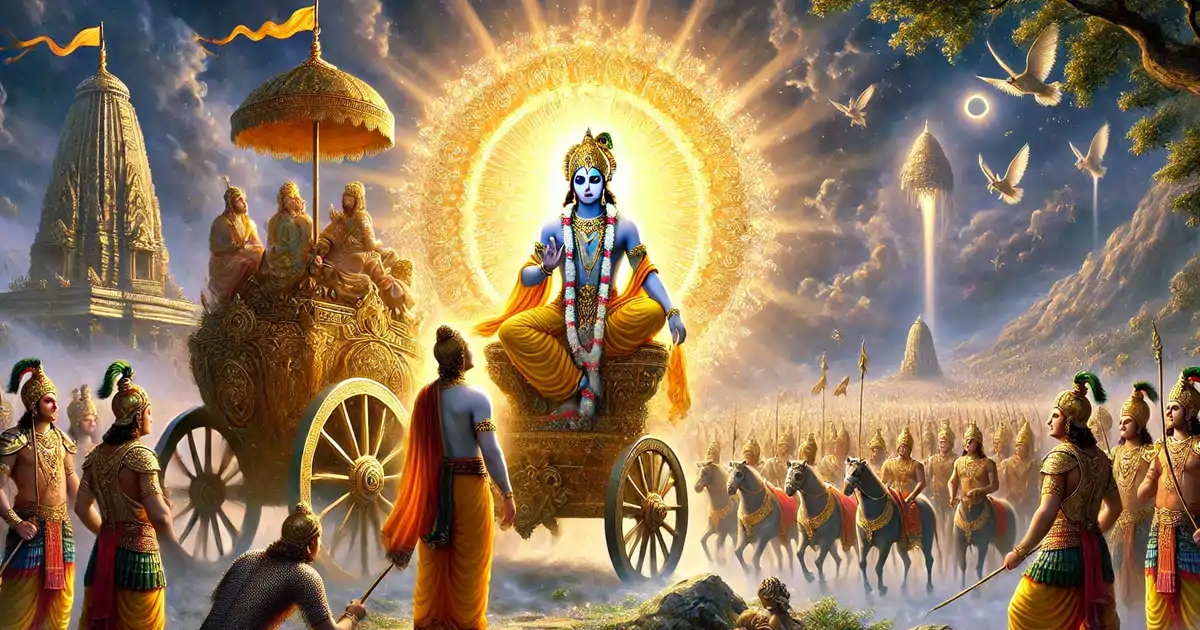
Arjuna prayed twice for these two insights. In the seventeenth verse of the tenth chapter, he asked, “O Lord, how should I meditate on You?” To direct the power of thought, Lord Krishna described His divine attributes. In the eleventh chapter, Arjuna expressed a desire to see God’s form. In response, Lord Krishna revealed His universal form and granted Arjuna divine vision to perceive it.
Thus, a practitioner should not spend their power of thought and perception on anything other than God. They should meditate on God and perceive God in everything.
“O Arjuna, the Lord dwells in the hearts of all beings, directing their wanderings according to their karma. Seek refuge in Him alone with all your heart. By His grace, you will attain supreme peace and the eternal abode.”
This verse implies that we should not associate our sense of self and possessions with the body but seek refuge in God. Our minds should meditate on God, our bodies should worship Him, and we should joyfully accept all His decrees, recognizing them as His blessings meant for our ultimate welfare.
In this verse, Lord Krishna urges Arjuna to seek refuge in the omnipresent God. This might raise a doubt: is Lord Krishna not God Himself? If He were God, why would He ask Arjuna to seek refuge in someone else?
We should note that Lord Krishna referred to seeking refuge in the omnipresent God as “Guhyadguhyataram” (18/63), meaning more confidential than the confidential, but referred to seeking His own refuge as “Sarvaguhyatamam” (18/64), meaning most confidential of all. This distinction establishes the superiority of the personal form of Lord Krishna over the impersonal omnipresent God.
In reality, the indwelling God and Lord Krishna are entirely identical. The God who resides in everyone’s heart as the indweller is Lord Krishna, and Lord Krishna is the indwelling God in everyone’s heart. He stated:
“I am seated in the hearts of all.”
Arjuna sought guidance for his spiritual welfare from Lord Krishna, who then explained various paths of spiritual practice – Jnana Yoga, Karma Yoga, Bhakti Yoga, Samata Yoga, Dhyana Yoga, Laya Yoga, Ashtanga Yoga, Yajna, Dana, Tapas, etc. The highest path, as described by Lord Krishna, is surrender to the personal form of God. He called surrender to the impersonal, formless Brahman “Guhyadguhyataram,” while surrender to Himself is “Sarvaguhyatamam.” The essence of the Gita is encapsulated in the 66th verse of the 18th chapter.
We should also remember that the Gita’s teachings were delivered by a guru to his disciple:
Sishyaste’ham shadhim maam tvam prapannam
I am your disciple; instruct me, for I have taken refuge in you
Thus, surrender to the guru is also essential. The guru will destroy the disciple’s sins, but only when the disciple truly surrenders to the guru, has complete faith in his words, and follows his teachings without reservation.
Summary
The Shrimad Bhagavad Gita has been a source of immense peace and joy for the author since childhood, despite not initially understanding its meaning. Over time, the teachings of Sri Guru Maharaj, Swami Sudarshanacharya Ji, brought deeper insight into the Gita, as his life exemplified its principles. His selfless dedication to the construction of Sri Siddhadata Ashram and the well-being of his disciples demonstrated the Gita’s philosophy in action. The Gita’s teachings, given by Lord Krishna for humanity’s welfare, continue to guide spiritual seekers today, emphasizing both material and spiritual upliftment. This booklet aims to interpret key verses of the Gita in alignment with Guru Maharaj’s teachings, drawing from his discourses and resolutions to common spiritual inquiries.
The Gita presents three primary paths of yoga—Karma Yoga (selfless action), Jnana Yoga (knowledge), and Bhakti Yoga (devotion). It also discusses additional practices such as Yajna (sacrifice), Dana (charity), Tapas (austerity), and Dhyana (meditation) for spiritual advancement. The cause of bondage lies in identifying with the body and worldly attachments, while liberation comes through surrender to God. The highest teaching of the Gita, “Sarva-dharman parityajya,” encourages surrendering all attachments to the Supreme, ensuring ultimate peace. Lord Krishna’s distinction between seeking refuge in the formless Brahman and the personal deity emphasizes devotion to His divine form. The role of the Guru is also crucial in guiding disciples toward spiritual realization. By surrendering to the Guru with unwavering faith, one’s sins are destroyed, leading to true liberation.
Important Points
- The Gita’s teachings remain relevant for spiritual and material well-being.
- Swami Sudarshanacharya Ji embodied the essence of the Gita in his life and teachings.
- The three main yogic paths—Karma Yoga, Jnana Yoga, and Bhakti Yoga—lead to liberation.
- Identifying with the body creates bondage, while realization of the self brings freedom.
- Surrendering all attachments to God ensures liberation and ultimate peace.
- The Gita describes additional spiritual practices such as Yajna, Dana, and Dhyana.
- True devotion is surrendering entirely to God and acting selflessly.
- Lord Krishna highlights the superiority of devotion to His personal form over formless Brahman.
- Seeking refuge in the omnipresent God leads to peace and the eternal abode.
- Arjuna’s transformation from doubt to conviction in the Gita shows the power of divine guidance.
- The highest teaching of the Gita is encapsulated in Chapter 18, Verse 66.
- The role of the Guru is indispensable in attaining spiritual knowledge and liberation.
- Disciples must surrender fully to the Guru and follow his guidance for true transformation.
- The power of thought should be directed towards contemplating God’s divine attributes.
- Recognizing the world as a manifestation of God enhances devotion and spiritual vision.