Book 10 – Questions & Answers
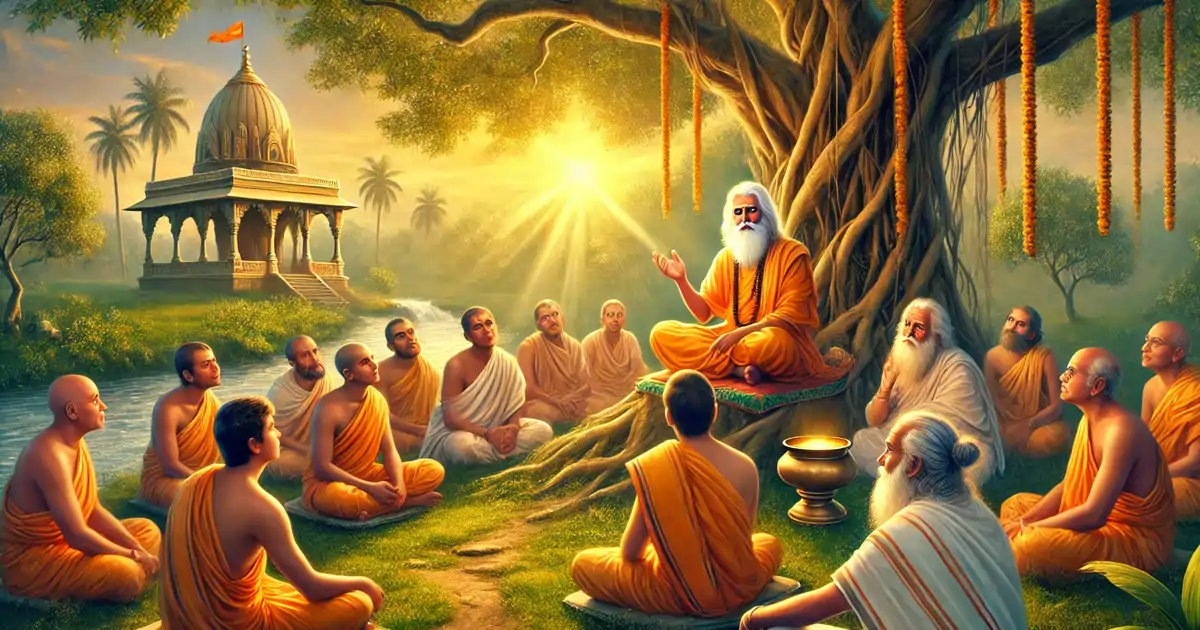
Question: Which is superior, service or remembrance?
Answer: Service and remembrance are complementary to each other. Neither is lesser nor greater than the other because they both are incomplete without each other. Therefore, they are complete only when combined. Without service, remembrance is incomplete; it does not lead to salvation, progress, or peace. Merely performing service does not bring peace. Therefore, these two complement each other, like the heart, kidneys, liver, and lungs. If the kidneys fail, can the heart function alone? Similarly, if the heart fails, can the kidneys function alone? They are complementary and cannot function without each other. Similarly, service without remembrance and remembrance without service are both incomplete. However, remembrance does not bring service, but service automatically brings remembrance. Therefore, the primary part is service. They are incomplete without each other. In a wheel, there is a small pin; without it, the wheel does not move, although it is a small thing. The main point is that remembrance automatically comes through service, as our Acharya Ji Maharaj, the spokesperson and creator of Jagadguru ShriMath, Ramanujacharya Ji Maharaj has written —
Kaikaryam Lakshan Vilakshan Moksha Bha
The one who possesses extraordinary qualities (vilakṣaṇa lakṣaṇa) and engages in divine service (Kaikarya) is blessed with Moksha (liberation)
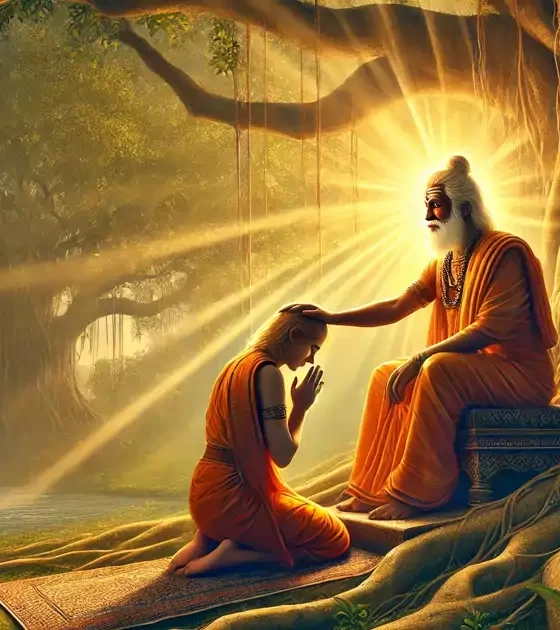
Kaikaryam service is a smaller task. Kaikaryam is like this: “Son, clean the latrine-bathroom;” he says, “Alright, Guru Ji.” “Oh, go and bathe the deity;” he says, “Alright.” “Fetch water for us to bathe.” “Alright, Maharaj.” Oh! Today, wash our head. He said, “Alright, Maharaj.” So, from washing the head to cleaning the latrine-bathroom is called “Kaikaryam,” which means not counting small or big in service, that word is called “Kaikaryam.” So “Kaikaryam Lakshan Vilakshan Moksha Bhaj,” the disciple who acquires the characteristic of Kaikaryam, his state becomes extraordinary and he becomes eligible for salvation. Here, the context of the name has not come at all. Our commentator Ramanujacharya Ji says that only after acquiring the feeling of Kaikaryam does the soul attain salvation. The name is also taken for salvation and Kaikaryam also leads to salvation because in doing Kaikaryam, the name itself comes. When you do Kaikaryam with selfless feeling, then Jai Gurudev, Jai Shri Hari, Jai Shri Narayan, Jai Dev, Jai Devi will automatically be there. So, service itself calls the name. Just like in fatigue, you say “Haye Ram, now we are tired, let’s sit down.” That fatigue has called Ram. If you do not serve, the Lord will not come, never come. Therefore, the main part is service, and its supportive complementary name is. Serve with the body and remember with the mind. Every saint has said this. Baba Nanak Sahib says serve with the body and remember with the mind. Both of these are beneficial for you.
Question: Why are rituals like worship stopped at the time of impurity due to birth or death?
Answer: This is a common doubt. This is a common matter. It is not because of impurity. While carrying the corpse on the shoulder, it is said that “Ram Naam Satya Hai” (The name of Ram is the truth), “Speak the truth, the time has come,” “Govind Naam Satya Hai” (The name of Govind is the truth). So, it proves that rituals are not stopped for the dead.
The rituals and prayers are stopped after death because, for 4 or 12 days, we should focus on the funeral rites; we should think about and reflect on the departed soul’s salvation. Who says that rituals and prayers stop at that time? The Garuda Purana, which is the foremost among the 18 Puranas and Garuda, the vehicle of Lord Narayana, says that the recital of the Purana begins on the same day. Who told you that rituals and prayers stop? The rituals and prayers for the deity are stopped so that for a day or two, we can mourn the soul, and by mourning, contemplate their journey. Therefore, you are given this time. During the birth of a child, rituals are stopped for a day or two because it is a time of great joy, and there are also certain traditional observances. Otherwise, chanting the name of God is never forbidden in the scriptures, no saint forbids it, nor do the gurus. You can continue mental remembrance wherever you are; for example, when taking the corpse, people say, “Ram Naam Satya Hai” (The name of Ram is the truth). So, there is no prohibition on remembering God’s name. Sutak and Patak are two terms. The scriptures say that during Sutak (period of impurity after birth) and Patak (period of impurity after death), do not perform personal deity worship because it is a time of mourning and great sorrow, and during the birth of a child, it is a time of great joy. Therefore, rituals are stopped during these times. Otherwise, the chanting of God’s name continues. After death, the chanting happens every day, and the recitation of the Garuda Purana begins on the third day. There is morning and evening chanting. The story of Lord Narayana is recited, with dialogues from the Garuda Purana, written by Vedavyasa.
Therefore, there is no prohibition anywhere, my dear. I mentioned that there are two terms, “sutak” and “patak.” “Sutak” occurs at birth and “patak” at death. The religious scriptures have stated that offering food to our idols, bathing them, changing their clothes is not because God is happy or sad. In “sutak,” it is prohibited for one day, two days, or three days, and in “patak,” it is for 13 days or one day. Both are valid; either one day or 13 days.
Question: Can wearing gemstones like diamond, emerald, coral, sapphire, pearl, etc., remove problems?
Answer: It depends on one’s belief. Those who do not possess divine-like qualities in gemstones such as sapphire, diamond, pearl, emerald, topaz should wear them, as they are related to gems. And those who have complete faith in their guru and God, whether they wear them or not, like these hands (indicating his hands) always remain bare.
Question: Want to know the difference between “Naam” (Name) and “Shabd” (Word).
Answer: My dear, both “Naam” and “Shabd” are the same.
Shabd is the earth, Shabd is the sky. Shabd is the light of Shabd.
“Shabd” is the name of the “Naam” and “Naam” is also “Shabd.” There is no difference between “Naam” and “Shabd.” The word is the same, and the name is also the same. Many saints have called it “Shabd,” some have called it “Naam.” Both are synonyms. They are not different.
Question: Is it necessary to receive the initiation of a name? Many gurus give the initiation of a name on the microphone. Is this according to the scriptures?
Answer: My dear, receiving the initiation of a name is very necessary. When a child is born, the parents must have given the child a name. This is a materialistic matter. Without receiving a name, the soul cannot be blessed. God explained this at the beginning of creation. When the creation came to an end, each phase passed, and after each phase – again Reva: when the resolve to start the creation anew was made, the goddess began to weep. She wept and said, “Lord! You are creating the same creation again, that’s why I am crying. I will have to cry.” At that time, the practice of giving the initiation of a name was established. God said that by performing five types of rituals, namely, the initial fire sacrifice, the expiatory fire sacrifice, wearing the sacred thread, and adorning them with marks like the tilak, and by engraving with the conch and discus, and explaining the meaning of the eight-lettered mantra. By chanting that mantra, the soul never goes to hell, does not face great calamities, does not suffer any kind of disturbance or illness. If due to past karma it happens, it stops after a little. Therefore, receiving the initiation of a name is very necessary.
The initiation of a name is not given over the microphone. Over the microphone, songs are sung, and I have delivered discourses over the microphone.
Baba Nanak Dev Ji gives evidence of the initiation of a name. Read on page 1362 of the original copy of Guru Granth Sahib. Baba is writing –
Jagadīśvara ghaṭ ghaṭ pūra rahe mere jīvana prāṇa,
The Lord of the Universe (Jagadishwara) is present in every heart,
Bhava bandhana mere kaṭe jab mantra diyo guru kāna
My bondage to worldly existence was cut when the Guru whispered the divine mantra into my ears
The gift of a name (Naam Daan) happens only in the ear. The unstruck sound (Anahad Naad) awakens only when the mantra is given in the ear. Through a microphone, it is just a story. This is not Naam Daan. Naam Daan is given through the Panch Sanskar method in the ear, and that is called Naam Daan. The name is just the name, but what is the gift? That sage, that monk, that guru takes a vow that the penance I have done in my life, I give a part of it to this person. So, along with the name, the gift of penance is given.
Question: What is the difference between a guru and a true guru? What is the need for a true guru in life?
Answer: My dear! When we read Guru Granth Sahib, it mentions four gurus — Guru Sharanam, Sadguru Sharanam, Adi Guru Sharanam, and Jagadi Guru Sharanam. It talks about four gurus. You mentioned two gurus. So, one can be called the guru of materialism who gives worldly education, who can be many. The one who teaches the work of the world, teaches business, teaches reading and writing, teaches living, that is the guru; as Baba said, Guru Sharanam. His guru was Pandit Hardatt Shastri Ji who taught him the Vedas, taught him the Puranas. He was a guru.
The true guru was referred to for Bhakta Renuji who gave him Naam Daan and showed him a path. By remembering the name, you will attain salvation. There can be many gurus of materialism, but there is only one guru in the spiritual world who gives the right path.
Question: After performing the Pind Daan at Gaya, should we continue to perform Pind Daan?
Answer: My dear! More is the fruit of more. If you want to bid farewell to the departed souls by performing Pind Daan at Gaya Ji, it means that you do not love your ancestors. Leaving them in the jungle, you bid them farewell. Oh, you should perform rituals for Badrinarayan, do it at other places, you have turned the ghosts into ancestors. If you have provided Pind Daan for the ancestors, they have become divine ancestors. Ancestors are of nine types. There is not just one type of ancestor. If you performed Pind Daan at Gaya, you have turned a ghost into an ancestor. If you provided Pind Daan to the ancestors, they have become divine ancestors. And if you provided Pind Daan for the divine ancestors, they have become gods. But you cannot abandon them. For them, you must provide food, water, and Pind Daan. This is the scriptural view. I do not speak my own opinion. I only speak the scriptural view. I presented the views of many scriptures the day before yesterday. I will repeatedly say that you should continue to perform Pind Daan. again.” The disciple replied, “I will not eat or drink anything without the guru’s permission.”
Summary
Sri Guru Maharaj explains that both service (Seva) and remembrance (Naam Smaran) are interdependent and essential for spiritual progress. Neither can be considered superior to the other, as true remembrance arises naturally from dedicated service. Through service, devotion deepens, leading to the automatic remembrance of God. Ramanujacharya emphasizes that engaging in divine service (Kaikaryam) leads to salvation, making it an essential aspect of spiritual practice. Guru Maharaj further clarifies that rituals are paused during periods of impurity (Sutak and Patak) not because of restrictions on devotion, but to allow time for mourning or celebrating. The chanting of God’s name, however, is never prohibited, and scriptures like the Garuda Purana continue to be recited after a person’s passing.
Regarding astrology and gemstones, Guru Maharaj states that faith in God and the Guru renders external remedies like gemstones unnecessary. The distinction between “Naam” (Name) and “Shabd” (Word) is clarified as being synonymous, both representing the divine essence. Receiving a Guru’s initiation (Naam Daan) is emphasized as crucial for spiritual advancement, as true Naam Daan transmits spiritual power and is traditionally given privately in the ear, not publicly over a microphone. The need for a true Guru is highlighted, distinguishing between worldly teachers and a spiritual Guru who leads one toward salvation. The practice of Pind Daan is encouraged beyond just a single ceremony at Gaya, as continual offerings ensure the well-being of one’s ancestors, elevating them to higher realms.
Important Points
- Service (Seva) and remembrance (Naam Smaran) are complementary and incomplete without each other.
- True service naturally leads to remembrance, making it the foundation of spiritual practice.
- Rituals are paused during impurity periods to allow focus on mourning or celebration, but God’s name is never restricted.
- The Garuda Purana is recited after death, confirming that devotion continues.
- Wearing gemstones may help some, but faith in Guru and God surpasses such remedies.
- “Naam” (Name) and “Shabd” (Word) are synonymous, representing divine energy.
- Naam Daan (Initiation into the Divine Name) is essential and must be given by a Guru privately, not publicly.
- True Gurus lead to liberation, while worldly teachers only impart material knowledge.
- The four categories of Gurus mentioned in Guru Granth Sahib highlight different spiritual roles.
- The importance of continuous Pind Daan is emphasized, as it elevates ancestors to divine status.
- The soul’s journey after death depends on the devotion and offerings made by their descendants.
- Spirituality is about devotion, selfless service, and deep surrender to the divine.
- Rituals and astrology are secondary to unwavering faith in God and the Guru.
- The ultimate goal of human life is salvation, not material achievements.
- Accepting divine surrender ensures spiritual liberation and inner peace.