Book 10 – Message Of The Gita
Man-manā bhava mad-bhakto,
Fix your mind on Me, be devoted to Me,
Mad-yājī māṁ namaskuru,
Mām evaiṣyasi satyaṁ te,
Pratijāne priyo ’si me
Worship Me and offer obeisance to Me.
You will surely come to Me—this is My solemn promise,
For you are dear to Me
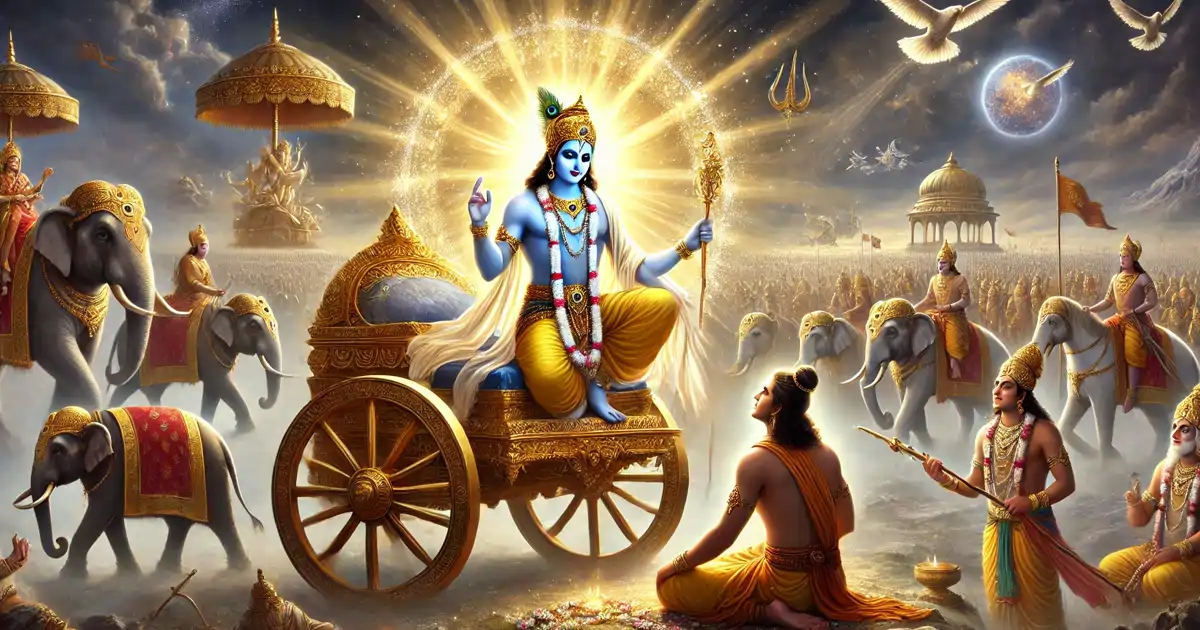
Lord Krishna says to Arjuna — Become my devotee, let your mind be in me, worship me, and bow down to me. By doing this, you will attain me alone — this I solemnly promise you because you are very dear to me.
In the 63rd verse of this chapter, the Lord uses the term ‘Guhyad Guhyataram.’ This means that this knowledge is more secret than the most secret. The Lord called ‘Karma Yoga’ secret knowledge but described surrender to the manifest, attribute-bearing Supreme God as ‘Sarvaguhyatamam,’ meaning even higher than the most secret. This shows that the essence of the Gita is hidden in this verse and the next.
Mamnana Bhav: By considering God as one’s own, love for Him arises naturally. Then, the mind automatically contemplates God’s name, qualities, influence, pastimes, etc. Devotion to God then occurs with great eagerness and dedication.
Madbhakta: The aspirant must first change their sense of ego (I—mine). The feeling should remain that I belong to God.
After marriage, the girl changes her sense of ego and completely detaches from her father’s lineage. Similarly, the aspirant should change their sense of ego to think that I do not belong to the world, I belong to God. Changing the ego naturally changes attachment.
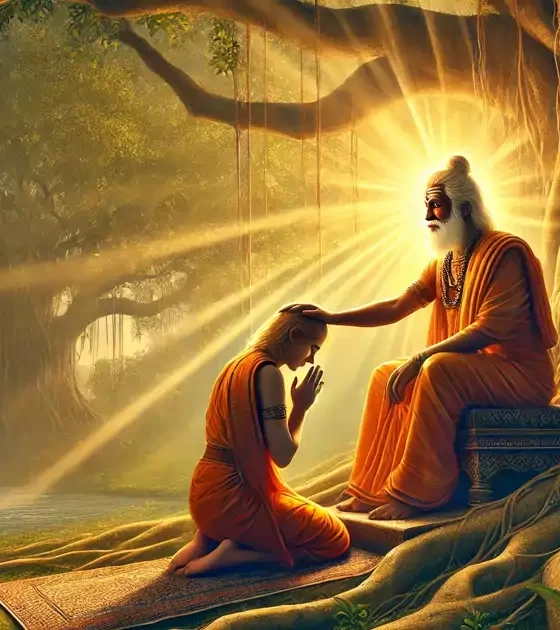
Meyaji:— Upon accepting God as one’s own, all worldly tasks transform into acts of serving God. In other words, the tasks that the seeker previously performed as worldly duties now become tasks for God.
Maa Namaskuru:— By offering a full prostration at the feet of God, a person should become completely devoted to God. This means believing that God, by sending favorable or unfavorable circumstances, destroys one’s merits and sins, purifies them, and draws them to His feet. Having such steadfast faith is true devotion to God’s feet.
Mamevaisyasi Satyam Te Pratijane:— God says that by worshiping Me in this way and by bowing to Me, you will attain Me, and I promise this truthfully.
Priyosi Me:— The soul is very dear to God. Only the soul turns away from God and starts considering the ever-changing world (wealth, family, body, senses, mind, intellect, life force, etc.) as its own, while the world has never considered the soul as its own. This is the biggest mistake of the soul, that it considers the ever-changing relationship with the world as eternal. This assumed relationship is the cause of ignorance. Therefore, by renouncing this assumed relationship, and recognizing the real and eternal relationship we have, we should take refuge in God.
Sarvadharmanparityajya Mamekam Sharanam Vraja,
Abandon all duties (dharmas) and surrender to Me alone,
Aham Twam Sarvapapebhyo Mokshayishyami Ma Shuchah
I will free you from all sins; do not grieve
It is also said in the Ramcharitmanas:
Sanmukh hoi jīv mohi jabahi,
The moment a soul turns towards Me,
Janma koṭi agh nāsahi tabahi
Sins of millions of lifetimes are destroyed instantly
Sarvadharmaparityajya: — For the sake of protecting which religion the Lord incarnates, would the Lord ask to abandon that religion? Absolutely not. Would the Lord ask Arjuna to abandon caste and family duties? Absolutely not. Arjuna considered it more honorable to leave the warrior’s duty and live in the forests, but the Lord said that if you do this, you will incur sin, meaning you will go to hell, and if you fight, you will go straight to heaven. So, what kind of religion is the Lord asking to abandon? Shri Guru Maharaj explained to us in satsang that the Lord is asking Arjuna to renounce the qualities and duties of the senses. The senses are a part of nature. This is the rule — ‘Pigeons go with pigeons, falcons go with falcons.’ That means pigeons will move with pigeons, and falcons with falcons. Similarly, the senses will always pull the living being towards nature. That is their duty.
Arjuna threw down his weapons and said that fighting is unrighteous and not fighting is righteous. The Lord said that you are a warrior, running away from battle is cowardice, unrighteousness, and for you, fighting is righteous. The Lord said that O Arjuna if you win in the battle, you will enjoy the kingdom, and if you die in the battle, you will attain heaven.
In the second chapter of the Gita, Arjuna said —
Dharmasammūḍha-cetāḥ
Mind deluded by dharma
Regarding dharma, my mind has become confused. Another meaning of ‘Sarvadharmaparityajya’ is that you should not get caught up in the cycle of dharma and adharma. Whatever I tell you to do is dharma.
Kārpaṇya-doṣopahata-svabhāvaḥ,
My nature is overcome by weakness,
Pṛcchāmi tvāṁ dharma-sammūḍha-cetāḥ,
Śiṣyas te ’haṁ śādhi māṁ tvāṁ prapannam
and my mind is confused about dharma (righteous duty),
I ask You to tell me decisively what is truly beneficial for me,
I am Your disciple; instruct me, for I have taken refuge in You
Arjuna called himself a surrendered disciple. I am your disciple; instruct me who has taken refuge in you.
The conversation in the Gita is between the disciple and the guru. The meaning is that, O human! You will not be able to decide between dharma and adharma. What the scriptures say, what the guru says, that is dharma.
‘Sarvadharmaparityajya’ also means that you should perform sacrificial rituals, charity, penance, etc., which are acts of dharma, but without attachment. Do those acts only for God. Performing dharma for oneself will not end the cycle of birth and death. Without ending the cycle of birth and death, the soul will never attain peace. The pain of birth and death will continue to afflict the soul.
The Lord says —
Yat karoṣi yad aśnāsi yaj juhoṣi dadāsi yat,
Whatever you do, whatever you eat,
Yat tapasyasi kaunteya tat kuruṣva mad-arpaṇam
Whatever you offer in sacrifice, whatever you give,
Whatever austerities you perform, O Kaunteya (Arjuna),
Do it as an offering unto Me
O Arjuna! Whatever actions you perform, whatever you eat, whatever you offer in sacrifice, whatever you give, whatever penance you do, offer all of it to me. That means, perform all those religious acts not for yourself, but for me.
Traividyā māṁ somapāḥ pūtapāpā,
Those who are well-versed in the three Vedas,
Yajñair iṣṭvā svargatiṁ prārthayante,
Te puṇyam āsādya surendra-lokaṁ,
Aśnanti divyān divi deva-bhogān
Who drink the soma juice and are purified of sin,
Worship Me through sacrifices, seeking the heavenly realms,
Having attained the meritorious world of Indra,
They enjoy the celestial pleasures of the gods in heaven
Te taṁ bhuktvā svarga-lokaṁ viśālaṁ,
Having enjoyed the vast heavenly pleasures,
Kṣīṇe puṇye martya-lokaṁ viśanti,
Evaṁ trayī-dharmam anuprapannā,
Gatāgataṁ kāma-kāmā labhante
Upon the exhaustion of their merit, they return to the mortal world,
Thus, those who follow the path of the three Vedas (ritualistic dharma),
And seek desires, attain only the cycle of birth and death
The Lord says that those who perform the rituals prescribed in the three Vedas, drink soma juice, and are free from sin, worship Me through sacrifices and seek to attain heaven; these men, having obtained the merits, attain the heavenly worlds and enjoy divine pleasures in heaven.
They, having enjoyed the vast heaven, return to the mortal world when their merit is exhausted. Thus, those who follow the three Vedas and take the path of desire and enjoyment, experience the cycle of birth and death repeatedly, as they go to heaven due to their merits and return to the mortal world when their merits are exhausted. O Arjuna! Perform your duty without desire.
“Surrender unto Me alone” — The Supreme is attained through exclusive devotion. The Lord emphatically says, surrender only to Me, think only of Me. By taking refuge in the deities, one should perform natural duties.
By surrendering to material objects, by surrendering to the world, O soul! You will not find peace. This is the essence of the Gita that by renouncing ego and attachment, surrender to the Lord.
Without surrender, the salvation of the soul is impossible. The essence of surrender is that O Supreme Soul! O Gurudev! I am yours. The guru principle and the supreme soul principle are one and the same, not different.
We should not worry about whether the Supreme Soul is mine or not. One should have the feeling that I belong to the Supreme Soul, I am for the Supreme Soul. This human body has been given to me by the Supreme Soul for service and remembrance. A girl leaves her parents and takes refuge in her husband. She serves him. She even renounces her gotra. She adorns herself for her husband, eats for her husband, and lives for her husband. She has nothing of her own. Even an ordinary husband fulfills every need of his wife. Will the Supreme Being, the Supreme Soul, not take care of us? Of course, He will. History is witness that the Supreme Father has plowed fields for His devotees, driven chariots, become a barber, and become a sari – what has He not done?
Ego is the biggest obstacle in surrender. The Supreme Soul does not tolerate ‘ego’ at all. It is essential to have the attitude of a ‘servant’.
What does God do for the surrendered devotee, this is described in many places in the Gita. God has shown many means and many paths for attaining the Supreme Soul; such as Sankhya Yoga, Karma Yoga, Samata Yoga, and so on. By following those paths, the Supreme position can be attained.
The responsibility to achieve is on the seeker. But in surrender, the responsibility for the welfare of the soul is on God.
The Lord says that those exclusive loving devotees who constantly think of Him with a selfless attitude, He personally takes care of their welfare. The meaning of “Yoga Kshemam” is that the responsibility for the welfare in this world and the next is entirely on God —
Ananyāś cintayanto māṁ ye janāḥ paryupāsate,
To those who worship Me with exclusive devotion,
Teṣāṁ nityābhiyuktānāṁ yoga-kṣemaṁ vahāmy aham
Always absorbed in My thought,
I personally carry what they lack,
And preserve what they have
The Lord says that if a devotee offers Him a leaf, a flower, fruit, or water with love and devotion, He accepts that loving offering presented by the devotee —
Patraṁ puṣpaṁ phalaṁ toyaṁ,
Whoever offers Me with devotion
Yo me bhaktyā prayacchati,
Tad ahaṁ bhaktyupahṛtam,
Aśnāmi prayatātmanaḥ
A leaf, a flower, a fruit, or water,
I accept that offering of pure love,
Given with a sincere heart
Then the Lord says — those who constantly fix their minds on Me and who dedicate their lives to Me, those devotees, by discussing My devotion among themselves, understand My influence, and while narrating My qualities and influence, they remain ever content and constantly delight in Me, Vasudeva. To those devotees who are constantly engaged in My meditation and who lovingly worship Me, I give the knowledge of the absolute truth, through which they come to Me. O Arjuna! To show compassion towards them…
Being situated in their hearts, I dispel the darkness born of ignorance with the shining lamp of knowledge —
Mac-cittā mad-gata-prāṇā,
“With their minds fixed on Me and their lives devoted to Me,
Bodhayantaḥ parasparam,
Kathayantaś ca māṁ nityaṁ,
Tuṣyanti ca ramanti ca
My devotees enlighten one another,
Always speaking of Me,
They rejoice and delight in Me
Teṣāṁ satata-yuktānāṁ,
To those who are constantly devoted to Me with love,
Bhajatāṁ prīti-pūrvakam,
Dadāmi buddhi-yogaṁ taṁ,
Yena mām upayānti te
I grant them the wisdom (buddhi-yoga),
By which they come to Me
Teṣām evānukampārtham,
Out of compassion for them,
Aham ajñāna-jaṁ tamaḥ,
Nāśayāmy ātma-bhāvastho,
Jñāna-dīpena bhāsvatā
I, dwelling in their hearts,
Destroy the darkness of ignorance,
With the shining lamp of knowledge
Ye tu sarvāṇi karmāṇi,
But those who surrender all their actions to Me,
Mayi saṁnyasya mat-paraḥ,
Ananyenaiva yogena,
Māṁ dhyāyanta upāsate
And regard Me as their supreme goal,
Worship Me with exclusive devotion
And meditate upon Me with undistracted yoga
Teṣām ahaṁ samuddhartā,
For them, I am the swift deliverer,
Mṛtyu-saṁsāra-sāgarāt,
Bhavāmi na cirāt pārtha,
Mayy āveśita-cetasām
From the ocean of birth and death,
O Arjuna, I quickly rescue those,
Whose minds are absorbed in Me
“I will deliver you from all sinful reactions” — Even after all the assurances mentioned above, Arjuna still seems not fully satisfied. At the beginning, Arjuna had said that by fighting, I will incur great sin, my entire family will go to hell, the women of the family will fall from their dharma, mixed classes will be born, and the ancestors will also fall to a degraded state…
You will attain it. Lord Krishna knew what was in Arjuna’s mind. He said, ‘Aham tvā sarva-pāpebhyo mokṣayiṣyāmi’ – I will absolve you of all your sins, not just those of this life but of countless lifetimes.
We get contented by acquiring wealth, family, honor, praise, luxuries, and transient pleasures. The ultimate happiness that comes only with liberation from the cycle of birth and death doesn’t attract our attention. This is the misfortune of the soul. Every saint says that, O human! While fulfilling your worldly duties, worship with a sense of surrender. But the fleeting and perishable pleasures of materialism prevent us from progressing towards the Divine. They neither become a support for the soul themselves, being perishable, nor do they allow the Eternal to become a support.
Regarding surrender, there is a proverb that once many sheep and goats went grazing in the forest. Among them, one goat got entangled in a vine while grazing. It took her a long time to free herself from that vine, and by then the other sheep and goats had returned home. It was getting dark. The goat, while wandering, reached the edge of a lake. On the wet ground near the shore, there was the imprint of a lion’s paw. The goat took refuge in that paw print and sat beside it. At night, wild animals like jackals, wolves, and tigers came to eat the goat. But the goat told them to check first whose refuge she was in before eating her. Seeing the mark, they said, “Oh, this is the refuge of a lion’s paw print, run away quickly! If the lion comes, he will kill us.” Thus, all the animals fled in fear.
In the end, the lion itself, whose mark it was, came and asked the goat — ‘How are you sitting alone in the jungle?’ The goat replied — ‘Look at this footprint and then speak. I am under the protection of the one whose footprint this is.’ The lion saw and said, ‘Oh! This is my footprint, this goat is under my protection!’ The lion assured the goat, ‘Now you do not be afraid, stay fearless.’
At night, when an elephant came to drink water, the lion told the elephant — ‘Take this goat on your back. Bring it to graze in the jungle. Always keep it on your back, otherwise, you don’t know who I am? I will kill you!’ Hearing the lion’s words, the elephant started trembling. He immediately picked up the goat with his trunk and placed it on his back. Now the goat, sitting fearlessly on the elephant’s back, would eat the top shoots of the trees and remain happy.
Khoj pakad vishram le, dhani mile lo aay,
Seek, hold on, and rest—your Master has arrived.
Gajiya gaj mastak chadhi, ghar pahunchi hai jaay
Like an elephant that climbs atop the royal seat, it reaches home
Similarly, when a person takes refuge in God, takes the support of His feet, he becomes fearless from all obstacles and hindrances. No one can frighten him, no one can harm him.
Sankhya Yoga, Karma Yoga, Samata Yoga, and other means of attaining God, among all these means, the primary means is surrender. Arjuna asked many questions about the means of his welfare, and the Lord answered them. It is clear that the essence of all means and the highest means is the exclusive surrender to God.
In the Gita, God has sung the praises of exclusive devotion extensively, such as the means to easily cross over the dreadful illusion is exclusive surrender (7/14). I am easily accessible to the one with exclusive consciousness (8/14); the supreme person is attained through exclusive devotion (8/22); I personally bear the yoga-kshema (maintenance and protection) of my exclusive devotees (9/22); through exclusive devotion, God can be known, seen, and attained (11/54); I quickly deliver my exclusive devotees (12/6 and 7); the means to transcend the qualities is exclusive devotion (14/26). Thus, by singing the praises of exclusive devotion, God explains the entire essence of the Gita here – ‘Take refuge in me alone.’ The implication is that I am both the means and the end.
‘Do not grieve’ – God says that if you surrender to me and still worry, it is an offense against me, it is your pride, and it is a trouble in surrender. Even after surrendering to me, if you do not have complete faith in me, it is an offense against me. Worrying about your faults is actually a sign of pride in your strength. Suffering is not a fault, worrying is a fault. Worry means that there is reliance on one’s strength within, and this is your pride. Worry means a lack of faith.
Even if your emotions, tendencies, and behavior are not purified, do not worry. God will take care of the worry. No one’s grief has ever been removed by material perishable objects. To grieve after taking refuge in God is a mistake. After becoming a surrendered devotee, whether it is the worldly or the otherworldly,
One should not worry about salvation, misfortune, or any such matters.
When there is firmness in the relationship with God, the dependence on the physical body of the world completely ceases. Then the desire to live, the fear of death, the attachment to action, and the greed for acquisition—all these four do not remain. The surrendered one becomes free from fear, worry, sorrow, and doubt.
God sees only the belongingness of a devotee, not the virtues or vices. In other words, God does not see the faults of a devotee. He only sees the sense of belonging that the devotee has with Him. A mother, even if her child is covered in mud, will immediately pick him up if something happens to him, because her sight is on the child, not on the mud.
The kitten relies on its mother. It has no worries. The baby monkey worries because it relies on itself. The surrendered devotee does not keep his will or his thoughts; he is content with whatever is God’s will.
It has been observed that people apply such tests: if this person is a devotee of God, then how did he get sick? If he worships God, why did he get a fever? Why did he suffer? Why did his son die? And so on. Applying such tests is foolishness. It is a very cheap mentality. Such people have never been near satsang. They do not know what devotion is or what surrender is.
Bharat Ji says –
Artha na dharma na kāma ruchi,
I do not desire wealth, dharma (righteousness), or pleasure,
Gati na chāhoṁ nirvāṇa,
Janam-janam rati Rām pad,
Yah varadān na ān
Nor do I seek the path to Nirvana.
From birth to birth, my only love is for the feet of Lord Ram,
This is the boon I seek, and no other
In Shrimad Bhagavad, God says that a devotee who surrenders to me does not desire the position of Brahma, the position of Indra, the sovereignty of the entire earth, the realms of the netherworld, all the yogic powers, or even liberation.
Summary
The discourse highlights the essence of surrender (Sharanagati) as taught by Lord Krishna in the Bhagavad Gita, emphasizing that true devotion is a state of complete reliance on the Supreme. It explains that remembrance and service are complementary, with service naturally leading to devotion. The highest form of surrender involves relinquishing ego, attachments, and worldly identifications, while fully dedicating one’s actions, thoughts, and will to God. Lord Krishna assures that those who surrender to Him alone are freed from all sins and worries, and He personally takes responsibility for their welfare. This principle of divine dependence is illustrated through various scriptural references and practical examples, such as the analogy of the kitten and the baby monkey, where the surrendered devotee trusts entirely in God’s grace.
Furthermore, the discourse stresses that the ultimate goal of human life is liberation, not just material success or temporary happiness. Performing actions with detachment and offering all efforts to God leads to true spiritual fulfillment. Rituals and dharma should not be performed with selfish motives but as acts of devotion. The key message is that faith in God transcends worldly struggles, and true peace is attained when one fully surrenders, trusting in divine wisdom. Surrender is not about passivity but about aligning one’s will with God’s, knowing that He will provide, protect, and guide His devotee beyond the cycle of birth and death.
Important Points
- True devotion (bhakti) involves fixing the mind entirely on God.
- Remembrance (Naam) and service (Seva) must go together for spiritual progress.
- Surrender (Sharanagati) means giving up ego and attachment to the world.
- All actions should be dedicated to God as an offering.
- Rituals and religious duties should be performed without selfish motives.
- Krishna guarantees protection and liberation to those who fully surrender to Him.
- Worry and anxiety indicate a lack of faith and are obstacles to surrender.
- Seeking material pleasures alone binds one to the cycle of birth and death.
- God does not look at a devotee’s faults but at their sense of belonging to Him.
- The ultimate goal of human life is liberation (moksha), not just worldly success.
- One should not be confused between dharma and adharma; listen to God’s guidance.
- Surrendering to material objects or worldly relations will not bring lasting peace.
- Even those with sinful pasts can attain salvation through exclusive devotion.
- Just as a wife serves her husband with love, a devotee should serve God.
- The Lord personally ensures the welfare of His surrendered devotees (Yoga-Kshema Vahamyaham).