Surrender – Satsung 2 (02 April 2000)

Just now, Pandit Lakshmichand Ji said in the hymn that the word ‘Refuge’ is paramount. This word is the essence of all devotion, all penance, the essence of all sacrifices, and the essence of all essences. There is no higher ultimate goal or ultimate means than this. No matter how much penance you do, how much yoga you practice, how much devotion you perform, how many sacrifices you make, you cannot attain the divine realm. By giving donations, you can enjoy the pleasures of being a donor, but you cannot attain that realm. And by doing devotion, you may get another opportunity, but you cannot attain the divine realm. The attainment of that realm is only through the word ‘Refuge.’ This refuge is the ultimate means. Lord Krishna also says in the final message of the Gita to Arjuna:
Sarva-dharmān parityajya mām ekaṁ śaraṇaṁ vraja.
Abandon all varieties of religion and just surrender unto Me.
Bhagavad Gita, 18/66
Give up all means because they do not attain God. If God could be attained by salvation, by means, then is it wealth that can be obtained by hard work? Absolutely not, it is only attained in refuge. There is no other means than refuge. Therefore, the word ‘Refuge’ that Pandit Lakshmichand Ji spoke of, today the scriptures, Puranas, and the opinions of saints all speak of refuge.
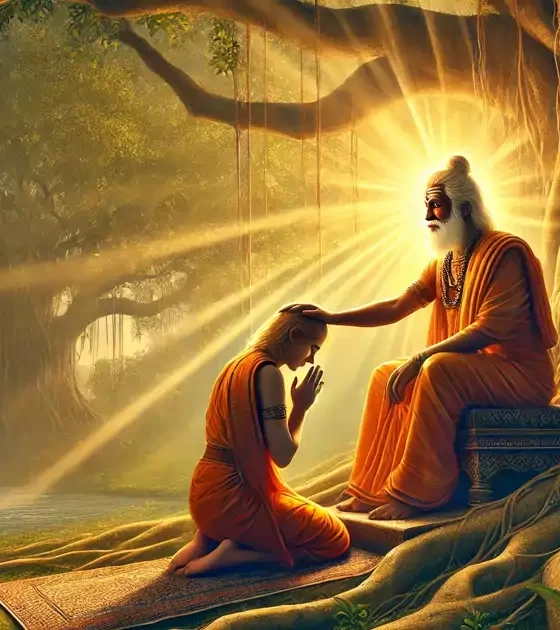
Devotees of the Lord, that is, my spiritual children! Offspring are born of sensual pleasures, but a saint, a guru, gives birth to spiritual offspring, that is, creates mental sons and daughters. That is why there is initiation. So, my spiritual brothers and sisters, today’s topic is kept on refuge.
My devotees of the Lord! We first take from Lord Shiva. When the highest penance is reached, Lord Narayana asks what boon you desire. Lord Shiva says in very simple words:
Bār-bār bar māngūṁ Hari dehu Shrīrang,
I repeatedly ask only for this boon, O Lord,
Pad saroja anapāyinī bhagati sadā satsaṅg.
Grant me the company of Your devotees and unwavering devotion at Your lotus feet.
O Lord who delights with Shri (Lakshmi), I ask of You only one prayer, only one boon. The word ‘Anapayani’ means — refuge. That is, O Lord! I want to accept Your refuge, and my mind always remains engaged in Your stories and events. May I get such opportunities repeatedly so that I keep listening to Your stories. May I always remain at Your lotus feet in refuge. After millions of years of penance, what did Lord Shiva ask for as a reward — refuge. He could have asked for wealth. Usually, He gives to the world, but He could have asked for a place like Vaikuntha for Himself. But no, He asked for refuge.
Prabhu rākhuṁ śaraṇa gahe kī lāj.
Lord, protect the honor of those who have taken refuge in You.
Devotees also say that they have come into refuge. Protect the honor of those who have taken refuge. Baba Nanakdev Ji says:
Hariji rākh lehu pat merī,
O Lord, protect my honor,
Thākur tab śaraṇāī āyo.
Thakur, I have come to Your refuge.
Guru Nanakdev Ji also accepted the word ‘refuge’ saying that I have done much, but now O Lord! I have taken refuge in You.
Tulsidas Ji accepted refuge and repeatedly with folded hands, he prayed:
Yah binatī Raghubīr gusāīṁ, aur ās viśvās bharoso, Hari jiv jaṛtāīṁ.
“This is my plea, O Lord Raghubir.
Chahauṁ na sugati, sumati, sampati kachu, siddhi sidhi vipul baṛhāīṁ.
Hetu rahit anurāg Rām pad, baṛhu anudin adhikāīṁ.
And with hope, trust, and faith, I rely on You, O Lord, to dispel my ignorance and stupidity.
I do not desire prosperity, wisdom, wealth, or vast accomplishments.
I desire pure, selfless love for the feet of Ram, which increases day by day.
May my surrender be at Your feet, and may that surrender continue to grow, never diminish. Both are the same prayer. That is, every saint and every scripture has described surrender as the supreme means.
The meaning of surrender is not merely saying, “I am your refuge, I am your refuge.” It is achieved by acceptance. Saying “I am surrendered, I am surrendered, I am surrendered” is merely a matter of the tongue. Until surrender is accepted by the soul, saying it millions of times with the mouth will not make you surrendered. And when the mind and soul accept that “O Lord! You are mine, and I am yours,” then surrender is achieved. Focus on just two words — “You are mine, I am yours.” If you say, “You are mine,” there is a bit of pride. If you say, “O Lord! I am yours,” there is no pride. It ends pride. It means, “Your will is how You keep me. Your will is how You keep me, I am yours.” This is called surrender. To achieve surrender, you don’t need to read any scriptures, Vedas, or Puranas. I know the Vedas, I know the Upanishads, I know Mimamsa, there is pride in this. Where there is pride, there is no God. They may fulfill desires, but they don’t meet. This is certain. They only meet when surrender is accepted.
In surrender, there is no need for special types of scriptures or special studies. There is no distinction between high and low, rich and poor. What Vedic studies did Gajendra undertake? What penance did he perform? What yoga did he practice? What Vedantic recitation or meditation was Draupadi doing? What contemplation was she doing? In the Ramayana, there is the story of Shabari. Lord Ram tells Sita to learn devotion from her and clearly says to Shabari:
Sun Shabarī mam bhāvinī.
Listen, Shabari, my beloved devotee.
The term ‘Bhavini’ means beloved. The one who pleases the mind is Bhavini. Poor Shabari was embarrassed; she bowed her head to her knees thinking she did not understand. What is He saying? I am already 90 years old. How did He call me ‘Bhavini,’ she wondered. Then Lord Ram said:
“Your devotion has tied me. You have become surrendered, this surrender pleases me.” Shabari’s devotion was not just devotion, it was surrendered devotion. She stayed in the ashram of Sage Matanga and, following her guru’s instructions, surrendered to the Lord and practiced devotion — “Chanting the mantra with firm faith.” She chanted the mantra with firm faith. This mantra is supreme. She had the firm belief that the Lord would surely meet her, that He would surely come. This steadfastness is called surrender. Making a firm resolve that “O Lord! I am yours. Whether You are mine or not, You know, but I am yours, this I know for sure.” This is called firm devotion. Seeing this devotion, the Lord was pleased.
Think that there would have been thousands of sages’ ashrams there, with many ascetics and great renunciates, but the Lord did not go there. He went to Shabari’s house, and Shabari, who was saying to herself:
Adham se adham, adham main nārī, tāhū par mati mand gavārī.
The lowest of the low, the lowest I am, a woman.
Even so, my mind is slow and ignorant.
O Lord, I am a great fool, and my caste is low indeed. But ‘the lowest of the low, the lowest I am, a woman,’ the word ‘lowest’ is used three times here. Shabari, you have become my devotee, your faith is firm. Your faith transcends any concern of caste, your beauty does not concern me, your age does not concern me. In surrender, age is not a factor. Prahlad was 5 years old, and Shabari was 90 years old. Where does age come into it? There is no distinction of high and low. If there were a high-caste devotee, there were also Bhil and Vulture, who were carnivores by birth, and Jatayu, the great sinner and murderer, but after surrender, they attained the ultimate means, the highest goal which is the divine realm. In surrender, there is no distinction of high or low, nor of king or commoner. Prahlad was from a royal family, while the Bhilni was not. Therefore, in surrender, there is no distinction of high and low, caste, or age.
Today, people say they don’t have time for satsang. When they have time, they will listen. But when that time comes, their senses will fail them. How foolish is it to say that they will do the best things when their senses fail them. They will sit and receive a pension, unable to speak with their tongue, unable to say anything. In surrender, there is no distinction of any kind. Therefore, no devotee should think that if they were rich, then if one is surrendered to God, whether educated or uneducated, it is considered the highest form of surrender. Being uneducated and surrendered is highly regarded because educated people often use reasoning, and reasoning does not involve God. Reasoning cuts off surrender. Therefore, even educated people should surrender as if they were uneducated. I will repeatedly say that surrender is a very miraculous method.
Now, understand what surrender is. Accepting God is surrender. After surrender, feelings change. If feelings do not change, then it is not surrender.
Father’s Gotra changes to Swamastare Gotra.
This means that a girl belongs to her father’s Gotra, like the Bharadwaj Gotra. The girl is born in the Bharadwaj Gotra and, upon going to her husband’s house, her Gotra changes. Whether she belongs to Kanva, Vasishta, Parashara, or Jaimini Gotra, she changes her Gotra and adopts her husband’s Gotra. Born in her father’s Gotra, she adopts her husband’s Gotra upon marriage. Similarly, those who become devotees of Hari (God) and surrender are said to be ‘Hari Gotre Sujyate’, they belong to God’s Gotra. The worldly Gotra is removed, it ceases to exist. This kind of surrender means that one merges into God’s Gotra.
But the feeling of merging into God’s Gotra, my dear ones, should not be misunderstood that we only belong to God and forsake everything else. It is not so because Lord Krishna imparts the full knowledge of Karma Yoga to Arjuna, saying, “Arjuna, you must perform your worldly duties while living in the world.” In surrender, people often say that we must. Doing nothing is a wrong notion; it is a backward idea. Just as a girl changes her Gotra after going to her husband’s house but still performs her duties, similarly, surrender to God means serving Him diligently.
A resident of Braj used to farm. One day a saint came by and asked, “Brajvasi! What are you doing?” The Brajvasi replied, “I am farming for my Kanhaiya Ji.” The saint said, “But the food will be eaten by your children, you yourself will eat, yet you say you are farming for Kanhaiya Ji.” The saint continued, “We are devoted exclusively to one God, who are you devoted to?” The Brajvasi replied, “If you are exclusively devoted, then we are ‘fanatical’ devotees.” The saint asked, “What does ‘fanatical’ mean?” The Brajvasi asked back, “What does ‘exclusive’ mean?” The saint explained that those who meditate only on Narayan without paying attention to Ganesh, Brahma, etc., are exclusive devotees. The Brajvasi replied, “We do not know these gods you mentioned, so we are ‘fanatical’ devotees.”
This means after surrendering, one should regard the chosen deity as supreme. Be it Ramji, Krishnaji, Govindji, or Gopalji, they should be regarded as supreme. While accepting them as supreme, one should bow to them without desiring anything from other gods. Bowing is prescribed in our scriptures. It is a rule of Hindu culture:
Vasudhaiva Kutumbakam
The world is one family.
This means seeing God in everything, be it in an ant or an elephant, everywhere. This is our culture, our Hinduism. That is, bowing to every god. While accepting your chosen deity as supreme, recognize that this is true exclusive devotion and ultimate surrender.
After surrendering, if one continues to worship and pray to numerous gods, it disrupts the surrender. God says that if you are worshipping various places, then take from them. Therefore, it moves one away from true surrender. A surrendered devotee prays only to their supreme deity and believes that this deity is the master of 33 crore gods. These 33 crore gods are subordinate to the supreme deity. Brahma, Vishnu, and Mahesh (Shiva) perform their respective duties of creation, preservation, and destruction through sattva, rajas, and tamas qualities. They themselves are bound by karma and cannot free you from bondage. If your hands are bound and you ask someone who is also bound to free you, it won’t help. Therefore, only the one who creates these gods can grant liberation, not the gods themselves.
A story is shared about a saint who went to the Gopis (milkmaids) for a spiritual gathering. He told them that Lord Krishna bestows nine treasures and eight siddhis (supernatural powers). The Gopis replied that they hold the key to the treasure, implying that a truly surrendered devotee possesses the key to God’s treasures. Thus, a surrendered devotee always has the key to God’s grace.
When devotees ask, God grants their wishes without hesitation. If no one asks, He gives Himself to them. This is His way. Those devotees who did not ask, God presented Himself before them. The Gopis did not ask, and God became subservient to them, enduring their scolding. The Gopis were surrendered to Him, and thus, God became subservient to them. He becomes subservient only when devotees do not demand more from Him. Surrender yourself to Him, and He will start working on His own.
Yashoda scolded Him. He got tied by Uddhava and endured numerous forms of torture; He became subservient. That means, in a truly surrendered devotee’s place, God becomes subservient and remains so as long as no excessive demands are made. Surrender yourself completely to Him, and He will act on His own.
In Rajasthan, there was a Jat named Dhanna. The story of Dhanna Jat is well-known, and there are songs about him. Dhanna was a devout Jat who worked as a farmer. You know that farming in Rajasthan is almost negligible. They grow millet and beans, but nothing much else. Dhanna forgot about farming and, by the grace of a saint, surrendered to God. He began worshipping God, and God became subservient to him. How? For 12 years, God worked as a farmer in Dhanna Jat’s field.
Buttermilk and cream were served in abundance, filling plates to the brim.Who knows this play of Shyam, your ways are wondrous.The lord of the three worlds became a laborer in the Jat’s home.
They became farmers, servants, and laborers. Surrender is supreme. Through it, you can purchase God and become the lord of divine realms. He says, “Come, I am coming.” How joyful it is! This is due to surrender.
We have heard many legends about surrendered devotees. We have heard with our own ears. “Hey, you have surrendered to such and such a great saint, so why do your eyes still hurt? Why does your back ache? Why does your stomach hurt? Why has your business declined? Why hasn’t your wealth increased? Why did you suffer such a loss? Why did he die?” I would say they are ignorant; they have not understood the knowledge of spiritual gatherings. Those who say this do not know because surrender is separate, and karma and its consequences are separate. These two cannot be combined. Borrowing and lending are two different subjects. The lender is wealthy; the borrower is indebted. Therefore, the subjects are different. You cannot mix karma with its consequences with new karma. Here is a small example related to this. There were two people, Ramlal and Shyamlal. Ramlal borrowed 100 rupees from Shyamlal. He kept deferring repayment, saying, “Not today, I will pay tomorrow,” “Not tomorrow, I will pay the day after.” One day, in anger, Shyamlal slapped him. Ramlal filed a criminal case. Both went to court. Shyamlal said, “He took 100 rupees from me. He kept deferring 100 times. One day I got angry and slapped him. Deduct his debt from the slap and give me the remaining amount.” The magistrate said, “Fool, this is a criminal case. To recover money, file a civil suit.” Therefore, what I mean to say is many people believe that if someone surrenders to a particular place or deity, why do they still experience suffering. This is due to the law of karma and its consequences. If someone questions why Lord Rama, the lord of the three worlds, walked on foot, faced hardships, or had thorns in his feet, and why he cried, it would be an ignorant question. These are the effects of karma and its consequences, which will manifest somewhere. However, the benefit of surrender is that 90% of the sufferings are eliminated, and only 10% of the sufferings remain, which is often said to be reduced from a crucifixion to a thorn after surrender.
There were two devotees of Shiva. A river flowed between them, and the Shiva temple was on the opposite bank. They had a rule: regardless of circumstances, they would go to the temple. One would perform regular worship, and the other would hurl abuses at God. This was their practice—one would worship, and the other would abuse. Once, during the monsoon season, the river was flooded. The worshipper performed mental worship on the bank of the river due to fear of drowning, while the abuser did not care for his life and crossed the river to hurl abuses at God. One day, the worshipper stepped on a nail and was hurt, while the one who abused God found a rupee. It was a strange incident—the one abusing received money. At that time, a rupee had great value. Mother Parvati questioned Lord Shiva about this strange rule, “Why is it that the devotee gets hurt, while the one who abuses receives a reward?” This does not seem just; it appears to be a great injustice. Lord Shiva said, “Parvati! This is justice, not injustice. Consider this: today, he was supposed to be hanged, but instead, he suffered a thorn. The one who hurled abuses was destined to receive a great treasure. Due to his foolishness, his critical state, and his suffering actions, he continued to harm himself through his abusive words and ended up receiving only a rupee.”
The surrendered devotee might feel distressed that the abuser received money while he suffered a thorn. But only God understands this law. When someone surrenders, God Himself takes on their sins and sufferings. It is written for those who surrender —
Sanmukh hoi jīv mohi jabahīṁ,
When a being faces me directly,
Janma koṭi agh nāsahiṁ tabahīṁ.
I destroy sins accumulated over millions of births.
As soon as one surrenders, God destroys millions of sins. This is God’s word, and it cannot be false. A human’s word may be false, but God’s word cannot be false.
We do not achieve complete surrender. Our hair turns white, we adopt various disguises, wear garlands of different colors, even pearl garlands, but we do not understand the secret of surrender. We ourselves fail to surrender. How can we then tell others to achieve that surrender? After surrender, it only takes a moment to erase sins and sufferings. It does not take long to remove them. However, as long as worldly desires remain in our mind until exclusive surrender is accepted, it is not considered true surrender. Surrender means that I belong to you, and you belong to me. Beyond this, nothing else is visible. Such a person is considered mad.
Nām tumhārī Nānak chaṛhī rahe din rain.
Your name remains in my heart day and night.
They bathed in and drank thousands of pots of hemp, doing both tasks. Continually chanting “Hari-Hari” does not equate to true surrender. However, even if we accept the second type of surrender where we say, “O Lord! I am yours, you are mine. Give me joy or sorrow as you wish; I have no concern with it. But I am yours.” The third type of surrender involves sometimes asking, sometimes quarreling, but always being yours. We may fight out of love or ask for something. This is the third type of surrender. The fourth type of surrender is motivated by desire, like Vibhishana’s surrender out of fear of Ravana, Gajendra’s surrender out of fear of death, and Draupadi’s surrender when her sari was being pulled by Dushasana. Initially, she relied on her husbands and her own strength. But when she finally shook off her sari from her teeth and called out —
He Kṛṣṇa, he Yādava, he Sakheti, Govinda, Mādhava, Dāmodara…
O Krishna, O Yadav, O friend, Govind, Madhav, Damodar…
She truly surrendered. This is called ‘Aarti,’ which means distressed. A beggar asks for something; a seeker asks for liberation; and one who asks for nothing. There are four types of surrender. Accepting any of these four types is good. In English, you say – “Something is better than “Nothing,” meaning accepting any form of surrender is good. We should learn to progress gradually. Everything progresses. We start small, weighing five pounds, and gradually grow to a hundred pounds. Everything increases, so why should we diminish? That means after surrendering, move from the fourth level to the third level, then to the second level, and finally to the first level. Progress.
Surrender is a miraculous method, my dear ones! Sacrifices, charity, austerity, or studying the Vedas cannot grant you liberation. Yoga is seen, but it does not achieve it. I say, if you meet in meditation, I will invest all the gold from the Reserve Bank into the temple. But nothing is gained from that, meaning surrender happens only in embodied devotion. How can surrender happen to the formless? Tell me. Without form, where will surrender be accepted? Lord Shiva mentions the lotus feet. If they are not His, where are the lotus feet? That means the lotus feet exist only if they are embodied. Surrender happens to the embodied God. After surrender, special methods are no longer needed. We just need to accept that God is mine. I belong to God, and whatever I do, I do for God. This house that I am building, I am building for God. It’s fine if our children live there, but it is for God – “I offer this to You.” This much sentiment brings one to the second level of surrender if not the first. Wealth is yours, the children are yours, everything is yours, and you are mine. Both the surrendered and atheists eat, but the way of eating is different. One eats for God.
He eats it considering it as Prasad (holy offering). He eats for taste, for living. Everyone eats, but the sentiment of eating has changed. The one who eats considering it as Prasad of God has surrendered. “O Lord! Whatever you have given is Prasad for me. Whether it’s kheer (sweet dish), poori (fried bread), churma-badi (a sweet dish), whatever you give. If you give dry bread, it’s good, and if today you don’t give anything, it’s very good. Maybe the dirt in my stomach is being cleaned. The stomach will be cleansed. Very good.” My point is, my dear ones, after surrendering, one should not have special desires. The Supreme knows much more than we do.
Think about it, a simple mother punishes her child. But even punishment has two types. An enemy hits to kill. He will aim at such a place where the child won’t survive. Or will hit the head with a stick so that the person won’t survive. And the mother also hits, but not to kill. Both hit, but the mother hits and the enemy hits. The enemy hits to kill, but the mother hits to explain, for the betterment of the child. After punishing, the mother sits alone and cries. She also thinks about whether she is a murderer. The mother punishes to make the child understand. The child’s future should become bright. The child should not make such a mistake again. For that, she hits. The mother knows this. The child will think that she is a murderer, cannot be my mother. He only knows that much, poor child. The mother knows that this will correct his mistakes. Many times we see that the mother stops giving food. My mother also stopped my food many times due to my misbehavior. But selflessly this does not happen. She must be thinking that I am not keeping my child hungry to punish him or save food today to accumulate wealth. She is doing it for his education, so if he doesn’t obey, he will feel hunger and then comply. He will comply. So, the mother gives children pain to make them obedient, not to hurt them. She does it for their better future. Similarly, do God or saints have enmity with their disciples? Are the saints such murderers that they want to see their disciples suffer? Do they want to see them in pain? Absolutely not. God is supremely compassionate — saints’ hearts are like butter. Ghee melts with a little heat, but butter starts melting at the touch. How tender is it? Similarly, God’s tender image is like this. Would they want to give pain? But why do they give pain? They want the sins of many births to be cut off so that they become part of God’s household. If they remain in sin, they will never become part of God’s house. Then they will go into lower forms of life like pigs and dogs. Then it will make me sad. Therefore, God gives us pain from time to time for our education and training, to give us the best strength, to give us enthusiasm because only humans can meet God. Tell me, how will demons meet God? So to make humans, God gives us pain from time to time, reminding us. Therefore, such feelings should never come to the mind of a surrendered disciple.
We should surrender to God, not to His wealth. Oh brother, we have not surrendered to wealth; we have surrendered to God. If God is wealthy, that is great. If He is opulent, if they are great, powerful, and influential, it is very good. If they are weak, it is still very good because we are surrendered to them. We are not surrendered to wealth or splendor. We are surrendered to God regardless of His condition.
Tulsidas surrendered to Lord Rama. One day, a saint came and asked, “Tulsidas Ji, to which God are you surrendered?” Tulsidas Ji replied, “To whom are you surrendered?” The saint said, “We are surrendered to Lord Krishna, who has twenty divine qualities.” Tulsidas Ji replied, “I am surrendered to Lord Rama.” The saint said, “Lord Rama has sixteen divine qualities.” Tulsidas Ji was delighted and started dancing, saying, “Until today, I believed that Lord Rama is the son of King Dasharatha. You have given me great news that Lord Rama has sixteen divine qualities.” Thus, after surrender, whether the deity is powerful or weak is of no concern to us. Once surrendered, always remain surrendered. Before surrendering, search for a master worthy of surrender. I surrender to the Supreme Being whom thirty-three crore gods worship. After surrendering, if one uses human intelligence and logic, then God says that this is not surrender! God says, “Take what you have come for. Take what you need and return home. You are not surrendered.”
For the surrendered, God is available twenty-four hours a day. God is ready to become a servant for the surrendered. Isn’t Lord Krishna the charioteer, i.e., driver, for Arjuna? To become a driver means to become a servant. He became the servant of the Gopis and continues to become the servant of every devotee. For this, surrendering is very important.
I emphasize surrendering because Pandit Lakshmi Chandji said first and foremost – “I have come to your shelter.” He said this.
Vibhishana accepted surrender. He didn’t have to do anything, and God gave him the kingdom of Lanka, for which Ravana sacrificed his head ten times and performed various austerities. Then he got Lanka, and that golden Lanka —
“Sakuch Deenh Ragunath”
Lord Rama, with modesty, bowed his head and gave it, saying,
“O Vibhishana! I am giving you nothing.”
When Narsinh Mehta surrendered, God filled 56 crore worth of food for Narsi’s daughter Nainabai. Even after a quarter year, God was apologizing to him, saying, “Devotee Narsi! I could not even pay the interest on your interest.” In other words, God says that “I am your debtor and will remain a debtor.” See how significant the surrender has become. After surrendering, God never ceases to be indebted. He remains indebted. In the Gita, God says that “I bear the weight of the sufferings of surrendered devotees. I accept their calamities.”
After surrendering, these feelings should disappear. I hear repeatedly that Siddhartha Ashram’s surrender, why did my eye start hurting after surrendering? Oh brother, when you walk, your eyes do get tired. Why did I get a fever? Why did my head start aching? In other words, surrender is not a matter of business. Karma’s outcomes are different, and the word surrender is different. Surrender is for the creation of one’s path, to eliminate the cycle of birth and death, and to achieve Golok (heaven), where the light of the sun, moon, or fire does not reach. Surrender is for attaining that divine realm. And it continues to protect us repeatedly; hence, surrender is essential. It is not for fulfilling desires. Those who seek desires, my dear ones, may come, no one will refuse. If their desires are not fulfilled, they should tell Babaji. Our resolution is that if dharma (righteousness), artha (wealth), kama (desires), and moksha (liberation) are not obtained here, then this Baba Siddhadata Ashram will leave and will not stay here. We did not come to this mountain to earn money or to take offerings. If you come with a business mentality and say you are surrendered, that is wrong. Surrender means surrender. Come for desires, come for relief from suffering, come seeking liberation, and come wanting wealth. This place is open for all four types of devotees, and if all four do not receive what they desire, then shame on this Babaji, his birth is useless, his penance is useless, and his building of this ashram is useless. My master’s command is that all four types of devotees will receive. But a wrong situation arises where someone is not surrendered but pretends to be and says, “I am surrendered.” This is the wrong way. One should declare oneself as distressed, wealth-seeking, or so. Saying “I am surrendered” when you are not is incorrect. I am distressed, meaning I am a pleasure-seeker. The wrong person’s the court does not listen. I say that when the sorrows are removed, he will also become surrendered. Therefore, everyone should come here. Even those seeking material benefits should come. After filling the stomach, the feeling of nausea naturally subsides. Ultimately, they will move towards surrender.
In surrender, there is no desire, meaning ‘wanting’ is absent. The surrendered only desires the Lord, not worldly things. In ‘wanting’ there is worry, but in ‘desire’ there is no worry. The concern of the surrendered is for the one to whom they have surrendered. Then God calls out. God Himself shows compassion and says that this has happened to my devotee. If the surrender is true, then even the writ of fate gets erased. Valmiki, who was a murderer, was turned into Sage Valmiki. Did the script of fate not get erased? Narada was a son of a maid, but he became a Devarishi. Did the script of fate not get erased? The writ of fate gets erased only when a being truly surrenders to God.
Meṭat kaṭhin ku’aṅka bhāl ke,
The hard writ of fate is erased from the forehead,
Ulṭā nām japat jag jānā,
Vālmīki bhae brahma samānā.
The world knows this by chanting the reverse name,
“Valmiki became equal to Brahma.
There is so much power in the name. Therefore, we must surrender to the name of God and accept it.
Summary
The discourse emphasizes that surrender (śaraṇāgati) is the essence of all spiritual practices and the ultimate means to attain divine grace. While penance, devotion, charity, and sacrifices are valuable, they are incomplete without true surrender to God. Drawing from the teachings of saints and scriptures, the discourse explains that surrender is not merely a verbal declaration but an inner acceptance of God as one’s own, where the ego dissolves, and one fully relies on God’s will. The discourse highlights how surrender is the key to overcoming suffering, as God protects and blesses those who surrender to Him. Even the consequences of past karmas are mitigated, and divine grace flows to those who truly surrender, regardless of their social standing or material circumstances.
The text emphasizes that surrender transcends all distinctions of caste, class, or education and is available to everyone. Examples from scriptures like Shabari, Gajendra, and the Gopis demonstrate how surrender leads to divine intervention and grace. Additionally, it explains that surrender leads to liberation, erasing the karmic script and bringing one closer to God. This state of surrender makes God subservient to the devotee, taking on their burdens and leading them toward liberation. Surrendering is considered the highest form of devotion and the ultimate spiritual path in both material and spiritual realms.
Important Points
- Surrender is the essence of all spiritual practices.
- Verbal surrender is incomplete without inner acceptance.
- Surrender eliminates suffering and karmic consequences.
- Social distinctions do not affect one’s ability to surrender.
- Surrender leads to divine grace and protection.
- Surrendered devotees experience God’s intervention.
- True surrender results in liberation and erases karmic scripts.
- God becomes subservient to fully surrendered devotees.
- Surrender is available to everyone, regardless of background.
- Penance and charity without surrender cannot lead to the divine realm.
- Surrender is simple and does not require special rituals or scriptures.
- Different levels of surrender exist, from desire-driven to selfless.
- Surrender is the key to overcoming worldly suffering and attaining bliss.
- Surrender can turn even the toughest fate into divine opportunity.
- It is the most direct path to union with God.